As Promised
I am back this week with the remaining winners of National Garden Bureau’s 2023 Green Thumb Awards. As a reminder, the Green Thumb Awards are given to the most innovative new plants and products, taking into account whether the plant/product is unique, is a technological innovation, solves a gardening problem/provides an opportunity and, of course, appeals to gardeners.
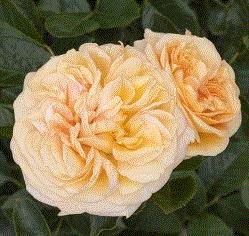
In the Flowering Shrub category, the winner is Rose Eau De Parfum Bubbly from Monrovia. It has big, beautiful, champagne-colored, high-petal-count blooms that are fragrant—how nice! It’s as classic a looking rose as you can imagine. And it has the added benefit of disease resistance. Hardy to Zone 5, it grows to 3-4 ft. tall.
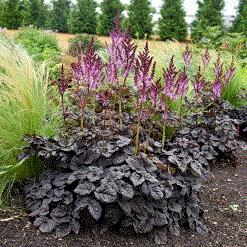
In the Perennial category, Astilbe Dark Side of the Moon from Walters Gardens took home the award. NGB called it “a new instant classic.” It’s currently the only dark-leafed astilbe with purple flowers on the market. Those chocolate-burgundy leaves form an 18-24 in. mound above which rise dark stems holding rosy-purple flowers. Hardy in Zones 4-9.

And the Rest
(continued from above)
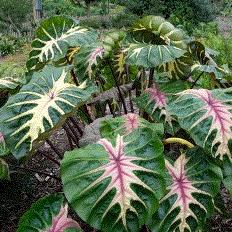
There was a tie in the Annual category. We’ve mentioned Colocasia esculenta Royal Hawaiian Waikiki in buZZ before as it is an All-America Selections National Winner for 2023. From Plant Haven, Royal Hawaiian Waikiki is not only gorgeous with its white and flamingo-pink veining, but it’s also disease resistant and happy in full sun. Compact at just 3 ft. tall and wide, it’s awesome in containers as well as in a garden bed.
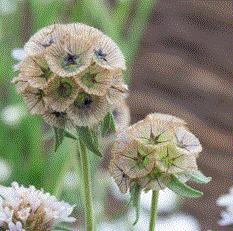
Its co-winner in the Annual category is Starflower Paper Moon from Sahin/Takii EU. This stunning novelty annual has small, pale-blue blossoms that open to bronze-colored geometric and globe-shaped seed heads. Atop wiry stems, the blooms are grown primarily for its papery seeds pods used for bouquets.
Last but not least, the Edible category winner is Tomato Sun Dipper from PanAmerican Seed. Just look at its elongated, cinched-middle shape! Easier to hold on to as you dip in the ranch sauce, they say. This tomato is an indeterminate type and has plenty of disease resistance.


Monrovia’s Consumer Rewards Program
Consumers shopping on Monrovia.com will earn points that they can use for discounts. That is the new e-commerce strategy just announced by the folks at Monrovia. The good news for you garden retailers is that these online purchases will involve a stop at your establishment to pick up the plants.
Chief Marketing Officer Katie Tamony says in a press release that the new rewards program is meant to incentivize more frequent online purchases and bigger orders. “Because the consumer picks up their online orders at the garden center, the reward program will also encourage more frequent shopping at garden centers for soil, pots, tools and fertilizers—and more plants,” she says. “Our goal is to bring more qualified shoppers in the door for our retail partners.” If you yourself have done any online shopping for pickup at Target.com, for example, you know you’re always going to shop for more when you walk through the doors. Same in this situation.

The rewards program for customers is simple: Complete a sign-up form online, and every time a person purchases a plant, rewards are automatically added to their account. They can start redeeming points with a minimum of 100 points. Monrovia.com is taking pre-orders for spring now. Plants will be shipped to the shopper’s IGC chosen at checkout. Click HERE for more information on the customer loyalty program.

“Sad Poinsettias”
Remember my item a few weeks ago about Wingard’s Market’s plant-for-a-poinsettia trade-in program? Colleague Jen Polanz informed me that she had seen a similar trade-in program from the folks at Groovy Plants Ranch.
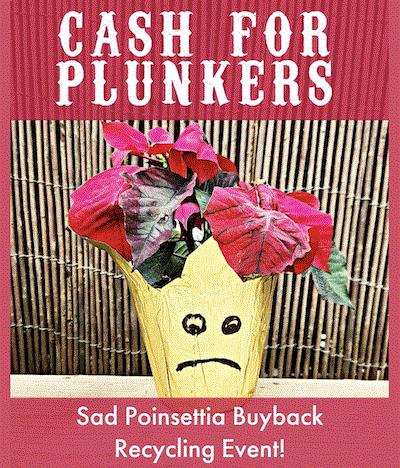
It’s called “Cash for Plunkers,” and it’s a “sad poinsettia” buyback recycling event. I love that they tied this in to recycling/composting, as it gives the program a do-good/feel-good aspect to it and hopefully would further encourage folks to participate.
Here’s how it works: Groovy Plants is offering a one-for-one credit on any poinsettia brought back for recycling. “Your poinsettia will be given new life as compost for our new children’s garden,” says their information, “and the pots will be reused or handed off to younger growers to help them grow their businesses.”
One poinsettia is $5 off one houseplant (multiple poinsettias cannot be used toward one plant, btw). That’s a pretty good discount if you ask me. The information also coaxes people into the store by saying, “This is a great way to fill the empty spot your poinsettia leaves behind.”
Check out the Groovy Plants Ranch Facebook Page and get inspired by more of their can’t-scroll-by social posts!

Pairing Plants and Pantone
It seems I haven’t written the words “Color of the Year” in at least three weeks. Maybe four! Beth Engle of Griffin Greenhouse Supplies wrote in to ask what, if anything, folks in the industry are doing with these various and sundry colors that color experts anoint with “Color of the Year” crowns, particularly Pantone’s Viva Magenta (18-1750).
I have received a few plant-and-Pantone pairings in my inbox over the last month. See these following links for:
Any other breeding companies out there who have variety pairings with Viva Magenta? I will include you in next week’s update, as well. Email me a link to the plant-Pantone pairings HERE.
Viva Other Colors, Too
Of course, Pantone doesn’t have a stranglehold on color. Others are just as authoritative on color. Take Benjamin Moore, for instance. Their Color of the Year for 2023 is called Raspberry Blush, a color they are calling “a vivacious shade of coral tinged with pink [that] enlivens the senses with an electric optimism.”

And then there’s the ultimate authority on home décor, Martha Stewart. Martha Stewart (the magazine Martha, not the actual Martha) caught my eye on Instagram earlier this week with their Instagram feed.

This is what the magazine’s editors are saying about the colors, “Big, bold color is back—and 2023’s most defining shades are quite the departure from the soothing pinks, blues and quiet neutrals that have defined the last few years. Now’s the time to experiment with rich shades of brown, red tones and forest-inspired green.” Read about them HERE.
In conclusion, the world is full of color. Let’s use it, no matter which color it is.
Be a HortScholar, Change Your Life
That’s what I have heard happens when a horticulture student becomes a HortScholar. HortScholars, if you aren’t familiar, are students who receive beyond-the-classroom experiences at Cultivate each year. The experience allows them the gift of insight into the whole breadth of the industry, and that goes a long way in helping them find which aspect of horticulture suits them best. Their time at Cultivate also allows them access to networking events, job and internship opportunities and #realhortlife experiences.

And it’s an exclusive club, too. Just six students are chosen by AmericanHort for the HortScholars program each year. To be eligible you must be an undergrad or graduate student in a 2- or 4-year college or university program. Chosen participants will spend several days on-site at Cultivate’23 in Columbus, Ohio, volunteering with set-up, learning, networking, meeting with industry leaders—you know, all the good stuff that’ll help them go far in their careers. They also get an all-access pass to Cultivate’23 and a one-year AmericanHort student membership. Bonus!
To throw your hat into the ring, you’ll need to apply by February 1. That’s soon! Follow THIS LINK to apply. And I’ll see the HortScholars there!

Part 1 of a Tree Trifecta
A trio of tree topics passed across my desk this week (figuratively, since one was from a BBC News podcast), and all were so interesting, I just knew I had to tell you their tales.
Let’s start with that podcast I mentioned. The death of Scotland’s—nay, Europe’s!—oldest Wych Elm happened late last week. The Beauly Elm toppled over after a drawn-out decline, having just had a celebration of life event for it last fall. The tree, which stood at the gates of the Beauly Priory, is said to have been about 800 years old. Dutch Elm Disease is the culprit. Wych Elms, by the way, are thought to be the only elms truly native to the UK.
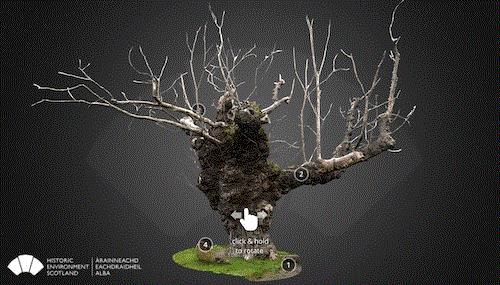
But the Beauly Elm does live on! In digital form, that is. The tree was laser scanned before its fall, and now viewers can look at all the details of this once-massive tree in 3D online. Just click on the above photo or click HERE to zoom around the tree. It’s wild!
“A Little More Picky”
Fast Company usually covers topics more associated with entrepreneurs or the pivoting tactics of start-ups. But trees were featured in a recent article about cities and their future tree canopy. The article’s title says it all: “We’re Being A Little More Picky: How cities are rethinking their trees in the face of climate change.”
The article talks about how the trees occupying space in cities in 50 years must be able to withstand a variety of environmental challenges—heat, drought, storms, flooding, air pollution, etc. But that’s only half the story. No longer should we or can we rely on “a handful of climate winners,” the article says. Using just a few different types of trees leads the urban forest open to loss from pests and diseases (like the aforementioned Dutch Elm Disease). We’re going to need a whole palette of different trees, all with superb resilience.
A recurring issue in the article is that cities aren’t finding the trees they need in local nurseries. Did that grab your attention? See what they say about that issue HERE.

And Finally …
But despite climate challenges and lack of a diversity of trees and all the issues that befall folks working in the tree trade, people working in logging, forestry and agriculture are the happiest folks among us. The Washington Post claims in THIS ARTICLE that people in these three fields have the highest level of self-reported happiness, according to the paper’s analysis of thousands of time journals from the Bureau of Labor Statistics’ American Time Use Survey.
The article is a bit of a slog to get through, but the gist is this: If you work outside, you’re probably having some happy experiences. In fact, the survey analysis found that the only places as happy or happier than being outdoors is being in your place of worship and being in someone else’s home.
Next time you’re stuck in your office and finding your crank level building, just take a walk out through the nursery. It’ll make you happy.


Questions, comments, suggestions? Drop me a line if you'd like at ewells@ballpublishing.com.

Ellen Wells
Senior Editor
Green Profit
This week's BuZZ! was sent to 24,649 loyal readers!
If you're interested in advertising on BuZZ! contact Kim Brown ASAP!