Two things before the news starts
A pair of quick reminders/updates before getting into the meat of this week's Acres Online ... and it is a meaty one!
1. Don't forget to sign up for next week's livestream (aka webinar) on new perennials from Walters Gardens and Proven Winners! It's Thursday, March 12 at 1:00 p.m. Eastern/noon Central. Perennial expert Laura Robles will show us at least 30 exciting and colorful new perennials for 2026 and 2027. Do NOT miss this one! Sign up HERE.

2. I've posted another Chris Beytes Podcast to YouTube, this time featuring Young Grower Award Winner Jill Mullaney. Jill's journey from her family's grain and hog farm in South Dakota to running her own premier wedding florist business in Dallas is fascinating, and proves that there are many ways to enjoy a good career in horticulture. Jill even shares tips on tracking floral trends that growers and retailers can use. Watch it HERE.
USDA Statistics—February 26 was a banner day!
It was Christmas in February for our resident Hortistician Dr. Marvin N. Miller when he was gifted this week (1,2) with not one but TWO packages of statistics from the U.S. Department of Agriculture National Agricultural Statistics Service (USDA/NASS): The 2024 Census of Horticultural Specialties (which is conducted every five years) and the Floriculture Crops: 2024 Summary (an annual survey). He stayed up late crunching the data for us and here’s what he found. First up, the Census data:
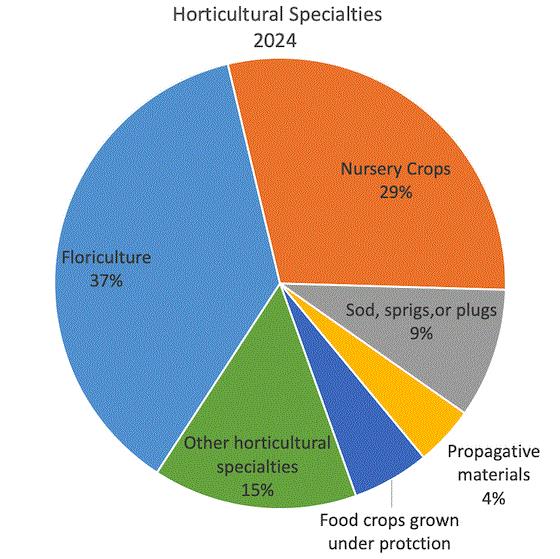
From the Census data, we learn that total sales of all horticultural specialties for 2024 were reported at $18.307 billion. This was up from the $13.779 billion reported for 2019, however, the 2024 data include $1.503 billion in cultivated mushrooms and $34.011 million for hemp grown under protection—two new crop categories to the Census for 2024.
The Census data includes reports from producers that had as little as $10,000 in sales of horticultural specialties in 2024—the same definition that's been used since the 1998 Census. Overall, 23,060 firms reported sales of one or more of the horticultural specialty crops in 2024, up 11.6% from the 20,655 firms reporting in 2019.
Examining Census data for floriculture, we learn that there were 12,497 firms reporting floriculture sales for 2024, compared to only 10,939 firms who reported sales in 2019, an increase of 14.2% in grower numbers. Sales for these firms were $6.795 billion in 2024, compared to $5.545 billion in 2019, an increase of 22.6%. Over the 2019 to 2024 period, the Consumer Price Index increased 22.63%, suggesting that total floriculture industry sales just kept pace with inflation during this period.
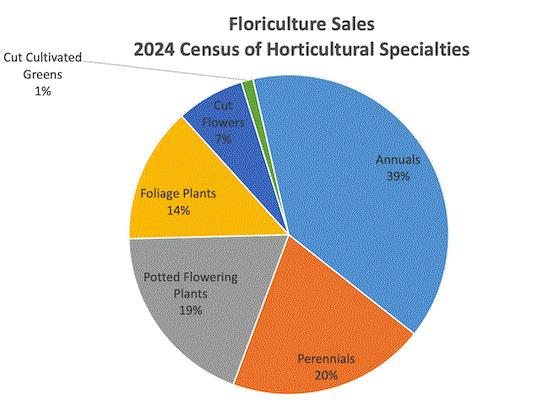
Sales of bedding/garden plants were reported by 8,739 firms in 2024, compared to 8,165 firms that reported sales in 2019, an increase of 7.0% in producer numbers. These firms reported sales of $4.027 billion in 2024, compared to only $3.167 billion in 2019—an increase of 27.2% in sales.
Within the bedding plant category, annuals were produced by 7,066 firms in 2024 vs. 6,687 firms in 2019 (an increase of 5.7% in producer numbers). These firms had 2024 sales of $2.667 billion vs. $2.244 billion in 2019 (an increase of 18.8%).
Perennial plants were produced by 5,068 firms in 2024, down 0.8% from the 5,108 firms producing perennials in 2019. The firms reported perennial sales of $1.36 billion in 2024, up 47.4% from the $922.6 million reported in 2019.
All told, annuals made up 66.2% of the bedding/garden plant sales in 2024, compared to 70.9% in 2019, thus, sales of annuals are yielding some share to perennial sales for the bedding/garden plant category.
Sales of potted flowering plants for 2024 were reported by 4,014 firms vs. 3,977 firms in 2019, an increase of 0.9% in grower numbers. These firms had sales of $1.287 billion in 2024, up 7.2% from $1.200 billion in 2019. Considering inflation of 22.63% over this period, this sales increase is rather disappointing.
Sales of foliage plants for 2024 were reported by 2,524 firms vs. 2,336 firms in 2019, an increase in grower numbers of 8% producing in this category. Sales in 2024 were $931.6 million, up 34.7% from 2019’s sales of $691.5 million.
Sales of cut flowers for 2024 were reported by 3,347 firms vs. 2,035 firms for 2019. This 64.5% increase in grower numbers was the largest percentage increase for any segment in the entire 2024 Census of Horticultural Specialties. Sales were $467.5 million in 2024, up 21.2% from the 2019 sales of $385.7 million.
Sales of cut cultivated greens in 2024 were reported by 617 firms vs. 644 firms for 2019, a decrease of 4.2% in grower numbers for the category. Sales were $81.0 million in 2024, compared to $99.98 million for 2019, a decrease of 19%.
Sales of nursery stock in 2024 were reported by 6,437 firms, down 0.3% from the 6,458 firms reporting sales in 2019. Sales were $5.340 billion in 2024 vs. $4.545 billion in 2019, an increase of 17.5%.
The 2024 Census of Horticultural Specialties includes sales of 13 other horticultural specialty crops, including data on plant propagative materials; sod; bulbs, corms, rhizomes and tubers; mushrooms; hemp grown under protection; food crops grown under protection; transplants of commercial vegetable and strawberry production; vegetable seeds; flower seeds; aquatic plants; cultivated Christmas trees; short rotation woody trees; and tobacco transplants.
1 USDA has released both the Census of Horticultural Specialties and the Floriculture Crops simultaneously for the last few Censuses to be sure data was consistent between the two reports.
2 These reports were both due to be released last December, but were delayed due to the government shutdown.

Floriculture Crops: 2024 Summary
Even though both surveys cover producers in all 50 states, in contrast to the above data, the Floriculture Crops: 2024 Summary limits respondents to those who have $10,000 or more in total sales of only floriculture crops, i.e., cut flowers, potted flowering plants, foliage plants, bedding/garden plants (both annuals and perennials), cut cultivated greens and propagative floriculture materials (including pre-finished plants). Hence, this universe is smaller than those included in the Census of Horticultural Specialties because the Census might include some firms that produce both floriculture and other horticultural specialty products in the counts of participating firms for any category, as well as their sales.
For the Floriculture Crops: 2024 Summary, sales totaled $6.710 billion (1.3% less than the Census total for floriculture sales of $6.795 billion). This was scarcely 0.3% higher than the 2023 sales of $6.691 billion. These sales were reported by 11,262 producers in 2024, compared to 10,216 in 2023—an increase of 10.2% in grower numbers reporting. Of these firms, only 3,987 of the 2024 producers had sales of $100,000 or more (35.4% of the total grower numbers), yet these “larger” firms accounted for 95.9% of the sales in the survey. These numbers compare to 3,261firms in 2023 with sales of $100,000 or more (31.9% of total grower numbers), which accounted for 95.6% of total 2023 sales. It's only these firms with sales of $100,000 or more who complete all of the crop-by-crop reporting in the Floriculture Crops Summary.
Here are the 2023 and 2024 Floriculture crop pies for comparison:
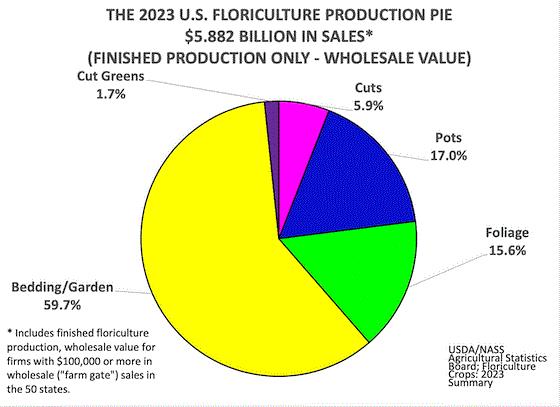
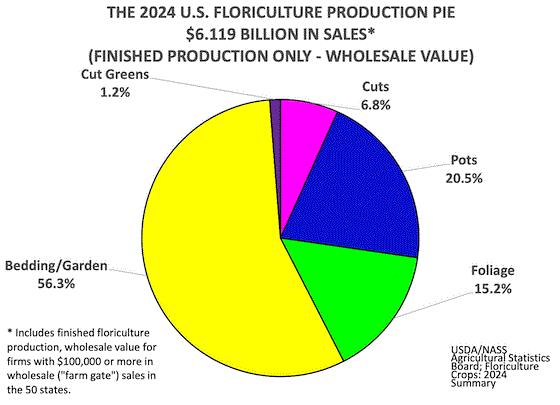
For bedding/garden plants, the Floriculture Crops Summary reported 2024 sales of $3.446 billion in sales. In comparison, in 2023, there were $3.514 billion in bedding/garden plant sales, about 2% more than in 2024. In 2024, a total of 2,630 firms reported sales of annuals totaling $2.55 billion. This compared with 2,257 firms in 2023 reporting sales of annuals, totaling $2.48 billion. Thus, sales of annuals accounted for 74% of the bedding/garden plant sales total in 2024, compared to 70.5% in 2023. Perennial sales were $896.091 million in 2024 reported by 2,121 firms, compared to $1.038 billion in 2023 sales reported by 1,846 producers. Thus, perennial sales declined by 13.7% in 2024, even though 14.9% more firms contributed to the total sales.
There were $1.255 billion in sales of potted flowering plants in 2024 reported by 1,652 firms. This compared to 1,457 firms reporting sales of $1.002 billion in 2023. Thus, sales in 2024 increased by 25.2% over the 2023 level.
In 2024, foliage plant sales of $928.436 million were reported by 1,162 firms. This compares with $918.852 million in foliage plant sales reported by 1,043 firms in 2023. Thus, foliage plant sales increased 1.04% in 2024, though 11.4% more firms contributed to the 2024 sales.
Cut flowers were produced by 541 producers in this survey in 2024, netting sales of $414.044 million. In contrast, 423 firms reported cut flower sales in 2023. These firms reported sales of $349.978 million. Thus, 27.9% more firms reported cut flower sales in 2024 and the sales dollars increased 18.3%.
A total of $75.572 million in sales of cut cultivated greens were reported by 145 producers in 2024. This compared to $97.781 million in 2023 sales reported by 140 firms. Total sales were off 22.7% in 2024, though only five fewer growers participated in the category.
The Floriculture Crops Summary reported a total of $316.40 million of plant propagative materials and prefinished plant sales in 2024, down 38.4% from the $513.82 million reported for 2023.
When comparing the Floriculture Crops Summaries for 2023 and 2024, we see that the bedding/garden plant category yielded some of its share of the finished floriculture sales pie to cut flowers and to potted flowering plants. This was largely the result of the significant decline in perennial sales. This was also the result of the significant increases in both cut flower sales and sales of potted flowering plants.

Structure news: Atlas acquires Stuppy
Consolidation news in the greenhouse structure world, as Atlas Greenhouse of Alapaha, Georgia, acquired one of the oldest names in the U.S. greenhouse world, Stuppy Greenhouse of North Kansas City, Missouri. Combined, the two firms represent nearly 200 years of industry knowledge and experience—but Stuppy, founded in 1873, accounts for more than three-quarters of that history!
The press release offered a few important tidbits about the deal, including the fact that customers will “continue to have full access to both the Atlas and Stuppy product lines, supported by the same trusted teams, engineering expertise and service standards they have come to expect.”
“Our focus is simple—strengthen what customers already value while expanding what we can deliver,” said John Edwards, CEO of Atlas and now of both companies. “By combining Atlas and Stuppy, we bring together decades of engineering excellence, manufacturing capability and customer commitment. This is a win for our customers and a win for the industry.”
The combined company will continue to support a diverse customer base, from agriculture and ornamental commercial growers to retail garden centers, educational institutions and research facilities.
As always, I had a few questions that the press release didn’t address, such as how challenging it must have been for Matt Stuppy, the fifth-generation owner of Stuppy Greenhouse, to make the decision to sell. He replied with this note:
“I have the privilege of being part of a family business that has adapted to change for 153 years. Fortunately, some of the collective wisdom made its way to me. One thing I learned is that a business must constantly evaluate customer, employee and community needs, and then adapt to meet those needs. Over the last two years, I asked myself and many other people questions about the current state and future of the greenhouse market. It became clear to me that new capabilities and products were needed to address future requirements. To achieve that, going solo or collaborating with partners in the industry were both options. In taking the path of collaboration, Atlas Greenhouse became a clear favorite of mine. Both companies share similar cultures and visions of becoming more impactful in the industry. I believe we will achieve more together than apart.”
“And will you be staying on?” I asked.
“I will continue to work in and on the business," he replaied. "There is much to do and I'm grateful to have the opportunity to do it.”
As for Atlas, I asked John Roberts what they’re gaining in the Stuppy buy. He wrote:
“We are bringing together two trusted businesses and expanding our structural portfolio with additions such as the Venlo-style Pro Line, AeroMax, and the Rainbow Plus and Super lines. The combination strengthens our overall product offering and market reach.”
I also asked about a rumor I’d heard that they would be consolidating their manufacturing at Atlas’s Georgia headquarters. John shot that down … at least for now.
“We will continue operating both locations while building synergies through combined purchasing power and operational efficiencies. Our focus is producing high-quality products in the most efficient manner possible, utilizing both facilities.”
Not to leave out the Atlas history, the company was founded in 1986 by J.C. Browning. Mark Davis joined the company in 1992 and became general manager 10 years later. In 2008, he bought the business from Mr. Browning. In late 2022, Mark brought on investment partner Mangrove Equity. In the news of that event, he said, “We are excited about our partnership with Mangrove and look forward to investing in our team, continuing to provide best-in-class greenhouses to our customers and taking Atlas to new heights.”
I guess this is one of those new heights!

Jen visits Pennsylvania
Intrepid Editor Jennifer Zurko founder herself in the Quaker State recently and filed this report about her visits to Gro ’n Sell and Longwood Gardens:
Last week, I was in the Philadelphia area to assist Osvaldo with a video project, and one of our shoot locations was Gro ’n Sell in Chalfont, Pennsylvania. Gro ’n Sell is a well-known young plant supplier, and though I run into owner Dave Eastburn at industry events often, it had been ages since I’d paid a visit to his facility.
It being Week 8, they were in peak production, but the real news was about their recent transition of phasing out annuals completely and providing mostly cut flower plugs. Dave said they made the switch to drop annuals from their lineup late last summer. They still offer perennials, as they’ve been doing for 45 years (and especially with the recent closure of Green Leaf’s Pennsylvania facility), plus herbs and vegetables, but now a majority of their offering consists of cut flowers, growing about 1,500 different varieties, with 250 of those being a selection of lisianthus.
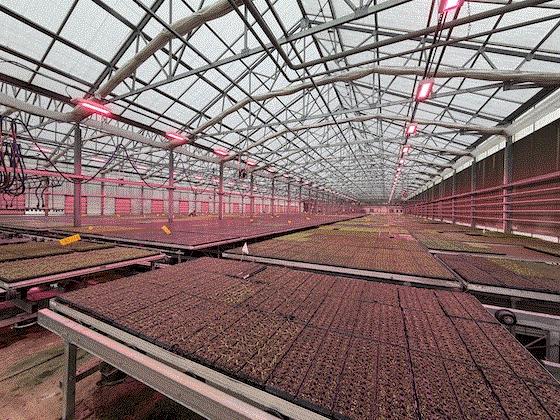
Dave and his son, Jonathan, said that they’d been discussing the switch for a number of years because they felt that the market was shifting. There’s a lot of competition in the young plant market when it comes to annuals, so they decided to focus on something that wasn’t as readily available in their area and was in demand—hence, cut flowers.
“The way we look at it is we have a core group of customers who know us and know who’s going to do the best job for them,” said Dave. “When we told them, they thought it made sense.”
One area that’s been lacking for cut flower growers is more predictability in the supply chain and Gro ’n Sell knows that their years of experience can help with that. They already have a customer base that adheres to strict growing schedules, so growing to order isn’t new to them. And it offers a chance for them to be a one-stop-shop for their customers, old and new.
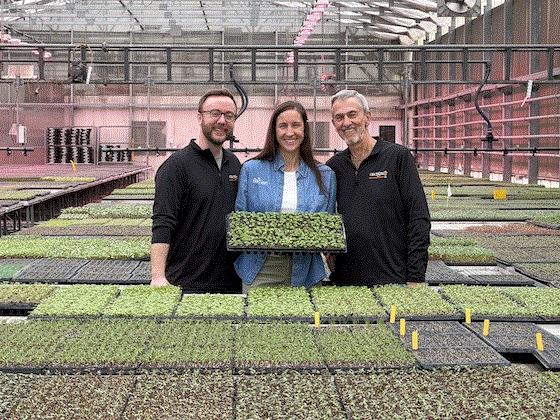
Jonathan and Dave with Ball Seed Sales Rep. Aston Ward.
Most of their cut flower customers consist of small and medium-sized specialty growers who have a few cold frames and/or an acre or two of outdoor field production. Dave and Jonathan said that they don’t use PGRs on their cut flower plugs—instead they use temperature to control height. They have a handful of small houses where they can hold product until the customer is ready for it. This is an added service they provide these emerging growing businesses.
“There are plenty of other annuals growers out there,” said Dave, matter-of-factly. “Why compete?”

It was winter outside, but glorious inside
We spent the next morning at Longwood Gardens in Kennett Square to pop into a brand-new event called “From Breeder to Beauty” that they held in partnership with Ball Seed (more on that later). It’s always a wonderful experience spending time in Longwood’s conservatory, surrounded by creative, stunning displays of hundreds of plants. And while attendees were learning about new varieties and trends, Osvaldo and I got a private tour.
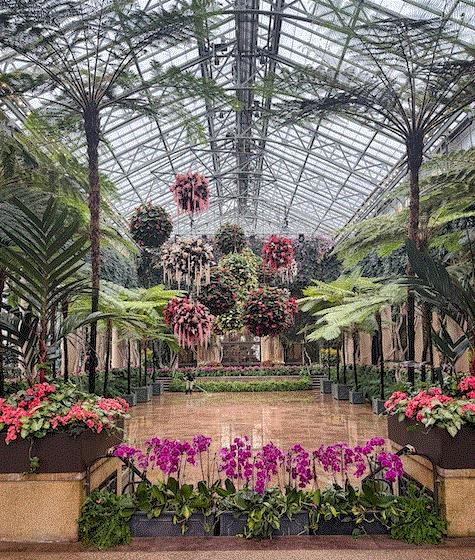
Tropical foliage and water features were part of the late-winter theme at Longwood Gardens.
Longwood Gardens’ newest conservatory is a Midwestern gal’s dream because the plants that grow within its 32,000 sq. ft. (about the size of a football field) you can only find in temperate climates like Southern California, the Mediterranean region, Australia and South Africa.
What they call the West Conservatory was officially opened in November 2024 (in comparison, the Main Conservatory debuted in 1921). The last time I was at Longwood, the bones of the West Conservatory’s skeleton had just been erected, so it was a real treat to see it in its completed glory in person.
West Conservatory Manager Kenny Silveira and Senior Horticulturalist Dean Dietrich are in charge of choosing and sourcing the plants that go into the display beds. (It’s really an indoor landscape because the plants are placed right into the soil.) While the displays in the Main Conservatory are changed out five times throughout the year, the West’s is designed to be a landscape featuring more permanent plantings with occasional seasonal additions.
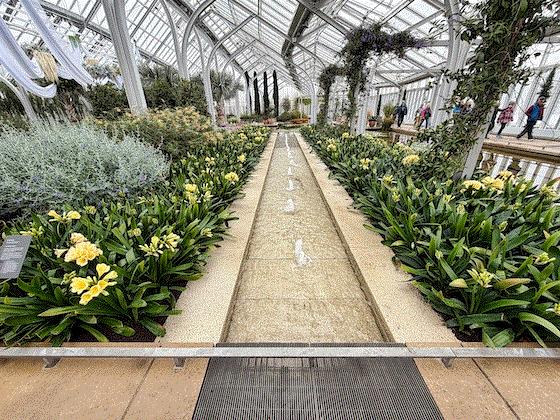
Since the 1970s, Longwood has been breeding new varieties of clivia. This one planted along both sides of the water feature is called Debutante. Note the unusual structure of the new West Conservatory.
As for which plants to put in, Kenny and Dean said that it’s been a fun and interesting journey. They’ve been trialing different cultivars, taking what they’ve learned while growing these types of plants in their research greenhouses over the years. Kenny said that they also work closely with specialized nurseries, mainly in California, to get new genera of plants from around the world, but sometimes that’s easier said than done—non-native plants have to go through a rigorous process before you can bring them into the country. But since the West Conservatory has only been open for a little over a year, there’s still plenty of room for growth when it comes to their plant knowledge.
“We’re living with a baby,” said Trish Evans, Longwood’s PR Officer and VP of Marketing. “So we’re still learning.”
To accommodate now two conservatories (plus all of the plantings on the grounds during spring and summer), Longwood did expand its floriculture production facilities. And seeing the Main and West side-by-side, it’s an interesting juxtaposition—one very traditional and one very modern. And that’s just fine with the folks at Longwood.
Said Kenny, “We don’t want two of the same thing.”
(For a deep dive into the design and construction of Longwood's new conservatory, watch this EXCELLENT DOCUMENTARY.)

Plant genetics take center stage
While Osvaldo and I were taking our tour and reveling in the plantings of the conservatories, about 160 people from nearly 50 different organizations were in Longwood’s ballroom listening to breeder presentations and learning about industry trends.
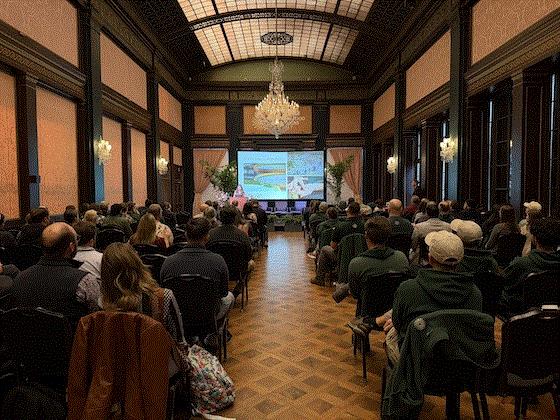
A roomful of growers, landscapers and academics listen to Dr. Kate Santos as she gives her welcome address at the first-ever "From Breeder to Beauty" event at Longwood Gardens.
For the first time, Longwood Gardens held its “From Breeding to Beauty,” event, which brought global plant breeders and the Mid-Atlantic’s regional growers, retailers and public gardens staff together to learn about and discuss the plants “that will shape tomorrow’s displays.” The goal was to take a different, more real-world point of view when it comes to looking at new plant genetics and how they’re used in not only large-scale public gardens, but in homeowners’ yards.
Public gardens are meant to be enjoyed and provide a beautiful destination for visitors, but also to inspire them to use different plants and flowers in their own homes. The more realistic and attainable the displays are, the better gardeners’ own experiences will be. That’s why Dr. Kate Santos, Longwood’s Associate VP of Science, wanted to put together a formal event where representatives from every step of the supply chain were in the same room talking about the same topics.
Over two days, attendees heard plant variety presentations from a handful of breeders based on specific criteria that included climate-ready cultivars, plants ideal for containers and crops with long bloom windows. Panel discussions on trends and the future of the industry were peppered in between.
Longwood partnered with Ball Seed to help coordinate the event and bring the different breeding partners and growers together.
“Both Ball and Longwood have a rich history in floriculture—both focus on color and the power of plants,” said Jim Kennedy, Senior Commercial Sales Director for Ball Seed. “We wanted to partner with Longwood to anchor our efforts in breeding and production in products that will bring value to the professional horticulture market. For Ball Seed, it was a great opportunity to talk to customers and suppliers in the peak of the transplanting season.”
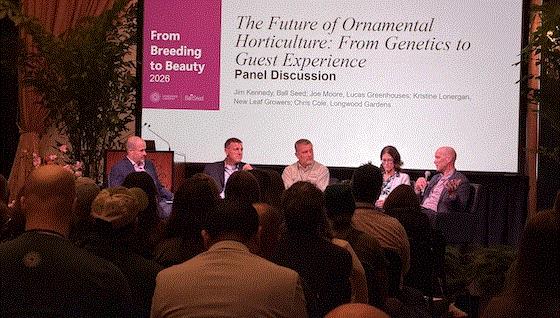
A panel discussion included industry notables on the first day of the event.
“Breeding to Beauty brought together representatives from the entire ornamental horticulture pipeline,” said Kate. “The enriching conversations, connections made and response from attendees clearly show that the future of horticulture is not defined by any single sector, but by how intentionally we work across them. Ball Seed was the perfect partner to bring this event to fruition, and I hope it is the first of many regular opportunities for cross-sector exchange.”

Glad I asked!
I’ve discovered over more than 20 years of newsletter writing that if I don’t know something just write about it anyway and the experts will shoot me emails with all the real facts. Who needs ChatGPT when my readers have LIVED IT?!
Case in point, when I speculated recently about domestic gladiolus bulb production, Glen Oosterhoff of Richard Oosterhoff & Son Flowers in Momence, Illinois, emailed to say, “Hey Chris, the domestic gladiolus bulb business is gone.”
How is he so certain? He grew up in the business, following in the footsteps of his dad and grandfather.
Kankakee County, about an hour south of Chicago, used to be one of, if not THE top, gladiolus growing area in the U.S. In fact, a vintage gladiolus show advertisement he sent me brags, “World’s Center of the Gladiolus Industry.” (At least two Florida cities used to claim that title, too: Fort Myers and Delray Beach.)
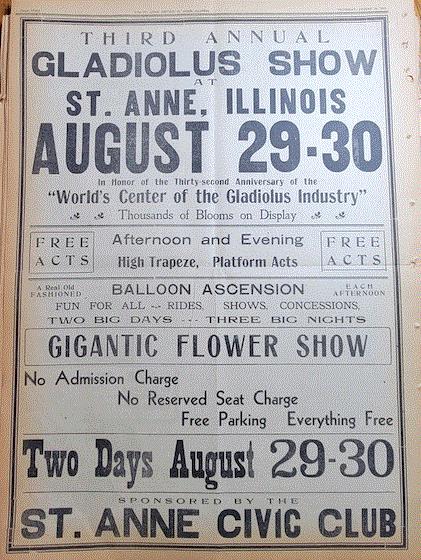
“The areas of Momence and St. Anne, Illinois, were home to some 80 glad growers starting in the early 1900s and peaking in the ’60s and ’70s,” Glen wrote. “Thousands of acres of glads were grown for both bulbs and cuts. My dad and many others made their livings with their glad routes, as well as shipping bulbs all over the country. For 50 years, we hauled glads into St. Louis to the wholesalers there on LaSalle Street. We quit doing wholesale in St. Louis in 2021 and I quit my glad route (selling to florist shops in Chicago) in 2023.”

Glen shared this vintage photo of the glad bulb co-op they had years ago to ship bulbs around the country.
Glen said he still grows glads for area farmers’ markets, but as far as he knows, he’s the last Kankakee County glad man standing.
“We were always the little guy, never had more than probably 40 acres of bulbs and cuts. The last few years, we grow about 7 acres, all for sale at farmers’ markets, and grow about 25 acres of other cuts.”
But, he added, “The days of $2 bunches of glads are gone. Our cost of bulbs is probably about 10 times what it was even 10 to 15 years ago. We also need to import our bulbs from the Netherlands, and it has been quite challenging the past few years just getting bulbs, and we have also had problems with both bulb quality and getting varieties true to name. This year looks better; we just got a shipment in from DeVroomen. Time will tell.”
Glen mentioned a few of the other cut gladiolus growers he knows and their histories, including a large one in Michigan called Lynn Mayer’s [Great Lakes Glads], and then said, “I would invite you to the Momence Gladiolus Festival, but there really aren’t many glads there anymore. Last year was the first year there were no local glads at the festival. They got them all from Mayer’s!”

If you’re now hankerin’ to grow some glads …
My friendly Dutch bulb expert Ko Klaver of Zabo Plant wrote in to share a bit about gladiolus, including a large cut flower operation in California called Glad-A-Way Growers, which happens to be a sister company to Por La Mar Nursery, which will be the Spring Trials home of German breeding company Benary, so perhaps I can talk glads when I’m there.
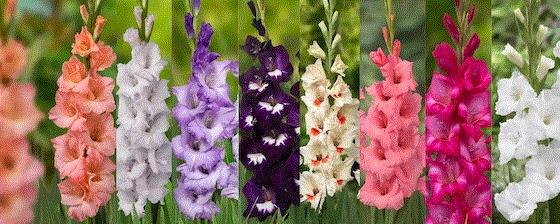
Prisma glads from Zabo Plant.
But Ko also told me that Zabo Plant has its own line of glads called Prisma that they’re introducing to North America. Prisma touts:
-
A broad range of large-flowered and small-flowered gladiolus in stunning color combinations.
-
Bred for maximum resistance and ease of production, ensuring robust and beautiful blooms.
-
Extensive testing in multiple countries guarantees the suitability and performance of each variety.
-
Dedicated promotion and customer support ensure that you receive the best information and service.
You can learn more about Prisma HERE.
Finally ...
A few weeks ago, I told you that PlantCon, that crazy, wild, hip new plant-selling-and-trading (and maybe get a tattoo while you’re there) event was not scheduled to come back to Florida due to low attendance compared to their other events. However, they’ve received such strong love from the Florida industry that they really want to try again.
So to that end, they’ve launched a Kickstarter fundraiser called PlantCon Project Florida. The goal is $100,000 by March 15—meaning anyone who wants to see PlantCon return to the Sunshine State (exact city TBD) needs to put their money where their mouth is. You can find it HERE.
“This is the first time in our history allowing you to make the decision of where we go next!” says the page. “Our goal is to raise $100,000 for PlantCon Florida by March 15 so we can find and secure a venue, start the planning process and launch marketing for a PlantCon in Florida.”
Now, you do get something for your investment: Potential attendees can get $10 off a one-day admission or $35 off an early entry pass. And potential exhibitors are asked to put down a $500 booth deposit, which gives you a 24-hour headstart on booth signup; a $900 deposit gets you 48 hours. You can also buy show sponsorship packages.
So if you really want PlantCon to come back to Florida (perhaps Miami, Tampa or once again to Orlando), prove it and sign up! (If there’s no event, you get a full refund.)
Oh, where are other PlantCons taking place?
February 21-22 - Los Angeles (you just missed it)
April 25-26 - Houston
June (TBD) - Chicago, DC or Atlanta
August (TBD) - Chicago, DC, Atlanta or NYC
October (TBD) - Dallas and Houston
December – “Hopefully Florida”


Feel free to email me at beytes@growertalks.com if you have ideas, comments or questions.
See you next time!

Chris Beytes
Editor-in-Chief
GrowerTalks & Green Profit
This e-mail received by 31,270 loyal readers!
Thanks to my loyal sponsors, who help me reach the 29,728 readers of Acres Online in more than 60 countries. Want to be one of them (a sponsor, that is)? Give Kim Brown a shout and she will tell you about our many advertising opportunities.