What the ... ?
I had a wonderful time at Edisto Beach, South Carolina, last weekend. It was sunny, warm and the beach was totally deserted! Best of all, this is a laid-back beach with no high rises, tacky beach shops or loud bars. The ACE Basin (Ashepoo-Combahee-Edisto) is one of the best preserved estuaries in this country and Edisto Beach is my favorite among the many wonderful beaches along the southeastern coast. You should see the sheepshead I got from the creeks. It was this … big! (If only I could show you.)
Wait, no, I take it all back. Edisto Beach is awful and y’all should never consider it for vacation or home! Shoo! It’s all mine!
My lovely other half, our good friend Marion and I were having a drink at a local dive called Whaley’s and the conversation turned to the denuded pittosporum bushes on the island. Marion, who runs a local landscaping business, bemoaned the pest problem and the town’s reluctance to deal with the growing pest population. Just about every bush suffered serious defoliation.
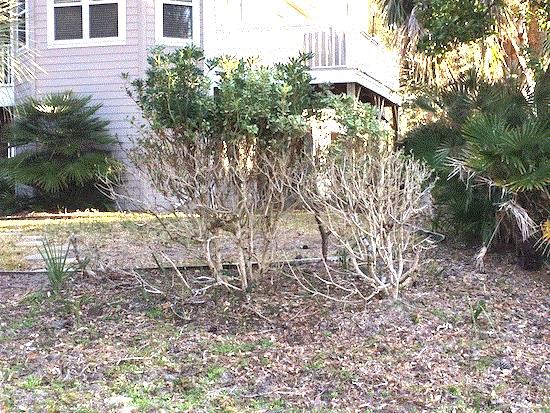
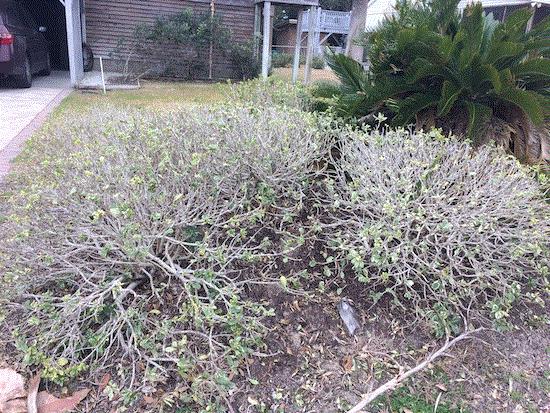
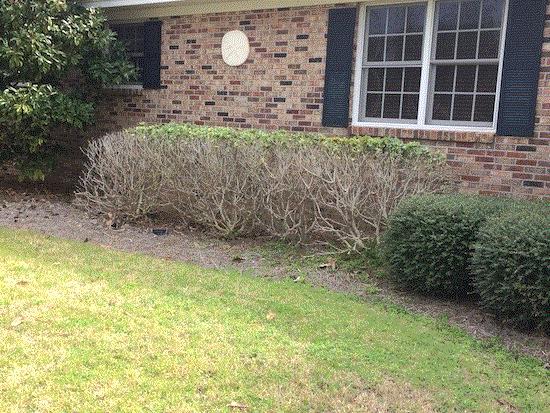
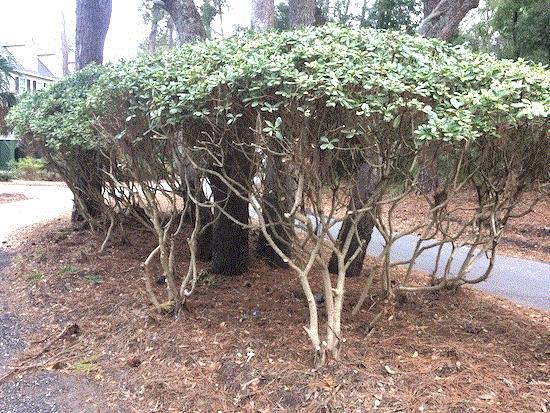
What do you think is happening here?
(I know this week’s quiz is an easy one. But, hey, that’s a good way of celebrating “What the … ?” returning from deep winter freeze.)

HRI awards 2019 research grants
The Horticultural Research Institute (HRI) announced on February 1 the recipients of its $437,200 research funds in 2019. Several are related to pest management.
The spotted lanternfly has become a hot topic these days. Kelli Hoover of Pennsylvania State University will receive a grant to work on understanding the movement of spotted lanternfly in the landscape and the preference of different life stages of the spotted lanternfly for host trees. Her project is titled, “Interactions between spotted lanternfly and woody ornamentals that influence tree health and insect fitness.”
James LaMondia of Connecticut Agricultural Experiment Station will receive a grant for his project, “Boxwood blight management in landscape.” James will conduct further evaluations of fungicide efficacy for managing boxwood blight in landscapes.
Rosa Raudales of the University of Connecticut will study how manipulating the irrigation system can help control algal biofilm that can clog irrigation emitters in her project, “Preventing clogging of irrigation emitters caused by algae in greenhouse and nursery.”
The last one doesn’t have a direct connection to pest management. Ryan Contreras of Oregon State University will be developing metrics that can help determine the invasiveness and the values of plant taxa to pollinator services. The project title is “Fertility, population dynamics, & pollinator attractiveness of standard & sterile cultivars: Buddleia as the case study may inform the way forward for our national industry.” The results of this project may help identify characteristics that are beneficial to pollinators with a balance to invasiveness.
Spotted lanternfly webinars
Speaking of spotted lanternfly …
The Northeastern IPM Center, in collaboration with New York State (NYS) IPM Program and NYS Department of Agriculture and Markets, has developed a webinar series on spotted lanternfly. This webinar series includes four one-hour webinars and provides information on the biology, identification, host plants, monitoring, management and regulation of this invasive pest.
On February 26, two webinars will be streamed. These are “Spotted lanternfly basics for hops, berry, and vegetable growers” at 10 am and “Spotted lanternfly basics for grape and apple industries” at 1 pm.
On March 4, two more webinars will be provided. “Spotted lanternfly basics for Christmas tree growers” will be presented at 10 am and “Spotted lanternfly basics for nursery, greenhouse, and landscape industries” will be presented at 1 pm.
Speakers will include Juliet Carroll, Brian Eschenaur, Elizabeth Lamb and Tim Weigle of NYS IPM Program, Dan Gilrein of Suffolk County Extension Service, and Ethan Angell of NYS Department of Agriculture and Markets.
The management practices covered in the presentations are specific to New York. However, the general management practices discussed will be applicable to the Northeast. Recordings will be available on the website a few days after the webinars.
For more information and registration, visit the webinar website.
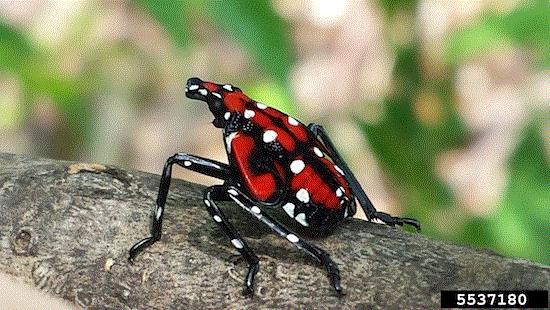
An immature spotted lanternfly. Pretty, isn't it? (Photo credit: Lawrence Barringer, Department of Agriculture and Markets)
I’ll be attending the Green Industry Spotted Lanternfly Summit next week (February 27 and 28). The meeting is organized by Pennsylvania State University Extension and hosted by Bartlett Tree Experts at its research facility in Charlotte, North Carolina. Experts from universities, APHIS and allied companies will share their experience and study results on the spotted lanternfly (its biology, interactions with host plants and control). Invited attendees and stakeholders will discuss with these experts approaches and research ideas that could help improve the management of spotted lanternfly.
I’m excited about the meeting and a chance to learn from those who have dealt with this beast in the past few years. That’ll get me ready for the eventual arrival of this pest in South Carolina. I’ll share what I learnt with you in the next newsletter, and look for an update on spotted lanternfly in the April issue of GrowerTalks.

Health Canada's statement on glyphosate
Matthew Chappell wrote an interesting piece in his newsletter, Nursery and Landscape Insider, last week about an official statement from Health Canada related to the agency’s 2017 re-evaluation of glyphosate’s health and environmental risks. I had to check it out.
Health Canada’s glyphosate re-evaluation decision was issued in April 2017. Some of agency’s reevaluation conclusions include that glyphosate is not genotoxic (i.e. damaging to genes; I had to check my dictionary to find the definition), unlikely to pose a human cancer risk, and not expected to pose health and environmental risks when used according to label directions.
The agency received eight notices of objection, of which the agency didn't specify the grounds for objection. I have to say, these notices of objection must have touched a nerve because the official statement is quite strongly worded for our normally soft-spoken (at least in “Officialese”) neighbor.
In response to the notices of objection, Health Canada conducted a review of its evaluation process and examined the validity of any study or issue in question. To ensure unbiased review, Health Canada selected staff scientists who were not involved in the 2017 re-evaluation. The statement, issued on January 11, stated that "Our (Health Canada’s) scientists left no stone unturned in conducting this review,” and concluded that, “The concerns raised by the objectors could not be scientifically supported when considering the entire body of relevant data.” Therefore, its 2017 re-evaluation decision for glyphosate stands. The statement continues, “No pesticide regulatory authority in the world currently considers glyphosate to be a cancer risk to humans at the levels at which humans are currently exposed.”
What drama! I don't have a TV at home so I was spared all the personal injury commercials related to glyphosate (which poor Matthew had to suffer through) and other general foolishness. Perhaps my wife was right that “TV eats your soul” (although our kids don't believe her).
Thanks for sharing the news, Matthew!
Answer to the "What the ... ?" mystery
If you answered deer, my friend, you are a winner!
Edisto Beach is a wildlife sanctuary and has a huge white-tailed deer population. A day before I took the picture, Sake (my wife’s dog) and I bumped into a group of seven bucks hanging out by a water hole in broad daylight, and they just stood there staring at us like we were interrupting a frat party. (Too bad I didn't have my phone with me at the time.) They’d never behave like that in my back-wood neighborhood where deer face hunting pressure and a chasing dog.
In winter (or when population is too large) when food sources are scarce, deer browse on anything that’s palatable to them. The pittosporum bushes I showed you earlier clearly are not deer resistant. You can apply exclusion fence, repellents or scare devices, but the best way to get around deer damage (when hunting is not an option) is to plant deer-resistant species. Extension services at University of Massachusetts and University of Georgia have factsheets on deer-resistant plants.
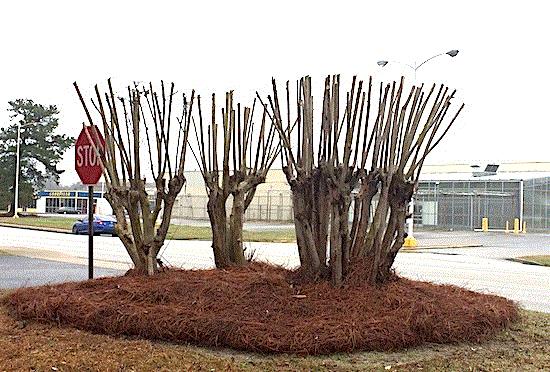
And the last picture was a trick. Deer didn't browse on this bush; it’s just a zealous pruning job. What? I’m sorry if I sound snooty, but I do consider a pair of pruners or a saw in untrained (or otherwise uncaring) hands a serious pest. Have you seen what they can do to crapemyrtles? Not to mention the mulch.


See y'all next time!

JC Chong
Associate Professor of Entomology at Clemson University
This e-mail received by 24,895 subscribers like you!
If you're interested in advertising on PestTalks contact Kim Brown ASAP!