How Do You Use Neonics? Please Let HRI Know!
AmericanHort and the Horticultural Research Institute (HRI) seek to better understand Green Industry use of the following nitroguanidine neonicotinoids:
-
Clothianidin (Arena)
-
Dinotefuran (Safari)
-
Imidacloprid (Merit, Marathon, others)
-
Thiamethoxam (Meridian, Flagship)
We anticipate that the EPA will announce proposed registration changes to these four products in the near future. Survey responses will better help us represent you and your needs.
This short survey should require no more than two minutes of your time and is completely anonymous.
Why is the HRI Survey Important?
That’s simple, because when you hear that “EPA will announce proposed registration changes,” that really means EPA may be cancelling pesticide registrations in the future. HRI, AmericanHort and state associations want to know industry needs so they can better represent you and convey your concerns to the EPA and legislators.
Don’t think EPA would pull/cancel a registration, do ya? Well, EPA just announced (May 20) they're cancelling registrations for 12 pesticides containing neonicotinoid. Those are:
-
Meridian 0.20G
-
Meridian 0.14F
-
Avicta Complete Corn 500
-
THX_MXM_FDL_TBZ FS
-
Adage Deluxe
-
Adage Premier
-
Emesto Quantum
-
V-10170 0.25 G GL Insecticide
-
Inovate Seed Protectant
-
Inovate Neutral Seed Protectant
-
Aloft GC G Insecticide
-
Flower, Rose & Shrub Care III
These product registration cancellations were actually part of a court case involving the pesticide manufacturers (Bayer, Syngenta and Valent), which you can read more about here. Also, as you can see from the list, these cancellations have very little to no impact on the Green Industry. But once the dam cracks, as they say, who knows what will happen in the future.

Camellia handelii
On Wednesday morning, I had the pleasure of visiting with Tommy Alden, owner of County Line Nursery. Tommy is one of those growers that does what others won’t do (like propagating Daphne odora and Edgeworthia spp.). He’s also one that’s not afraid of trying new plants. One of those plants that he's fostered in the market is Camellia handelii. While a new taxa to me, it's an impressive plant!
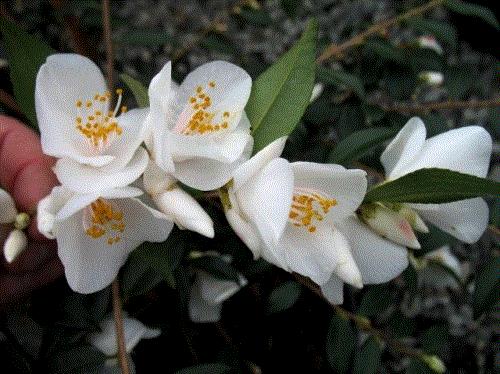
There a few interesting nuggets of information that make this species unique in the world of camellia. First, the foliage is very small and somewhat lanceolate, and from a distance favors leucothoe, as does the habit. The flowers appear in late winter and are small (1- to 1.5-in. diameter), pendulous and white. However, they're quite fragrant, which is an unusual characteristic for camellia!
If it has one fault, it's that it’s only listed as Zone 8 hardy. However, being native to Hunan, Guizhou, and Jiangxi provinces of China, I would think it may be able to push into Zone 7. If you happen to be growing it in Zone 7, I would love to hear from you. In the meantime, I'm going to force my loving parents in Virginia (Zone 7b) to try it out.

AFE Scholarship Winners
Being in academia, I'm amazed at the generosity of industry when it comes to providing scholarships to deserving students. I'm also amazed at how few students take advantage of these opportunities. I have a lot of students tell me that they don’t apply because they don’t think they have a chance. That’s hogwash—if I could get a scholarship as an undergraduate student, ANYONE can! But I digress ... let’s get to this year’s AFE Scholarship Winners!
Congratulations go to Paul Cockson, Yiyun Lin and David Tork, winners of AFE’s Altman Family Scholarship. This scholarship provides $5,000 to full-time grad students studying floriculture science and education. Paul’s current research at North Carolina State University involves enhancing succulent production and consumer preferences for poinsettias. Yiyun’s work at Ohio State is focused on flower petal longevity and she's also active in encouraging school kids to learn about floriculture. David’s work at the University of Minnesota-Twin Cities involves vase life potential, and breeding and selection for ideal cut flower plant habit.
The five recipients of AFE’s Vic & Margaret Ball Internship for students interested in production include UGA student Austin Vonkutzleben (six months at Skagit Horticulture), Mississippi State student Erin Sparkman (three months at Neal Mast), University of Arkansas student Katherine Myres (three months at Neal Mast), Kansas State student Renata Goossen (four months at Green Circle Growers), and UGA student Sarah Chance (six months at Northcreek Nurseries).
The two recipients of AFE’s Mosmiller Internship for folks interested in pursuing horticultural retail studies include University of Arkansas student Kelsey Brazelton (interning at Dr. Delphinium) and Virginia Tech student Keri Knott (interning at Longwood Gardens).

I may suffer a horrible advisor death, but this is a great representation of this fun-loving lady, Mary Lewis.
Finally, I’m proud to announce that Mary Lewis (my graduate student and adopted kiddo) is the 2019 winner of AFE’s Paul Ecke Jr. Scholarship. Mary is currently working toward a Master’s degree in horticulture at the University of Georgia and will receive $5,000 per year for two years. Her graduate work focuses on developing interspecific hybrids of Asclepias spp., which she had definitely accomplished. She has 5,800 hybrid plants and I'm wondering if anyone wants to donate a greenhouse because we’re going to start stacking plants soon!
But joking aside, Mary is also developing growing protocols to promote commercial production of the genera. She'd previously received the support of the AFE Vic and Margaret Ball internship/ scholarship for an internship at Disney’s Epcot and also interned under Dr. Ockert Greyvenstein at Ball Horticultural Company. The kid is a rock star and she doesn’t even know it.
Are you a student and want in on these scholarship opportunities? The next cycle of applications is OPEN, with submissions due by October 1, 2019.

What’s Up with the Weather?
Until early-mid May, things were humming along in the Southeast, southern plains, and Midwest. Across the U.S., as a matter of fact, all signs were pointing toward an extended spring season. Decent rainfall (snowpack in the west) and cool temperatures were giving consumers confidence that despite the passage of Memorial Day and approaching Mother’s Day, there was still time to do some buying.
Then it seems the train quite suddenly jumped the tracks. Here in beautiful Athens, Georgia, the last measurable rainfall occurred on May 12 and since that date there have been 13 days above 90 degrees (six above 95 degrees). Contrast that to the poor folks in the Midwest and Northeast who can’t dig a hole without it filling up with water immediately, despite comfortable temps, and the market hasn’t been too pretty in the last two weeks. Thank goodness for the west coast, where things are “normal” compared to the rest of the nation.
What’s to blame for this insanity? Well, there’s a pesky high pressure stuck over the southeast that's keeping it hot and dry in an arc from Mississippi to North Carolina. That same high pressure is funneling moisture in an arc from Texas to the northeast/Mid-Atlantic, which is why there's been so much rainfall in this region.
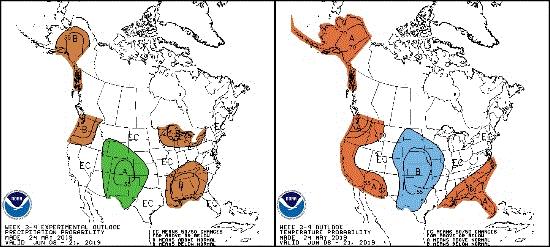
The three-to-four-week forecast from the National Oceanic & Atmospheric Administration. Note on the left that rainfall will be pretty much where it has been and on the right it will be hot where it's been for a few weeks.
So is this going to change in the short to medium-term? The short answer is no (see figure for the three-to-four-week outlook). However, in the six-to-10-day range, models are indicating that there may be a shot for rain across the southeast and a short drying trend for the southern plains. But that won’t last long before the high pressure builds across the southeast and the pattern resumes.

Tornado Devastates Free State Growers
Speaking of wild weather, my heart goes out to Mark and Andrea Illausky, owners of Free State Growers in Linwood, Kansas. On Tuesday, as the sun was setting, a large and destructive (preliminary National Weather Service estimates an EF-3 strength) tornado directly struck the business, leaving not a single structure standing.

There are so many photos of the devistation—I wanted to show a photo of how beautiful this place was ... and can be again. I refuse to
I'd just arrived at my hotel and turned on the weather after a day in the field visiting growers, only to hang my head and say a prayer for them upon seeing this. Luckily, only one employee was there at the time of the tornado and he came through unscathed, taking cover under a tractor. That’s a smart dude and if there’s a silver lining, it’s that this didn’t happen in the middle of the day.
Cephalotaxus Duke Gardens
Are you in Zones 6 to 9 and looking for a shrubby conifer that will tolerate shade? Well, then, Cephalotaxus harringtonia is about the only game in town. That’s right, folks, as you're panting and sipping on your gin & tonic while sitting in your hammock in the shade, you could actually glance over and revel in the beauty of a conifer that’s also loving the shade (but it can also take the sun, too—it doesn't discriminate). That’s because Cephalotaxus harringtonia grows where almost no other conifer dares to enter—the shade. And of the Cephalotaxus harringtonia cultivars on the market, Duke Gardens is the cream of the crop (pun intended).
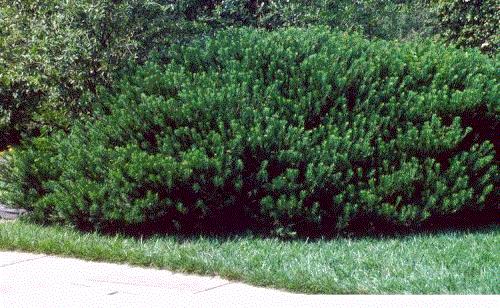
Duke Gardens will assume a 5-ft. rounded size at maturity and has a wonderful texture sporting emerald green foliage. While neither the foliage nor fruit are very noteworthy, that’s not why you need this plant; you need this because it fills a number of niches in the garden. It can serve as an accent plant, a backdrop hedge to a perennial boarder or a foundation plant (to name a few).
And as for care, once established, it needs pretty much none, unless you have an alkaline soil, in which case you’ll need to lower pH to below 6.5. It’s one of the better deer-tolerant plants, is relatively pest-free, is drought-tolerant and requires very little pruning. Hard to beat this cultivar if you’re in a tight spot wanting a conifer for a shady area. Just don’t plant it in a wet area, as that's the kiss of death for any Cephalotaxus harringtonia.

Our Wacky Wonderful World—Notes from the Edge of Sanity
In my last newsletter, I wrote a piece on the latest court case that went against Bayer regarding glyphosate. Aye de mi, did I get an earful (or inbox and voicemail full) of opinions on this one. The majority sounded like this response from Brian Aaron:
“Still cannot believe the author [that would be me …] continues to stand up for Monsanto/Bayer in the glyphosate battle. The issue continues to be the false research and information they fed the government agencies to get their product approval. If you read the trial documents, you see the evidence that they lied and finally they are in a court of law they cannot strong arm. Give it up—Roundup is a great product for selectively killing weeds (actually it is non-selective), but it has serious issues. They hid the issues and will now pay for it. And, hopefully, after 40 years of application by myself, I hope to live to see them admit their mistakes.”
That’s a solid debate point, Brian. However, I wasn’t standing up for Bayer. The point of this piece was simply to inform business owners that they need to consider their liability and how to approach mitigating that potential liability. My job isn’t to take up for any company, person, product or plant.
In today’s world, there are a lot of polarizing issues, such as the effects of Roundup on worker health or the role of pesticides on pollinator health. And just because I have a Ph.D., I certainly don’t claim to be an epidemiologist, ecologist or entomologist. However, as an academic, I appreciate the passion displayed and the conviction of a person’s debate point. And I wanted to share Brian’s because he does make a good point.
In that trial, the documents are quite intriguing to read and paint an entirely different picture compared to EPA documents. That, folks, is yet another wonderful perspective of the separation of powers in the United States. When it comes down to it, the science only matters in court if you can convince a jury of your peers that it's valid.

Live authentic,

Matthew Chappell
Editor-at-Large
Nursery & Landscape Insider
This has been received by 30,907 of the hardest-working horticulturists in show business!
If you're interested in reaching 30,907 (and growing) clients who eagerly await every Nursery & Landscape Insider and surely read every word, contact Kim Brown ASAP and she'll hook you up. And thanks for helping us reach a community of 30,000+ fellow horticulturists! Keep spreading the word.