Can States Ever Harmonize?
I read last week’s Acres Online at the Atlanta airport. A piece about the efforts by AmericanHort, the National Plant Board, and federal and state regulators to harmonize plant health programs from Jen Zurko via Chris Beytes caught my eye. Anything that’s about plant health regulation gives me twitches in my stomach, yet I can’t help reading about them.
I worked for and with APHIS and state plant regulators in my previous professional life. What I got out of the experience is that plant health regulation (quarantine in particular) is a complicated web of federal, state and local standards and programs. Changing any part in the regulatory framework is slow and difficult because APHIS isn’t the only agency that has the final say. Even if APHIS decides to deregulate a pest, individual states could still enforce their own rules that may effectively impose regulations on the same pest, particularly on plants that are imported into these states.
You can see why it’s important that all the states have the same or largely similar programs/ process when dealing with regulated pests or deregulating pests. The process of getting the federal and state plant protection agencies and the industry to agree, accept and follow the same set of standards and guidelines is the process of harmonization. It’s a word with lots of vowels, but it’s an important word for our industry.
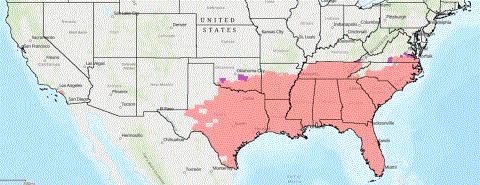
Areas currently under imported fire ant quarantine (orange) or where quarantine is being considered (purple). Federal quarantine was first imposed in 1958. USDA-APHIS may deregulate imported fire ant. The deregulation process will have to involve all federal, state, local and industry players. (Map: USDA-APHIS, Imported Fire Ant Federal Quarantine Interactive Map.)
As you can imagine, harmonization is a process with lots of negotiations, but the economic benefits (not to mention reduction in headaches) can be enormous. For example, the Domestic Japanese Beetle Harmonization Plan allows plant material treated as prescribed by the harmonization plan to be shipped from infested to non-infested areas and gives the receiving states the confidence that the imported plant material is properly treated and handled to minimize the risk of introducing Japanese beetle.
The box tree moth compliance agreement is a good recent example of harmonization. Harmonization for other invasive pests will likely follow the example of the box tree moth compliance agreement.
I know plant health regulations drive some of y’all bonkers, but go HERE in case you want to see what AmericanHort and the National Plant Board are working on our behalf.

Efficacy Against Two-Spot Cotton Leafhopper
The two-spot cotton leafhopper (TSCL), aka cotton jassid, is definitely in AmericanHort’s crosshairs in terms of needing regulatory clarity and more research. Why? Because it’s already causing regulatory headaches (and state-imposed quarantine) for some growers in the South.
I introduced y’all to TSCL in the September issue of this newsletter. I mentioned that studies in the cotton system had identified afidopyropen, bifenthrin, buprofezin, flonicamid, flupyradifurone, sulfoxaflor + spinetoram and thiamethoxam as effective management options. Now we have more data from ornamental system.
Zee Ahmed at Clemson University has published his research data in the December issue of GrowerTalks. Zee has emerged as a frontline researcher in dealing with this invasive pest. In a yet-to-be-published study, he examined the genetics of TSCL populations and found that there may only be one introduction event in the continental United States.
Zee starts the article by introducing TSCL and moves into a brief summary of what he and his Ph.D. students, Nisha Yadav and Peilin Tan, had observed on TSCL biology. One of the most important observations is that adults and young nymphs (first to third instar) died after continuous exposure to 39 to 41F for seven days. Does that mean a lower risk of TSCL establishing in the northern states? Does that also mean TSCL may behave like the potato leafhopper, which establishes summer populations in the North through migrants from the South? Only time and more research will tell.
Zee also tested several insecticides (one application) for their efficacy against TSCL on potted hibiscus plants. He found that tolfenpyrad (Hachi-Hachi SC) at 26.5 fl. oz. and flupyradifurone (Altus) at 8.75 fl. oz. (all rates are on per 100 gal. basis) provided the longest-lasting suppression of adult and nymph populations. Cyantraniliprole (Mainspring GNL) at 5 fl. oz. knocked down the adult populations, which bounced back within 14 days. Afidopyropen (Ventigra) at 5.9 fl. oz., bifenthrin (Talstar P) at 16.5 fl. oz. and dinotefuran (Safari 20SG) at 6 oz. provided mixed results. Note that Mainspring and Ventigra aren’t registered against leafhoppers. Zee included them in the trial because they’re translaminar or systemic products and may be useful in managing TSCL.
Zee only presented data from 14-day evaluations in this paper because that was how much he could do before the deadline to press. He will find another opportunity to share data from longer-term evaluations in the future. One important takeaway from Zee’s study is that re-application is needed because TSCL eggs are deposited in plant tissue, so they’re protected from the first insecticide spray. The nymphs hatch from these eggs must be killed with a second spray.
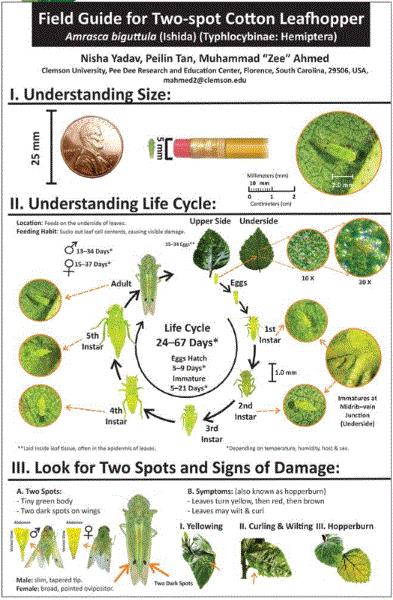
Zee also provided the above field guide for scouting and identifying TSCL. You can download a high-resolution copy (as well as field guides for spotted lanternfly, Thrips parvispinus and other pests) by scanning the QR code in the GrowerTalk article or from Zee's website.

Sample TSCL Effectively
One of the questions a person trying to control TSCL is, “How do I scout?” Well, a well-timed research paper on the sampling techniques for TSCL was just published last week in the journal Insects.
The study, conducted by a group of scientists at Florida’s Division of Plant Industry and the University of Florida led by my former boss Amy Roda, looked at the effectiveness of eight sampling techniques in collecting leafhoppers in okra fields with high density (about 15 leafhoppers per leaf) and in eggplant fields with low density (no visible damage).
The eight techniques tested were aspirating (sucking insects one by one into a container), bagging (cover a terminal with a bag then shake), beat sheet (place a sheet of paper or cloth under a terminal and shake), sweep netting (swing a net over and brush against an infested plant), and tapping a plant over a tray that’s either dry or wetted with 70% isopropyl alcohol, tap water or soapy water (either one of these “wetting agent” or none thereof was considered a technique). All trials were done in Miami-Dade County, Florida.
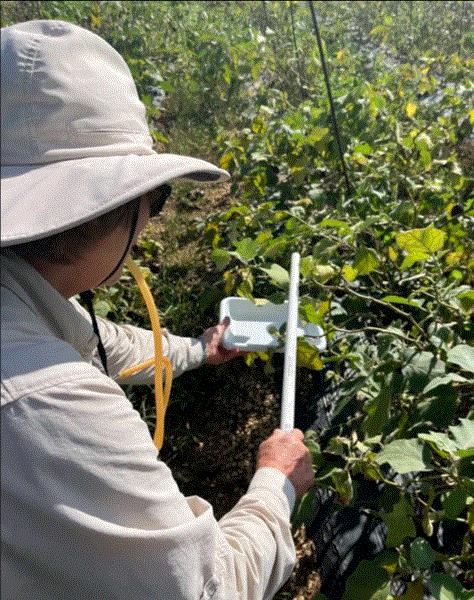
Two-spot cotton leafhopper can be effectively collected by tapping a plant over a white plastic tray wetted with alcohol. (Photo credit: Zapsas et al. 2025, Insects 16(12): 1226.)
Amy and the team found that tapping terminals over a tray wetted with alcohol captured the greatest number of leafhoppers in the okra fields. This was followed by aspiration and bagging. Although the experiment in eggplant fields didn’t yield significant results, the alcohol + tray technique still captured numerically more leafhoppers than other techniques. The most important finding is that the alcohol + tray method captured more male leafhoppers. What’s so important about capturing males? You need males to confidently identify the species.
The next time you’re out sampling TSCL (likely works for other leafhopper species, too), bring a white plastic tray and a bottle of booze. The alcohol kills the leafhoppers before they’ve a chance to hop off and it may help you feel like the day goes by faster.

Battling Botrytis
Also in the December issue of GrowerTalks is an article on controlling Botrytis from Janna Beckerman of Envu. This is also a timely article because spring crops will be here before we know it! Botrytis will raise its fuzzy head on a humid, overcast day or in a poorly ventilated greenhouse soon.
We know Botrytis mainly from its classic gray mold symptoms. It’s a little more difficult to manage at this stage because the spores are ready to “fly.” The first symptoms, such as small water-soaked spots, can be easy to miss, so prevention is the key to success.
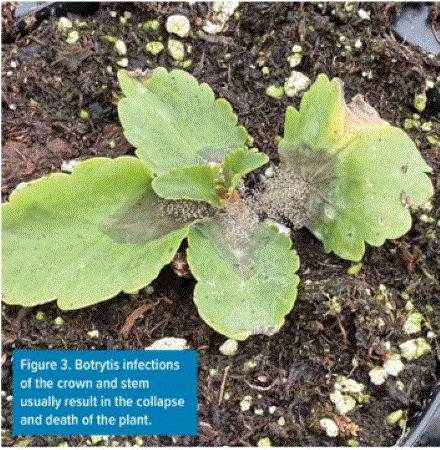
Yikes! is all I can say about this. (Source: GrowerTalks.)
Janna tells us that Botrytis loves overcast days, moderate temperatures (60 to 70F), high humidity (stays above 80%) and still air. Plants that are stressed by various causes or wounded by pruning, handling or insect feeding can be more susceptible. So let’s think about what the fungus loves and what we can do to make it difficult for them.
I love how Janna puts it—think about layering the defense when managing Botrytis. Start with sanitation and regular cleanup so there are fewer inoculums. Keep the humidity low by increasing air flow and changing irrigation timing and methods. Use and rotate fungicides when conditions are favorable for disease development. Janna provided a rotation program in the article. And, finally, don’t forget about boosting the management program with biological options, such as Trichoderma and Bacilus species.
Go HERE to read Janna’s article.

Cornell’s Cut Flower Conference
Our very own Lindsay Daschner (and Tater, of course!), editor-at-large of Bloom Beat, a sister newsletter on the cut flower trade, has introduced an education opportunity to us.
Looking for more educational opportunities this winter from the comfort of your couch and fuzzy pajamas? Cornell Cooperative Extension announced the dates for its fifth annual CCE Cut Flower Webinar Series. Sessions will be on Tuesday afternoons starting January 6 through February 3. Topics include disease and pest management, propagation techniques, market trends and more! Tater and I are eager to tune into these. We hope you will join us!
You can register for individual sessions for $20 each or register for all five for just $60. You can use THIS LINK to register.
The best part is, you'll receive a link to the webinar recordings for future reference. Partial scholarships are available to extension educators of Cornell Cooperative Extension and extension educators in other states.
For more information on the scholarship, you can reach out to Jingjing Yin via EMAIL.

Griffin’s Training Videos
Last piece of the news today is something I couldn’t squeeze in the last issue.
Griffin Greenhouse Supplies has introduced a series of free education videos on various aspects of growing and protecting plants. The first session focuses on addressing pollinator safety and strategies for reducing neonicotinoid uses. The second session offers guidance on selecting, applying and timing plant growth regulators. The third session talks about pesticide selection and application techniques. The fourth and last session provides information on building an effective pest management program that incorporates scouting, monitoring and application timing.
You’ll need to create an account with Griffin to watch the videos. Go HERE to do that.
I'll see y'all at the Great Lakes Expo!

JC Chong
Technical Development Manager at SePRO
Adjunct Professor at Clemson University
This e-mail received by 27,847 subscribers like you!
If you're interested in advertising on PestTalks contact Kim Brown ASAP!