Two-Spotted Cotton Leafhopper
I first learned of the Two-Spotted Cotton Leafhopper while skimming the December 3 edition of Floral Daily. The “Cotton” and the accompanying hibiscus image didn’t square in my brain, and I filed the URL in my “for Tropical Topics” folder for the next edition.
I went back to that piece today, read a bit about it, and then emailed my entomology friend Suzanne “Buglady” Wainwright-Evans. “Just wondering if this is something I should be including in my newsletter?” was my question. “Yes,” she replied. “Hibiscus is a host and Florida growers are getting worried. I would mention it.”
In a nutshell, the Two-Spotted Cotton Leafhopper, an insect with origins in Asia, made entry into Florida in 2024 via the Caribbean and has since been detected in Alabama, Georgia, Louisiana, Mississippi, Texas and the Carolinas. It causes leaves to turn yellow, red or brown, curling them under and eventually killing them. Female Leafhoppers lay eggs in the leaf veins, where the eggs stay out of harm’s reach—and that means out of reach of insecticides. The insect chows down on a variety of food and fiber crops such as cotton, eggplant, okra and soybeans. And hibiscus. When those other ag crops are not in production, the Two-Spotted Cotton Leafhopper will find refuge in a nursery’s hibiscus crop.
Like I said, that is the big-picture bullet points of what this creature is, what role hibiscus plays, and its potential impact on hibiscus production. Good thing that my fellow Ball Publishing newsletter editor JC Chong included all the in-depth scientific and technical information you need in the latest edition of PestTalks. And he in turn learned that information from the December issue of GrowerTalks, which just published an article by Zee Ahmed’s research team based at Clemson University doing the public research on the Leafhoppers and hibiscus.
Find JC’s technical synopsis of the Two-Spotted Cotton Leafhopper issue HERE. If you want to get into the nuts and bolts of what Zee’s team is finding in their research, find that in GrowerTalks HERE (scroll to page 52).
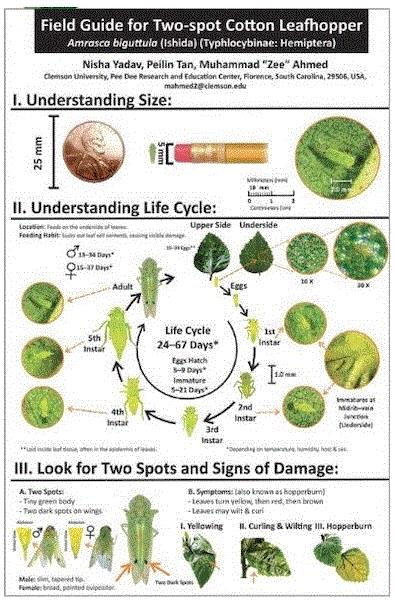
Zee also provided the above field guide for scouting and identifying TSCL. You can download additional field guides for spotted lanternfly, Thrips parvispinus and other pests from Zee’s website (under the Publications tab).

Pantone’s Color of the Year Is …
Cloud Dancer, also known to most anyone who sees it as white, albeit a bit of an off-white. Pantone is calling this particular shade of white a “symbol of calming influence in a society rediscovering the value of quiet reflection.”

Pantone Color Institute’s Executive Director Leatrice Eiseman said of the choice:
“At this time of transformation, when we are reimagining our future and our place in the world, PANTONE 11-4201 Cloud Dancer is a discrete white hue offering a promise of clarity. The cacophony that surrounds us has become overwhelming, making it harder to hear the voices of our inner selves. A conscious statement of simplification, Cloud Dancer enhances our focus, providing release from the distraction of external influences.” Read more about what went into their decision-making process HERE.
Whether you love the idea or feel like they copped out by choosing the absence of pigment, Cloud Dancer is actually a color that tropicals and houseplant growers can get behind. And it’s not because of the white flower blooms of plants such as spathiphyllum or Strelitzia nicolai (and other white tropical bloomers—drop me a note about them HERE). I’m talking about the deco pots that accompany nearly every tropical or houseplant that is bound for life inside or on a deck. There’s something about a white container that makes that bird of paradise sing that much sweeter, right? And the dark-green foliage pops even more when paired with white. As I mentioned in my buZZ! newsletter to my retail readers last week, I think white containers and deco pots are the ways we can use Cloud Dancer the best.
Other suggestions for how to get on the Pantone Cloud Dancer bandwagon? Drop me a note about your thoughts on the color HERE.

TPIE Announces Opening Session
The Tropical Plant International Expo (TPIE) has one of the most reliably terrific opening keynote sessions in the business. The speaker—no matter who it is—has a knack for inspiring the audience to think about consumer behavior, trends and the future in general. The speaker this year promises to do just the same. TPIE will be welcoming fashion psychologist and lifestyle futurist Jill Hawkins of Copenhagen to this year’s opening festivities.
Jill promises to help the audience build real connection with consumers by understanding their emotional quirks and creative potential. She’ll do that with her presentation titled “Cultivating Connection by Watering Our Weirdness: Discovering What Truly Connects People & Products.”

Jill has 20 years of experience working with businesses like L’Oréal and LEGO, helping them to design futures that put people and creativity at the forefront of change. Through her consultancy, The Future Thief, she researches trends and human behavior to design concepts that encourage healthy and sustainable choices.
Here’s a piece from Jill’s bio, which may offer more insight into what Jill will present: “Blending design thinking, foresight skills and psychological science, Jill helps challenge established mindsets and lifestyle narratives that keep us stuck in unhealthy loops. She sees trends as cultural shifts to be understood, sometimes ignored, and applied only positively and with conscience.”
In addition to her gig at The Future Thief, Jill teaches fashion culture at universities in the UK and Denmark; co-drives Muceum, a new magazine about style and materials; and hosts “Second Skin,” a podcast about our relationships with clothing and our bodies.
Jill’s Opening Session will take place at 9 a.m. Wednesday, January 21 at the Broward County Convention Center. And it is free to attend with your show badge, thanks to the generous sponsorship of LiveTrends.
By the way, the January 6 early-bird registration is around the corner. Register for the January 21-23 show by January 6 and receive your show badge for $10 less than you would pay after that date. TPIE hotels are starting to book up fast, too. You can kill both of those birds with this one stone HERE.

South Florida’s Cold Protection
A big swath of the country is frigid this week. Just take a look at this Weather Channel map I screen captured while writing this newsletter on Monday. Colder-than-normal temperatures are reaching as far down as parts of Texas—and it’s just the beginning of December. Brrrr.
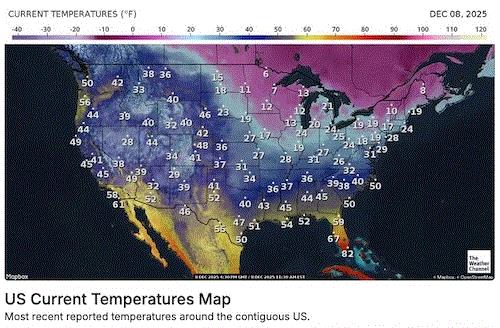
Brrrr.
Luckily, that cold mass is not over where a great number of the U.S. tropicals and foliage plants are grown—South Florida. At least not yet. I spoke to someone today who is located comfortably in that one red and warm spot in the continental U.S., Andrew Britten, Ball Horticultural’s Technical Sales Manager for Foliage and Tropicals in Homestead. He informed me that although the meteorologists predict a warmer-than-usual winter for folks down there, the region’s growers have tools and techniques available to them should weather turn too cold for warm-loving plants to handle.
“The first thing is, for some of the shade houses growing some of the more tender crops, growers will install one layer of poly that has holes in it so the rain can get through,” Andrew explained. Cordyline is a good example of a crop that doesn’t like temperatures anywhere in the mid 40s and below, so just having that semi-permanent protection through the winter is a good thing.
The main cold weather protection technique, however, is running water over the crop. It’s what the orange industry does when cold weather comes, and you’ve probably seen news footage of that in your day. It’s essentially the same technique for nurseries.
“When we have a frost warning down here, the growers end up spending the night at the nursery because they have to manually turn on these pumps,” Andrew explained. “They watch the weather until it gets down to a damaging temperature, and then they’ll turn on the water for all their fields. For something like cordyline, they’ll turn it on in the low 40s. For the rest, it’ll be closer to the freezing point. Then we’ll run that water until the temperatures warm back up. So, if it hits 33 degrees at 10 p.m. the water will run all night long because generally, we see the coldest rate at sunrise.” (Running wells all night? Sounds like potato farming on Long Island.)
Andrew says the result of all the nurseries kicking their water on at night is that the temperature of the whole town will go up two or three degrees. And that warmer-than-air water also creates a mass of fog, too.
They haven’t had to put the water on all night yet this year—in fact, it’s been a few years since it was necessary. But Andrew did say he has seen an entire mandevilla crop iced over. “We ran water until the ice naturally melted and had almost no damage whatsoever,” he recalled. Whew!
Andrew wanted to point out that with all the water being applied to the crop, they will often do some preventative fungicide applications, especially if the watering all-nighters go on for multiple days to make sure they don’t end up with issues.
Cold weather spells like that can set a crop back both in timing and in size. But Andrew said nurseries account for cold spells in their production timing. With the predicted warmer-than-usual winter, Andrew expects it’ll be a very good spring, quality-wise.
If you have any comments, questions or suggestions for content, email me about them at ewells@ballpublishing.com.

Ellen Wells
Senior Editor
Green Profit
This edition of Tropical Topics was sent to 28,941 loyal readers!
If you're interested in advertising on Tropical Topics, contact Kim Brown ASAP!