NEW PODCAST: Bio-IPM for All Seasons with Joe Brenton
I recently took advantage of an opportunity to chat with Koppert's Joe Brenton for Tech On Demand Podcast EPISODE 211. Joe works with growers across the Midwest, MidAtlantic and Southeast to develop customized bio-IPM strategies that work—not only to control insects and diseases but to grow strong, resilient crops within each greenhouse’s unique set of circumstances.
Joe actually went to school to become a pilot, but after graduating, he realized his true passion was in science. So he went back to school to study biology, fell in love with plants, and started his career as a large-scale perennial grower before joining the Koppert team.
Joe and I covered a wide range of topics related to biolosolutions—including biological pest and disease management, biostimulants, biocontrol application methods, mass trapping and much more.

To kick things off, we spent time recapping 2025, from early spring propagation and production through poinsettia finishing and everything in between, from a biological and hybrid IPM perspective. We also talked quite a bit about the challenges of receiving tropical plants and moving them into bio-based production.
Joe’s experience working with greenhouses of all shapes and sizes (and product mixes), coupled with his ability to break down the realities of insect and disease control and prevention for greenhouse professionals will leave you with many new ideas to explore and a better understanding of why it’s critical to work with dedicated experts when implementing biosolutions strategies.
Be sure to subscribe to the Tech On Demand podcast on your favorite app so you never miss an episode. And if you’re not a regular listener, jump back into the archives and get caught up—there are more than 210 to choose from!
TECH ON DEMAND ON SPOTIFY
TECH ON DEMAND ON APPLE PODCASTS

Nick’s Tip of the Week: Water Quality & Fertilizer (pt. 2)
Each week, I’ll work with my buddy Nick Flax, a technical services expert at Ball, to share a concern that’s come up during one of his numerous calls with growers across North America. This week, he’s continuing the conversation about water quality and takes a quick step back to follow up on his tech tip from two weeks ago. And next Friday, as a belated Christmas Gift, he’ll cover blending water with non-RO sources. We know it was on your list for Santa …
PROBLEM: Last week’s Tech Tip was about how to implement acid injection—a follow-up to my WK 47 segment on alkalinity. For those of you who have struggled with which direction to take your acid injection strategy, I hope that info provided you with some clarity. I said I’d cover nutrient imbalances and occasional oddball water quality concerns here in WK 51, but I felt it was more important to touch on the general issue of elevated EC first.
NICK’S TIP: This week, I want to follow up to my WK 48 piece on water quality, specifically on soluble salts. As a quick refresher, soluble salts or EC (electrical conductivity) is the measure of how many ions (like Ca2+, K+, Mg2+, NO3–, NH4+ etc.) are in solution in your water. The higher the concentration of ions dissolved in your water, the higher the EC value.
Quick sidebar: A question I’ve gotten frequently these past few weeks has been on units of measurement. So …
-
While it’s fairly easy to convert EC units from one to another, mS/cm (MilliSiemens per centimeter) is the one to use.
-
This is the most common metric used in research and on crop culture sheets from different plant genetics providers.
-
Use of mS/cm or µS/cm only requires an occasional shift of a decimal place to interpret the value reported, depending upon what your EC meter reports. In contrast, if you use an EC meter that reports in ppm (parts per million), you need to know whether your meter uses a 0.5 or 0.7 conversion factor in order to translate the reading into mS/cm.
If your raw water’s EC is naturally high (much above ~1.0 mS/cm), this can cause issues for your crops over time. This is especially true if you rarely leach with clear water, provide constant liquid feed (apply fertilizer every time you water), maintain a low leaching fraction (limited water you apply runs out the bottom of the pot), and/or have salt-sensitive species like New Guinea or interspecific impatiens on the bench. If your water tends to run on the “salty” side, here are a few considerations for how to reduce it.
Install a Reverse Osmosis (RO) System
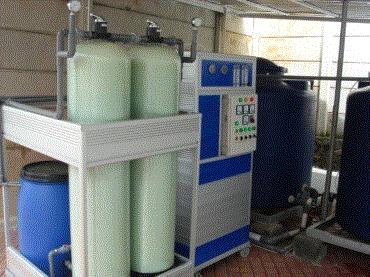
This type of system forces water through a semipermeable membrane that allows water molecules to pass through but not larger molecules like salts (plus other impurities). While this is undoubtedly the most expensive option for reducing EC in your water, it is the most consistent in terms of how much it can cut down EC year-round. Keep in mind, this system needs to be maintained regularly, and additional infrastructure must be installed to blend RO water with your primary source.
-
For example, if your raw water EC is 1.5 mS/cm, you could do a 50/50 blend with RO water to bring it down to 0.75 mS/cm. This will allow you to minimize EC-related disorders and reduce the cost of running your RO system.
-
You should not irrigate or apply fertilizer solution with pure RO water, or you may run into low-alkalinity issues and crash your substrate pH because you’ve removed all of the water’s natural buffering capacity.
Also, be conscious of the overall impact of using a RO system. It takes about 4 to 5 gallons of water to produce 1 gallon of RO water.

Calibrating Your Fertilizer Injector (a New Video)
Fertilizer injectors are an essential piece of equipment in most greenhouses, and while they’re usually reliable, regular calibration is necessary. When you reach out to your favorite technical specialist with a question, one of their first questions might be, “have you calibrated your injector recently?” If your answer is “yes, of course” the specialist in question will be happy and the task of solving your issue can start more quickly.
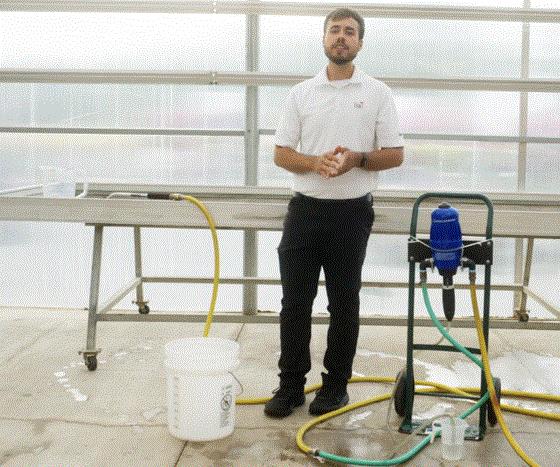
In THIS VIDEO, Ball Seed Technical Service team member (and frequent newsletter contributor) Josh Henry takes you step by step through injector calibration. All you need is your injector, a 5-gal. bucket and a measuring cup or graduated cylinder marked in fluid ounces.
Remember: You might need to run this calibration test more than once!
More on Injector Calibration …
Over time and with frequent use, “drift” in your injector’s calibration occurs— leading to over or underfeeding your crops or not applying insecticide or fungicide drenches at the correct rate. The Tech On Demand team has talked to countless growers about injector maintenance over the years and has some best practices and tips to make this task a bit easier or less confusing.
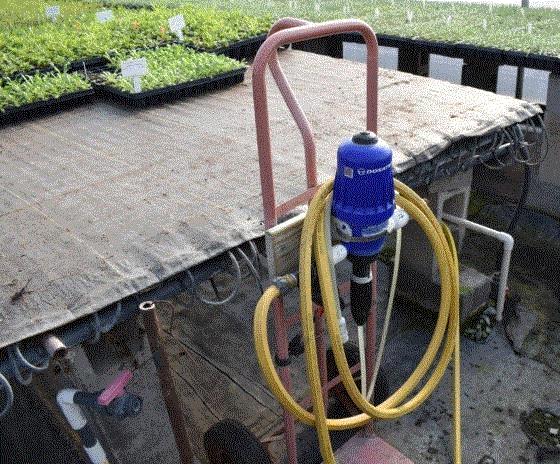
A calibration check is the easiest way to make sure your injector is hitting its mark. To do this, you’ll need the injector (of course), an EC meter, your favorite fertilizer and a cup or beaker for sample collection.
-
First, run your clear water for a couple of minutes and collect a sample in a clean cup. Test your raw water’s EC and write the value down (ex. raw water EC is 0.41 mS/cm).
-
Next, find the label on your fertilizer bag, select your desired feed rate and injection ratio (ex. 200 ppm N at 1:100), and find the corresponding EC value that you should be getting at the end of your hose (ex. label says at 200 ppm N 1:100, EC should be 1.29 mS/cm).
-
Add the raw water and fertilizer target EC values (ex. 1.29 + 0.41 = 1.70 mS/cm).
-
Next, set your injector ratio to the prescribed setting. In this case, adjust to 1:100.
-
Run your injector for a minute or two, allowing fertilizer stock solution to fully enter the injection stream. Collect a sample from your hose and test the solution’s EC.
-
If the EC value is close to what your math says it should be, your injector is good to go. Repeat this quick check several times throughout the season and adjust as follows:
-
If the EC value is too low, reduce the denominator of your injector ratio. (ex. if your target EC is 1.70 mS/cm at 1:100 but the test reads 1.50 mS/cm, change the ratio to about 1:90, run the injector for about one minute, collect a fresh sample and retest.
-
If the EC value coming out of your injector is too high, do the opposite and increase the denominator (ex. 1.90 mS/cm when it should be 1.70 mS/cm).
-
Retest and readjust until the EC of the solution coming out of your hose is close to what it should be, per the fertilizer label and your quick math.
If calibration adjustments to your injector are large (ex. need to set it to 1:75 to achieve the target EC that your fertilizer bag says you should achieve at 1:100), it’s time to service your injector. For many piston-driven injectors, manufacturers sell rebuild kits that include new O-rings, diaphragms and other parts that wear out over time and need to be replaced. Always follow manufacturer recommendations for self-service repairs and rebuilds and make sure that you do not void any warranties that may be active for your injectors.
(Note: For computerized and other digitally-driven injector systems, contact the manufacturer and schedule a service appointment ASAP.)

Thinking Ahead: Bareroot Storage Tips
In the first couple months of each year, our team hears from growers who received more bareroot material than expected or run into a labor crunch and need to set material aside to attend to other, more critical things. If this happens to you and your team is wondering how best to store the bareroot inputs for a month or so until there’s time to pot it up, here’s some advice.

Bareroot material can be kept in a cooler between 35 and 40F for later planting. However, if you want to do this, the best bet is to get it in cold storage ASAP and keep them in their packaging to minimize desiccation. Here are a couple things to watch for:
Check for signs of new root or shoot growth and bud swelling ASAP. If plants appear to still be dormant and there is no new tender growth, they can be held as-is in their original packaging.
If there are signs of new, active growth, you should plant as soon as you’re able. If dormancy is broken, they will start to grow in their packaging. If this occurs, shoots and leaves that develop will be etiolated (pale), very tender, and easy to damage. Leaves and shoots like this will either succumb to disease during storage or perform very poorly once they are planted.
Keep in mind that even if the crowns still appear to be dormant now, your team should check periodically for signs of active growth and be prepared to plant them ASAP if they break dormancy prematurely.

Finish Line ...
I collaborated with California Spring Trials registration managers at the National Garden Bureau to produce a series of PODCASTS featuring representatives from just about every exhibiting company in an effort to get you excited about the iconic industry event and some of the new plant introductions you’ll see on display in spring of 2026.
California Spring Trials is the horticulture industry’s “fashion week,” and with more than two dozen participating companies bringing hundreds of new plants to market for 2027 and beyond, opportunities to get inspired and plan new additions to your crop mix abound in my discussions with the folks who help put it all together.
All my conversations (which are just 10 to 15 minutes each) will be released as individual PODCAST episodes over the next few weeks. Watch for two episodes every day—one dropping at 1 p.m. Eastern/noon Central and one at 6 p.m. Eastern/5 Central. When it’s all said and done, you’ll have heard from just about all the exhibiting companies and had a thorough sneak peek into what will be on display in March.
Part of the goal of this miniseries is to encourage you to REGISTER! It’s sort of mandatory/highly encouraged so the trial locations can accurately budget for foot traffic and appropriate staffing (and of course food and beverages). And while you can register to visit all the companies at a specific facility with just one click, you definitely need to plan enough time to visit with each exhibitor. I’ll harp on this more over the next few months, don’t worry.
Until next week … MERRY CHRISTMAS and HAPPY HOLIDAYS! It just occurred to me that all the festivities are happening before my next newsletter, which will hit your inbox the day after Christmas. Which means I should get it written early so I’m not working on it instead of opening gifts—that would NOT go over well here in the Calkins house.
Hope you have a wonderful holiday week!


Please feel free to send your comments, constructive criticism and topic ideas to me at bcalkins@ballhort.com.

Bill Calkins
Editor - Tech On Demand
This email was received by you and 25,459 other fine subscribers!
If you're interested in advertising in Tech On Demand, contact Kim Brown ASAP and she'll hook you up.