End-of-December Farm Update

Some holiday roselilies, stock and snapdragons we sent to our florists this week.
Happy winter solstice! I'm pleased to say that we're on the uphill swing, the days are getting longer and spring will be here before we know it. Winter solstice coincides with some major planting and sowing dates for us. Tater and Team Forget Me Not are eager for what’s to come. We’re gearing up for our big Mother’s Day sowings of anemone, ranunculus, stock and snapdragons. We’re also knee deep in planning the summer flower line up for 2026. Tater and I enjoy pouring through all the seed catalogs and seeing pictures of our tried-and-true favorites, as well as some new stunning varieties Tater and I are eager to try.
If I could give you one piece of advice for succession planning, it’s to commit to your plan. The easiest way to commit to a plan is if it's easy to follow. Below are some guidelines from our friend and cut flower expert Dave Dowling. You can find Dave’s full succession planting guide
HERE.
-
Sunflowers—Every week after threat of frost until August 15
-
Celosia/Cockscomb—Every three weeks until August 1
-
Cosmos—Every three weeks until mid-July
-
Zinnias—Every three weeks until August 1
-
Gomphrena—Every three weeks until mid-July
Do you see any patterns? Dave did a great job simplifying this. I encourage you to read his plug planting
GUIDE and cool flowers
GUIDE, as well. We use these as a general guideline on our farm. Don’t overcomplicate this because when you're knee deep in the July doldrums you'll thank your past self for having your fall sowings planned. Trust me—you don’t want to scrounge through your first successions of zinnias and celosia to meet orders.
In this edition of Bloom Beat, Tater and I have a pop quiz for you and more! With all that being said, let’s talk shop.

Pop Quiz!
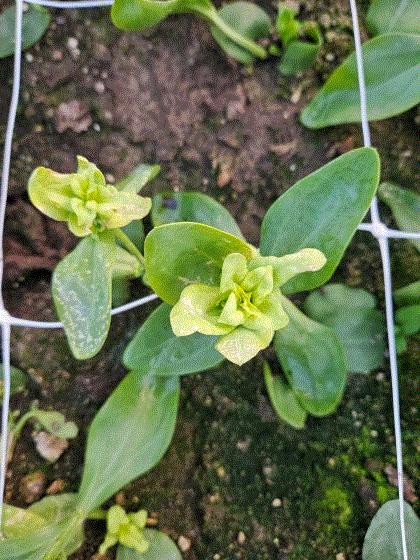
Tater and I are sharing one of our production hiccups in our lisianthus crop. Above is a photo—look carefully and we’ll give you the answer at the end of the newsletter. Here are some additional details to consider before committing to your answer. Read on for the answer!
-
These are inside a heated greenhouse—minimum night temperature is 55F
-
Soil pH is 6.9
-
Water pH is 7.0 with calcium carbonate levels at 250 ppm
pH Meter Selection Considerations
Our friends at
e-Gro published a new
ARTICLE on selecting pH and EC meters. This is a very important practice to implement if you aren’t doing this already. One of my goals for 2026 is to be more diligent in this practice because if you have your own in-house readings you can document changes in your soil over time. I still recommend sending samples to a lab at least once per year, but an in-house pH meter gives you instant data that will help you troubleshoot nutritional deficiencies. Many of us are using the same soil in our high tunnels year after year, so this practice becomes even more important the more seasons you farm.
Below are some things to consider when selecting a pH meter for your farm. Benchtop pH meters work great in a lab setting and are very accurate, but cumbersome to move. Portable pH meters work well for checking crops and are user-friendly. There are two types of portable meters—pen types and larger hand-held meters. Pen-type portable pH meters are cheaper, but can be challenging to calibrate. Larger portable pH meters are a popular option for growers since they're easier to calibrate.
-
Pay close attention to the EC range the meter can read. Some pH meters only read EC values of 4.0 mS/cm or less. Make sure the meter you choose will meet your needs. This is an important consideration if you're growing potted crops, as well.
-
If you have a meter that cannot read higher EC readings, Dr. Brian Whipker recommends diluting your sample by 50% with distilled water. Double the EC reading from the diluted solution and that will give you your reading.
-
Brian highlights a few meters in his article, although he doesn't endorse a particular one. He mentions three models that are less than $300.
-
The Hanna HI9813-61 only reads EX readings up to 4.0 mS/cm. The Hanna HI9811-51 reads EC up to 6.00 mS/cm, but you'll need to convert readings from mmhos/cm to mS/cm. Check out the note in the article on how to calculate this.
-
Milwaukee Instruments has a 3-in-1 pH and EC meter. The MW802 reads EC measurements up to 6.0 mS/cm.
Thank you Dr. Whipker and your lab for writing this article. You can also check out this
VIDEO from our friends at
Tech on Demand, where Nick Flax showcases the pour-through method for potted crops, but fast forward to the two-and-a-half minute mark to see how to take a reading.
This
VIDEO from Hanna Instruments is also a great primer for learning how to take pH readings and provides an in-depth explanation of different types of meters.

The Power of Affirmation

Your people are your best asset. A little affirmation goes a long way.
Those of you who've been reading our newsletter for awhile know that Tater and I love Harvard Business Review (HBR) articles. Most of us start farming because we excel at growing a crop and our love for the flowers. However, it’s just as important to learn how to manage people and become intentional leaders of our businesses. It takes some conscious effort, but this is a skill set I want to refine and work on for 2026, so I’m going to take you guys along for the ride!
HBR has many quick, thought-provoking and palatable articles. This month, I enjoyed reading this
ARTICLE about affirmation in the work place. The author, Zach Mercurio, cites data from a 2022 Gallup poll: 19% of business leaders surveyed prioritized employee recognition. In the 2024 Gallup poll, this increased to 42%. In spite of increased interest and investment by upper level management, 55% of employees surveyed report feeling undervalued and state they don't receive meaningful recognition. According to Mercurio, there are three types of distinction leaders use to recognize employees:
-
Appreciation: Values presence and role. “I’m grateful you’re here.” Often conveyed through awards.
-
Recognition: Highlights a contribution. “I see what you did.” Often conveyed through awards.
-
Affirmation: Validates how someone makes a unique difference. “I see how only you could have done it.”
All three are important, but according to the author, consistent affirmation of employees is lacking in the workplace. And employees have an inherent need to feel unique and important. Leaders who make a conscious effort to create meaningful relationships with their team and communicate the importance of each team member consistently are more likely to reduce employee turnover.
This is the basis of affirmation. Awards and appreciation events are flash in the pan—feel-good events for employees. Affirmation is the practice of consistently recognizing individuals for their special contributions that impact the organization as a whole.
How can leaders master the art of affirmation? According to the author, each employee has four everyday gifts that leaders can identify and use as the basis of their affirmations. For example, “I value your insight on this …” or “You make the team better by…” This is a helpful framework for mastering affirmations. Not only do employees appreciate affirmations, it increases motivation, performance and productivity.
-
Strengths—What does this person love to do and is good at?
-
Purpose—What is this person’s unique impact on a group? What’s missing when they're not there?
-
Perspective—How does this person see work? Do they notice possibilities, constraints or risks?
-
Wisdom—What experiences does this person have that can be taught to the team?
It’s also important to share these stories and successes consistently. The author recommends scheduling time to share experiences with employees and teams weekly. More importantly, these observations need to be heartfelt and authentic. Your employees know the difference.

All About Calcium!
The answer is … calcium deficiency. The crinkled, misshapen young foliage, tip burn and stunted growth are classic symptoms. Calcium is a critical component in cell walls, root development and shoot/flower development. Calcium is needed for cell division/elongation and helps cell membranes maintain their shape and integrity. In lemans terms, calcium is one of the unsung heroes in metabolic plant processes. Calcium deficiency can be especially problematic for ranunculus, lilies and lisianthus.
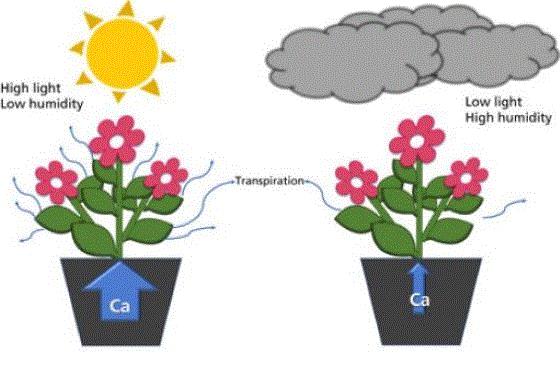
This surprised me a little bit, but it goes to show a little understanding of biological plant pathways can go a long way. Just because calcium is present in our water supply and the pH range is suitable for calcium uptake, doesn’t mean that it's available. Plants uptake calcium by mass flow. Factors that inhibit this process are low transpiration, high humidity, low light levels and poor air circulation. If environmental factors aren’t conducive then the plant can’t take up the calcium even if it's present in the soil.
Check out this 2019
ARTICLE from Katherine Bennett and Jim Faust explaining how plants take up calcium. The "CliffsNotes" are below:
-
Roots take in calcium via passive uptake. When conditions are sunny and the plant is actively transpiring, that plant takes in more water and calcium hitches a ride.
-
Plants don't actively expend energy to uptake calcium. If plants aren’t actively transpiring then calcium doesn't move throughout the plant.
-
Cloudy temperature, high humidity and clouds reduce transpiration and calcium uptake.
According to Sakata’s Bob Croft (aka my go-to lisianthus expert), this is a fixable problem if tended to in a timely fashion. The challenge with calcium is that it's relatively immobile in the plant, which is why it's important for calcium to be constantly available. Foliar sprays of calcium chloride will help new growth and, hopefully, correct our problem.
The good news is that this is a common practice for poinsettia growers and a lot of work has been on this very subject! Here's the
LINK to The Ohio State University's Dr. Garrett Owen's
e-Gro alert on calcium and the application rate for calcium chloride. For poinsettias the recommended rate is 5.6 grams of calcium chloride per gallon. Or you can apply 9 grams per gallon of calcium nitrate. Surfactants such as Capsil aid calcium uptake, but don't use it more than once per week. Remember when spraying something new test on a small area first; don’t spray the whole crop if you haven’t applied this before.
If you want to learn more about nutritional deficiencies in plants check out this
ARTICLE from our friends at Michigan State University. I also found this great
ARTICLE on calcium deficiency in oriental lilies by Dr. Roberto Lopez if you want a deep dive. Happy reading!

We're Cheering for You!
Lindsay Daschner (and Tater)
Editor-at-Large—Bloom Beat
Owner—Forget-Me-Not Farms
This email was received by 6,226 of your fellow fresh-cut flower growers!
If you're interested in advertising in Bloom Beat, contact Kim Brown and she will hook you up!