TDA Re-issued TSCL Quarantine
The invasive two-spot cotton leafhopper (TSCL) is certainly the hot item in the South these days.
In October 2025, the Texas Department of Agriculture (TDA) imposed an emergency quarantine against hibiscus plants of all species from Alabama, Florida, Georgia, Louisiana, Mississippi, North Carolina, South Carolina and Tennessee unless the conditions of movement have been met. These conditions of movement include phytosanitary certification (officially inspected and confirmed to be free of TSCL), treatment (in accordance with TDA- or USDA-approved methods) and exemption (scientific, research or immediately processed samples with TDA and/or USDA approval). Quarantine also applies to shipments of hibiscus plants out of Cameron, Grimes, Fort Bend and Wharton County in Texas.
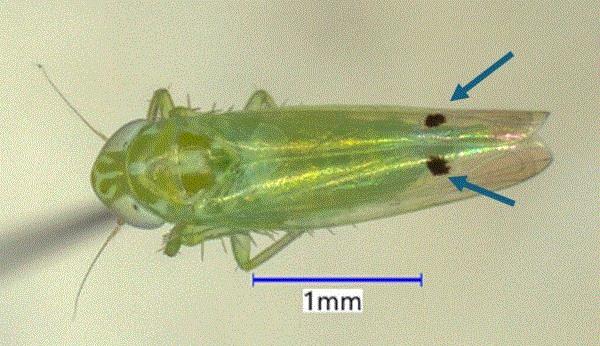
An adult two-spot cotton leafhopper, AKA cotton jassid. (Photo by Isaac Esquivel, the University of Florida.)
On February 20, TDA re-issued the quarantine, adding Arkansas and Kentucky to the list of quarantined states. Other parts of the quarantine order, including the original list of quarantine states and counties, remain the same. Go HERE for the re-issued quarantine order and HERE for TDA’s TSCL website.
I’d had growers and distributor representatives reaching out from several of the quarantined states reporting that some shipments had been stopped or delayed because of detection or a lack of treatment. My boss also reported from his visits to some of our clients in Florida that TSCL is widespread in the landscape in certain parts of Florida.
This pest is certainly well-established and is spreading in parts of the South. We all need to pay attention.

TSCL Rotation Guide
One of the conditions for movement that makes growers scratch their heads is the requirement that the plants must be treated with TDA-approved methods for them to be certified for shipment to Texas. Yet, on its TSCL website, TDA states that it “cannot propose a specific pesticide product,” so it “suggests a generic treatment for leafhoppers to facilitate plant shipments.” What can you use and what’s effective?
Fear not! Here comes the man (i.e. me) with the solution! (Or self-promotion ...?)
I’ve developed a management and rotation guide for TSCL. Y’all can download a copy, for free, by going HERE.
This guide contains several rotation programs that I've put together based on laboratory and field trial data. Most of the data hasn’t been published yet, so I’m not going to go into detail about them. But please believe me when I say I didn’t conjure these rotation programs out of thin air.
I want to give credit to Alexandria Revynthi of the University of Florida, Shimat Joseph of the University of Georgia and Zee Ahmed of Clemson University for graciously sharing their research data for the compilation of this rotation guide. Their research has identified several effective options for TSCL, including acephate, Altus (flupyradifurone), Hachi-Hachi SC (tolfenpyrad), Talus 70DF (buprofezin) and Talstar (bifenthrin). These products are included in the rotation guide, which has programs for landscape, nursery production and incoming plant material.
Alexandria, Shimat, Zee and Rafia Khan of Texas A&M University are at the forefront of our fight against TSCL on ornamental plants. They also provided freely accessible information on how to control TSCL, such as:
-
Alexandria and Shimat gave a tHRIve webinar on TCSL in November 2025. They provided a summary of what we know about this pest and some results from laboratory insecticide efficacy trial.
-
Alexandria also has an informative website on TCSL.
-
Zee wrote an article in the December issue of GrowerTalks summarizing some of his study results on biology (including cold tolerance) and insecticide efficacy. He also put together a colorful and useful scouting guide for TSCL.

How Many Things Can I Put in a Tank Mix?
I participated in a webinar about insect and mite management hosted by SePRO last week. I was lucky enough to join Lance Osborne of the University of Florida, Zach Brown of Bailey Nurseries and Billy Morrow of SePRO (formerly of Metrolina Greenhouses) in a panel discussion. Lance, Billy and Zach brought years of experience and different perspectives to the conversation.
Lots of great questions were asked during the panel discussion. One of the questions that stuck in my mind, because I’d been asked the same question in various forms on many occasions, is, “Can I put multiple modes of action (MOA) in the same tank mix?”
Hearing MOA, my mind immediately went to pesticide rotation. It's my opinion that tank mixing of insecticides isn’t a great approach in terms of reducing the risk of insecticide resistance development.
There are two scenarios when you want to consider tank mixes. First, when you’re dealing with different pest species at the same time. The second scenario is when you're dealing with different life stages at the same time. So it makes sense to mix two MOA with different pest spectra in the same tank under these two scenarios. (Interestingly, preemergence herbicides are often tank mixed because there are many weed species to be dealt with at the same time and each preemergence herbicide has its strengths and weaknesses on the weed spectrum.)
Tank mixing can make you run out of MOA pretty quickly. Take mixing miticides as an example. We have eight to 10 MOA with decent efficacy against spider mites. If you mix four MOA at a time, then you basically can spray two rounds with two different groups or mixes of MOA. What do you do after spraying the second group? You go back to the first group and then the second group again and on and on. That’s how resistance develops. Not to mention most products have limits on how many times you can spray within a year or a crop.
Lance considered this question from a product or physical compatibility perspective. Not everything is compatible. Sure, things may not explode if you mix something incompatible together. But weird stuff happens—the solution separates, curds or deposits appear, products can become ineffective, nozzles and screens may be clogged, etc.
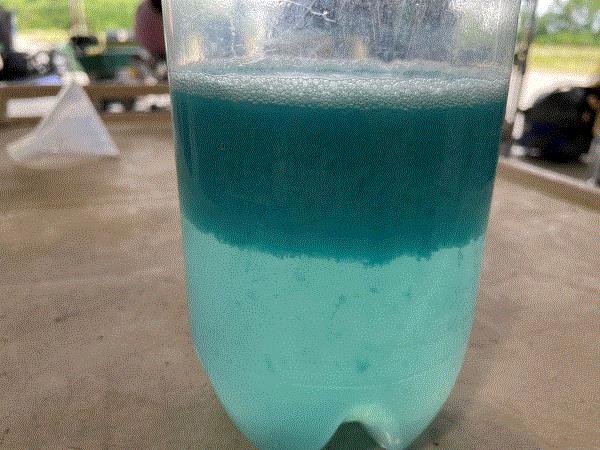
Want to know what happens when you mix mefenoxam and a copper fungicide? Behold! (Photo: Zach Small, SePRO.)
Billy and Zach came from a crop-safety perspective. Many pesticides have the potential to cause phytotoxicity or damage to plants. If you mix many things together, how are you going to know which is the product that causes the damage? It could also very well be that physical incompatibility causes more phytotoxicity. Zach added that, at Bailey Nurseries, they typically don't mix more than two products together.
So the consensus of the panel is that mixing more than two MOA in a tank mix may not be a great idea.

When Do I Need to Switch to the Next MOA?
This is also a question I’ve often been asked and it was brought up during the panel discussion. There are a lot of opinions about this. I’ve heard some folks use a product up to its allowable number of applications per year or per crop then switch. I've even heard folks say they use a product until it's no longer effective!
I follow the official recommendation from the Insecticide Resistance Action Committee (IRAC)—one MOA on one pest generation. This recommendation is sensible because genetic mutations that create pesticide resistance occur when genes are replicated, such as when one generation (adult) produces the next generation (egg). So if you expose two subsequent generations to different MOA, then you’re not continuously exposing the generations to the same MOA and lessening the chance of fixing the resistance genes. Generation should be the basis for rotation.
Operationally, you can time the transition from one MOA to the next based on the generational time of the target pests. Let’s use spider mite as an example: We know that two-spotted spider mites can complete one generation a week in the summer. If you spray once a week, knowing that each spray covers a generation, you need to use a different MOA at each spray. If you spray twice a week, then you can use the same MOA within that week, then switch to the second MOA for the third spray.
Hope that’s easy to understand. Let me know if you need help with understanding or building rotations program. Also, let me know if you think my opinion on when to switch is all bull.

Billion-Dollar Roundup Settlement
Last week, Bayer announced a proposed $7.25 billion settlement to resolve Roundup lawsuits in the U.S.
Bayer has been entangled in lawsuits ever since its acquisition of Roundup along with the herbicide’s maker Monsanto in 2018. About 200,000 Roundup-related claims and lawsuits have been filed since 2015. The settlement will also address cases in the coming years by people who were exposed to Roundup before the announcement on February 17.
Bill Anderson, Bayer CEO, said, “Litigation uncertainty has plagued the company for years and this settlement gives the company a road to closure.”
Under the proposal, Bayer will make annual payments into a special fund for up to 21 years, totaling about $7.25 billion dollars. The amount each claimant receives will depend on several conditions, such as route of exposure, age and severity of non-Hodgkin lymphoma.
The proposal still requires the approval of the St. Louis Circuit Court in Missouri where Bayer is headquartered and many cases were filed. Go HERE for more information about this settlement.


See y'all later!
JC Chong
Editor-at-Large
PestTalks
This e-mail received by 27,847 subscribers like you!
If you're interested in advertising on PestTalks contact Kim Brown ASAP!