Elevated Botrytis Risk
There were quite a few cloudy, humid days these past couple of weeks. I smell gray mold!
Well, not really smelling (certainly not like smelling soft rot or Erwinia), but I know gray mold (or Botrytis) is out there. Sure enough, I found some happily sporulating on my potted mum stock plants that didn’t survive the winter freeze. With a storm system pushing through the Plains towards the East this week, I expect more cloudy days, rain, cooler temperatures and more Botrytis.
Just about any spring crops can be infected by Botrytis cinerea, the most common gray mold species. The initial symptom of infection—small, water-stained spots on leaves or flowers—is pretty easy to miss. The way I described this symptom to my lovely wife, who's a portrait artist with absolutely no care for this kind of stuff, is like this: You know how I often get splatters of lunch on my shirt? Yeah, it looks like that.
The disease costs more than just a shirt as symptoms progress to Botrytis Blight, like the one on the gerbera daisy shown in the picture below. Folks often have to spend the time and labor to prune off the shriveled and dead parts or throw away the severely infected plants. I took the picture at a cut flower farm. Obviously, that infected flower went to the dump.

Gray mold management is often about prevention. Knowing when Botrytis raises its ugly head helps us prevent the disease. The risk of a gray mold outbreak is higher under high humidity (more than 85%) and moderate temperatures (55 to 70F/12 to 21C). High humidity may be the result of poor evaporation (during overcast days) or poor air movement (when fans and ventilation aren’t running or because the plants are packed too close together). A diligent grower will do a preventive fungicide treatment when these conditions are met, even before seeing any symptoms.

Botrytis Management
I want to direct y’all to an article by Janna Beckerman of Envu in the December 2025 issue of GrowerTalks. This article is the most recent update on gray mold management.
I love how Janna describes the management of gray mold as “layering the defense.” Indeed, you’ll need to integrate good sanitation, environmental control, and chemical and biological intervention to build a successful gray mold management program.
It’s important to clean up spent flowers and decaying tissue where the spores are hiding, so that you can have lower spore load and disease pressure. Stressed and wounded plants are more susceptible; anything you can do to alleviate plant stress or prevent injury will help. Any way you can decrease humidity and leaf wetness, such as using HAF and ventilation systems, increasing plant spacing, using drip irrigation, watering earlier in the day, etc. also goes a long way in reducing environmental conditions favorable to disease initiation and outbreak.
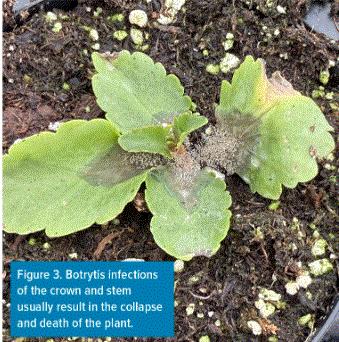
(Photo credit: Janna Beckerman in GrowerTalks.)
As I mentioned earlier, a preventive fungicide program will be needed when environmental conditions are ripe for gray mold infection or outbreak. Botrytis is famous for its ability to develop fungicide resistance, so rotating fungicide among different FRAC groups is important.
Janna provided rotation programs under different disease pressures in her article. Products in Janna’s rotation programs include chlorothalonil (Daconil Ultrex; FRAC M5), fenhexamid (Decree; 17), fludioxonil (Medallion; 12), fluopyram + trifloxystrobin (Broadform; 7 + 11), iprodione (Chipco 26019; 2), mancozeb (Dithane; M3) and polyoxin-D (Affirm; 19).
Additional options, shown as effective in trials conducted under the IR-4 Environmental Horticulture Program include benzovindiflupyr + azoxystrobin (Mural; 7 + 11), difenoconazole + pydiflumetofen (Postiva; 3+ 7), isofetamid (Astun; 7) and metconazole (Tourney; 3). While biofungicides, such as those containing Bacillus, Trichoderma and Ulocladium, aren’t silver bullets—they’re good additions to rotation programs against gray mold.
What about the gray mold on my potted mum stock plants, you asked? I’m not going to wipe them out because I’m keeping those for a couple of fungicide trials!

'Tis the Time for Ambrosia Beetles
I was traveling in and around the Shanandoah Valley last week. This is such a beautiful part of the country. Well, this is normally what I would have said, but not last week. I hit sleet and rain, then snow and rain, not far north of Roanoke, Virginia. You know how I feel about snow and cold weather ...
One of the purposes of the trip was to attend the stakeholder meeting for the Ambrosia Beetle Project held at the USDA-ARS Appalachian Fruit Research Station in Kearneysville, West Virginia. The Ambrosia Beetle Project is a multi-year, multi-region research and extension project funded by the Specialty Crop Research Initiative. The project is at its 4.5-year mark, and the meeting was to take stock of what the project has accomplished and what the researchers have learned.
I was a collaborator on this project during my tenure at Clemson University. Although I’m in the private industry now, I still attend this meeting because I want to keep learning about ambrosia beetles and I miss my colleagues and friends. (Yes, I do love these tiny beetles, although not as much as I love mealybugs. And, yes, I do have a collection of thousands of ambrosia beetles.)
The meeting was timed perfectly because it’s time for folks to get ready for ambrosia beetles.
Monitoring adult flight is crucial for managing ambrosia beetles because the most effective insecticides are repellent or preventive in nature and there’s no cure once the beetles bore into the trees. So you need to spray insecticides when the beetles are flying and before they enter the trees.
There are several ways you can monitor ambrosia beetle flights. The old school way is to capture the flying adults with a soda bottle trap baited with an ethanol lure. I’m not a fan of this method. Don’t get me wrong, this method is great for capturing a lot of beetles. And there lies the problem. This method captures so many beetles and so many species that it takes a lot of time to sort through all the beetles and identify the few species that matter, which are the granulate ambrosia beetle, the black stem borer, the camphor shoot borer and a few other species.
This method doesn’t tell you the precise timing when the beetles are likely to attack because adult beetles fly whenever it’s warm enough for them to do so. It may be so early (for example, as early as mid-February) that the beetles aren’t ready to attack trees (typically in March or April in South Carolina) yet. If you spray as soon as you capture beetles in the soda bottle trap, you’ll likely be spraying too early and waste one or two sprays.
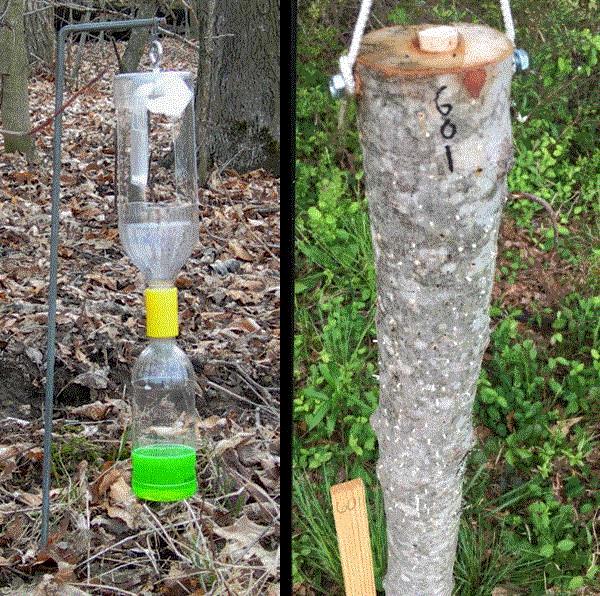
A soda bottle trap (left) and a bolt trap (right). (Photo credit: Chris Ranger, USDA-ARS; Shimat Joseph, University of Georgia.)
My preferred method of monitoring ambrosia beetle flight is to use a cored tree bolt filled with ethanol, like the picture above. A bolt trap is simple to make: You cut a section of a smooth-bark tree trunk, about 2 to 3 in. in diameter and 10 in. in length, then you drill a “well” in the middle of the trunk (about 3 or 4 in. deep), fill with an ethanol solution, cap with a cork and voilà!
The beauty of this trap is that it’ll detect the precise timing when the beetles are attacking trees, not when they’re simply flying because they can or want to. I usually set the bolt traps up in early March, refill the ethanol every week and replace the old bolts with fresh ones after three or four weeks or when beetles create such deep holes that the ethanol solution leaks out.
One of the objectives of the Ambrosia Beetle Project is to improve on this bolt trap. I conducted a study a couple of years ago and showed that trunks and branches of any smooth-barked, soft-wood tree species are suitable for making bolts. At the stakeholder meeting, Shimat Joseph of the University of Georgia summarized several studies and reported that: 1) Filling the solution with a higher concentration of ethanol was more attractive (no surprise here); 2) uncored bolts soaked in ethanol solution collected more beetles than cored bolts (soaked bolts are easier to make); and 3) commercial lures that release high or low doses of ethanol worked equally well.
There have been several attempts at developing degree-day models for predicting ambrosia beetle adult flights, such as those from Mike Redding of USDA-ARS and Jason Oliver of Tennessee State University. Julie Baniszewski, who was a post-doctoral researcher under this project at USDA-ARS and now a research scientist at Virginia Tech, also contributed to this effort.
Julie reported that a rectangular model (a model that’s based on averaging maximum and minimum daily temperature) with a base temperature of 50F (10C) and a January 1 start date performed as well as or better than more complicated models. Using the model, she found that the emergence of 10% of the population in Ohio occurred around 11 degree-days (GDD) for the black stem borer, which is surprisingly early. That’s delayed to 107 GDD for the granulate ambrosia beetle and 477 GDD for Anisandrus maiche, a new invasive ambrosia beetle that’s gaining prominence in the region.
Julie’s model doesn’t address the timing for initiating attacks. I think degree-day models can help with management timing, but there are still some rough edges and uncertainty across different regions that still need to be smoothened out.

Ambrosia Beetle Management
You set up the bolt traps and see that the ambrosia beetles are attacking the bolts this week—so what do you do next?
Go HERE for an earlier issue of this newsletter that was devoted to ambrosia beetle management. That newsletter was from a couple of years ago. There have been a few updates since then.
As much as I’d like to provide you with multiple management options, I hate to tell you that the one true and consistent management option is to spray preventively. According to a summary by Alejandro Del Pozo Valdivia of Virginia Tech University at the meeting, pyrethroids are the most effective insecticides in preventing ambrosia beetle attacks. Among the pyrethroids, bifenthrin and permethrin are more effective than other pyrethroids, such as cypermethrin, cyhalothrin and deltamethrin. For pyrethroids, lower application rates didn’t perform as well as the full maximum label rate (Surprise! Surprise!), but half the label rate may be a good compromise between efficacy and cost of product or concern over non-target effects.
So the insecticide options are limited. It isn’t that we aren’t trying hard enough—we threw labeled and unlabeled insecticides (and the kitchen sink) at the beetles! I know because I ran some of those studies. I can also say with certainty that spraying or drenching with systemic insecticides (any active ingredient) doesn’t prevent attacks by ambrosia beetles.
The push-pull strategy shows some promise according to reports by Kelsey Tobin of Cornell University (now at the University of Idaho) and Aaron Yilmaz of USDA-ARS (now at Case Western Reserve University). This approach relies on setting up ethanol-injected or baited trees on the edge of the wood and verbenone-baited trees in the interior of the nursery or orchard. The ethanol-treated trees serve as the “pull,” which attract the beetles to stop as they fly from the woodlot into the nursery or orchard. The verbenone-treated trees serve as the “push,” which deter the beetles from approaching the trees. Interesting concept that needs validation in large-scale field trials.
There are several other management options that have been studied under the Ambrosia Beetle Project, such as using acibenzolar to induce resistance in both orchard and nursery crops (there may be some benefits with the treatment), looking at the relationships between beetle attacks and flood- or drought-prone areas in nurseries (flood seems more strongly linked than drought), quantifying beetles’ flight distance (they can fly more than 460 meters or 1,500 ft. in 24 hours), and using Trichoderma, Beauveria and nematode metabolites in controlling the ambrosia beetles.
Too many for me to summarize here. Go HERE to check out information on the Ambrosia Beetle Project and these studies.

SLF Quarantine Expanded in OH
Jen Polanz, Managing Editor of Green Profit and Inside Grower, shared some news with me that I’d missed: The Ohio Department of Agriculture (ODA) has now expanded the spotted lanternfly (SLF) quarantine to all counties in the state. Only 18 Ohio counties were under quarantine before the February 17 announcement.
The expanded quarantine is an acknowledgement that SLF, first detected in Ohio in 2020, is now widespread throughout the state. ODA no longer encourages folks to report sightings of SLF.
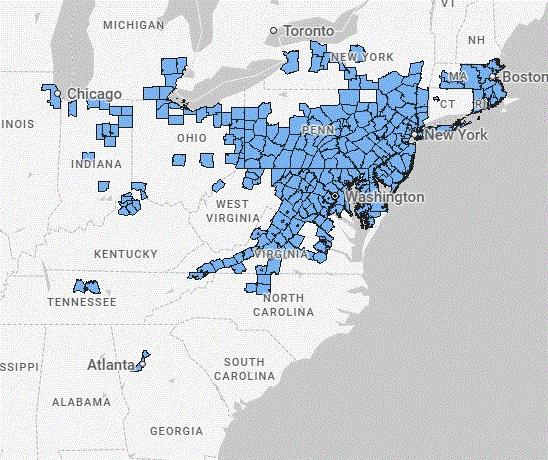
Counties infested by spotted lanternfly are colored blue. (Credit: New York State IPM Program.)
Nursery stock cannot be moved outside of the state without a compliance agreement, permit or inspection certificate. Regulated items include live insects (all life stages), trees (live or dead), nursery stock, firewood, logs, perennial plants, garden plants, agricultural produce and anything that may carry the insects. Each load of nursery stock must be inspected and certified as SLF-free before it can be shipped outside of the state.
Go HERE for more information on the SLF quarantine in Ohio.


See y'all later!

JC Chong
Editor-at-Large
PestTalks
This e-mail received by 27,847 subscribers like you!
If you're interested in advertising on PestTalks contact Kim Brown ASAP!