PanAmerican Seed Grower Insights On Select 2027 Varieties
For this Trending Now VIDEO, I was joined by three representatives from PanAmerican Seed who each bring specific expertise to the table, having worked with new crops for years to help bring them to market with solid foundations and supported by all the information you, as growers, need to be successful.

Lisa Lacy is Director of Product Management for PanAmerican, Robin Ruether is Senior Product Manager, and Sonali Padhye is PanAm’s Senior Global Technical Manager. Together they covered five key 2027 introductions from the global seed breeding company.
Here’s the list of crops—you’ll see they cover a range of genera, uses and market positions. There are landscape performers, combo components, Fleuroselect Gold Medal and All-America Selections winners, and seed forms of traditionally vegetative varieties—truly something for everyone!
-
African Marigold Lanna Lace
-
Bacopa Galactic Mist White
-
Sunflower Always Sunny Gold
-
Heuchera Heucherette Pink & Red
-
Sedum Spectacular
All product information is available on the PANAMERICAN SEED WEBSITE. If you navigate to Grower Facts for each crop, you’ll find all the culture and technical information you need.
As I usually try to do, this presentation is also available in audio-only podcast format. Subscribe on your favorite app so you never miss an episode. And jump back in the archives for more than 235 episodes covering a huge range of topics in the professional horticulture space!

Koppert Corner: Eliminating Black Vine Weevil and Red-Headed Flea Beetle in April
Black Vine Weevil (Otiorhynchus sulcatus) and Red-Headed Flea Beetle (Systena frontalis) are sneaky. They overwinter in the root zone, leading to a false sense of complacency for nursery growers. Until June, that is, when adults emerge and cause damage on their ornamental crops.
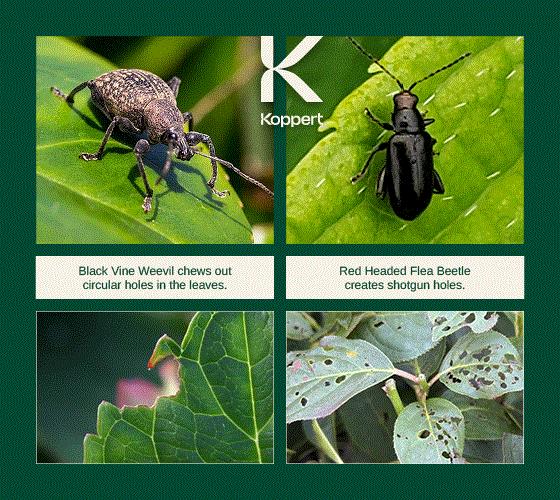
Past recommendations for managing Black Vine Weevil (BVW) have been three to four pesticide spray treatments once adults emerge in May and June. But by waiting for adults, we’ve missed the perfect opportunity to kill the pests before they emerge in the spring from the root zone. Eliminate the larvae before they pupate and that equals zero adults emerging.
Red Headed Flea Beetles overwinter in the root zone as an egg and hatch into the larval stage at approximately 250 growing degree days (GDD). This makes early to mid-April the perfect time to target this insect pest.
An excellent deep dive on this problem is this article, but let's cut to the chase and get rid of them:
Use Entonem (Steinernema feltiae) against BVW in cool conditions. You need only to drench nematodes into the area where larvae are present to cause mass destruction. In fact, research has shown that one well-applied drench application of Entonem in late March to mid-April will kill up to 100% of root weevil larvae, resulting in close to zero adults emerging in late May-June. As the adult stage doesn’t fly, you can put away your chemical sprayer for this pest for the summer.
Apply Capsanem (Steinernema carpocapsae) to effectively impact RHFB beetle larvae. Fortunately, those larvae are sitting ducks when entomopathogenic nematodes are released into their workspace. A well-timed and executed Capsanem nematode drench treatment in late March or early April will execute nearly 100% of the year’s flea beetle larvae population.
With one well-timed, well-done application of nematodes applied with a non-ionic surfactant, you’ll have eliminated 99% of the need for pesticide spray applications against these pests during summer. You’ll also have had zero negative impact on native beneficial insects, who will thank you for allowing them to continue working for you throughout the summer growing season.
Ready to set up a plan to eliminate this year’s population of red-headed flea beetles or root weevils now and prevent their damage throughout 2026 and 2027? Reach out to the nematode experts at Koppert and let's dial in the details. We know nematodes!

Nick’s Tip of the Week: 3 Causes of Geranium Yellowing
Each week, I’ll work with my buddy Nick Flax, a technical services expert at Ball, to share a concern that’s come up during one of his numerous calls with growers across North America. This week, he’s covering three common causes of geranium yellowing.
PROBLEM: Bacterial pathogens are no joke for the Pelargonium genus and, as a result, each spring I get many calls, texts and emails from growers with odd symptoms on geranium crops wanting to know, “Is this something that I should be worried about?” This week, I’ll cover three common factors that should raise red flags in geranium crops if you see them this spring.
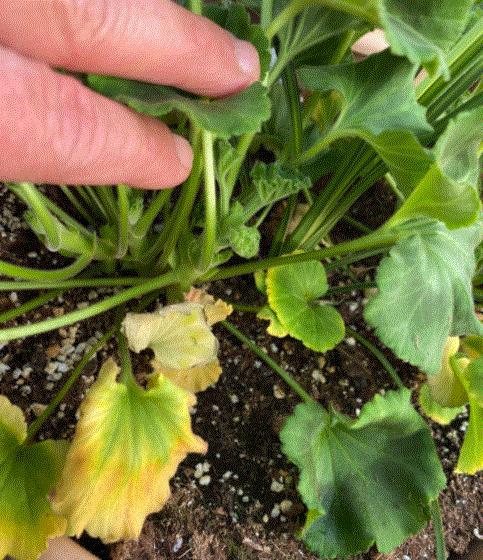
NICK’S TIP: Geraniums are grown in large quantities in North American greenhouses each year, so scrutiny of emerging health indictors is a good thing. However, questions that I usually get this time of year make it clear that some of you are so laser-focused on bacterial pathogens that it’s a good idea to remind you and your production team about a few of the most common causes of leaf yellowing and senescence in this crop.
Pythium Root Rot
“Black leg” from Pythium and bacterial soft rots like Erwinia/Pectobacterium are major concerns for URCs during liner propagation, but root rot pathogens seldom hit growers’ radars during finished production. Best practices are to grow geraniums on the dry side and establish thorough wet-to-dry cycles quickly after transplant, which greatly reduces the chances root rot pressure. However, if greenhouse conditions are dark, cool, and/or humid and growing media is staying too wet for long periods, Pythium can quickly gain a foothold.
Yellowing and discolored root tips are the earliest indicator of disease in the rootzone. Slowed growth often pairs with these symptoms, but it can be difficult to notice if you aren’t regularly spot-checking containers for root development or if you are growing a large assortment of cultivars.
General discoloration and sloughing of the outer layer of roots (the cortex) are advanced symptoms of Pythium. Noticeable stunting and lower leaf yellowing can occur at this stage. Wilting during the daytime also often occurs as disease progresses, but plants will typically recover overnight.
Feed and water carefully and ensure that media does not remain saturated for long periods. If the weather changes and prevents media from drying down within a couple of days after a given irrigation event, apply a fungicide drench to provide protection against Pythium. Fungicides containing etridiazole (Banrot, Terrazole, Truban) and mefenoxam (Subdue MAXX) provide excellent control during typical spring growing conditions.
Too-tight Spacing
Geraniums are high-light-loving crops, so light penetration through the canopy should be maximized. If not, plants will start to shed their less-productive leaves and reallocate nutrients into new growth. When geraniums pull mobile nutrients out of older leaves, the leaf senescence that follows can raise concerns—especially if leaves look like they are collapsing or wilting.
Avoid overcrowding your geraniums on the bench and on hanging basket lines. If you are producing 4- or 4.5-inch containers in shuttle trays, be sure to increase spacing between trays or checkerboard the pots once leaves begin to overlap with adjacent containers.
If you don’t have enough benches or basket lines to increase spacing, some handwork and removal of the largest mature leaves can help thin out the canopy. This will increase light penetration and help reduce occurrences of this low-light leaf senescence response.
Manage moisture and fertilizer appropriately to keep leaf size from ballooning and shading out the lower canopy. If canopy crowding still occurs despite your best efforts, you can use PGRs as a tool to help reduce the overcrowding effect.
Ethylene & Flue Gas Exposure
Geraniums are sensitive to ethylene and other flue gasses that can accumulate in your greenhouse, and leaf yellowing and senescence is a commonly associated symptom with exposure. Be sure to pay close attention to symptomatic plants’ locations in your greenhouse relative to unit heaters when troubleshooting these crops.
Service your gas-fired unit heaters regularly and inspect them for cracks. Also, avoid using unvented heaters in the greenhouse, as this will greatly increase the risk of gas-related issues occurring.
Some series and varieties are more sensitive than others to ethylene and other flue gasses. If you start to see symptoms in all of one variety but no symptoms are apparent on another variety immediately adjacent to the symptomatic one, this can be an indicator of flue gas contamination.
If you suspect flue gas/ethylene damage, you can put an indicator plant like tomatoes (which are highly sensitive to ethylene) below and slightly downwind of suspect unit heaters. If leaf epinasty (twisting) occurs, this is a good indicator that an overhaul of the unit may be necessary. Check out this e-GRO Alert for more details on flue gasses and how to minimize risk of damage to your crops.

Daily Irrigation Questions for Your Team
When you talk to your production growers in the morning, retired Ball Seed technical services guru Dr. Will Healy feels the first question to ask is, “How much water did the plants lose last night?” Producing a healthy crop starts with irrigation, and water loss is the clearest metric to drive good decisions. Getting in the habit of measuring this component can take your production to the next level.
In WATERING: QUESTIONS TO ASK, Will shares exactly what to ask your team and why. Communication is not only super-important in any business but might just mean the difference between profitable, high-quality crops and extra work or even dump. Aligning your irrigation goals will reduce risks associated to overwatering like stress and disease. Take three minutes to watch this video and then start asking these questions next week.
If you want a whole lot more (like an hour more), check out the complete Training Your Team to Water Properly video.
Circumventing Caladium Conundrums
In past issues of GrowerTalks, a team of Michigan State researchers put together a two-part series digging into some pretty in-depth research related to caladiums. The stated goal of the research was to determine the effects of air, substrate and irrigation water temperature on sprouting, growth and development, and to generate research-based protocols enabling greenhouse growers to optimize production of caladiums, consume less energy, and produce high-quality and uniform crops. If you grow caladiums, you’ll no doubt understand the importance of this project.
As the MSU team explains, it's not uncommon for greenhouse growers, especially those in northern latitudes, to report delayed leaf emergence, lack of crop uniformity in emergence and leaf number, and inconsistent crop timing due to exposure to temperature extremes. This can negatively influence profitability for growers due to increased energy costs for delayed and non-uniform crops, and reduced sales, as the ornamental value of caladiums and their performance in the landscape is determined by foliage quantity and quality.
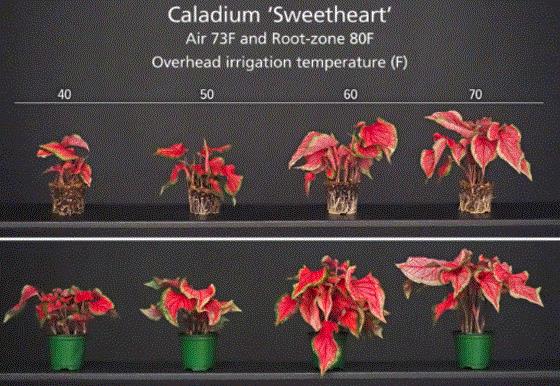
In a project to simulate greenhouse production of No. 1 tubers of more than 10 varieties, the team developed production protocols for forcing and growing crops and showed how the emergence of shoots is influenced by air and root-zone temperature and how this can be impacted by covering containers with plastic.
The research continued with a look at how irrigation water temperature influences emergence and quality of some of the cultivars, and how day and night temps during forcing can be used for height control.
Here are links to both articles, which go into great detail in an effort to help you produce you best caladium crops ever.

Finish Line ...
As we head into the busiest time of year in many of your greenhouse businesses, I always think about the importance of employee morale and positivity. This is critical content for managers, as well as everyone else on the team, because of how much it impacts day to day performance.
When morale is high and things are “clicking,” great benefits can be achieved. I had saved an article from the BetterUp blog with a solid list of goals to share before crazy season:
Employee retention. Low employee morale can make employees feel helpless, undervalued and ignored. This often results in higher turnover.
Work performance. High morale inspires employees, leading them to perform at their very best.
Employee motivation. When employees are given opportunities to develop their skills, it motivates them to take action to accomplish their work goals.
Communication. When employees have solid relationships with their managers and co-workers, they communicate effectively and have positive attitudes.
Employee productivity. When employees believe in their company’s mission and can see themselves advancing their careers, they produce more work at a faster rate.
Collaboration. Employees who are in sync with their peers are motivated and excited to collaborate with other team members on new projects.
Employee engagement. High morale encourages employees to feel more engaged with the work in front of them, instead of feeling overwhelmed.
Talk to you next week!


Please feel free to send your comments, constructive criticism and topic ideas to me at bcalkins@ballhort.com.

Bill Calkins
Editor—Tech On Demand
This email was received by you and 25,402 other fine subscribers!
If you're interested in advertising in Tech On Demand, contact Kim Brown ASAP and she'll hook you up.