End-Of-October Farm Update
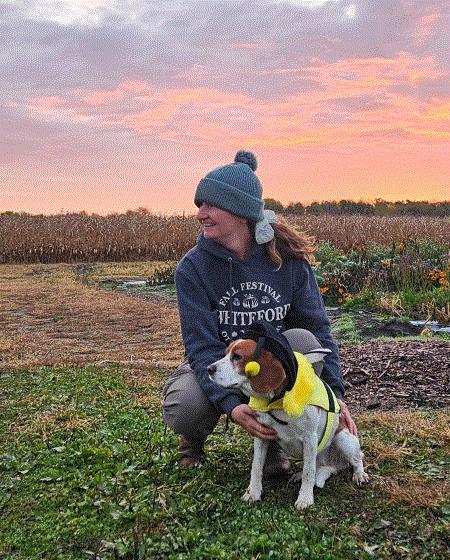
Throwback to Tater's Halloween costume from last year.
It's hard to believe we're already approaching the end of October! I even got Tater a new Halloween costume this year! The last two years she has been a bumble bee or a spider ... I won't reveal her 2026 costume for her beloved fans just yet.
Here in southeast Michigan we've been enjoying an absolutely beautiful stretch of weather, with plenty of sunshine and temperatures hovering around 65F for the better part of the last ten days. It’s hard to believe it’s the end of October. And while we haven't experienced a formal killing frost just yet, Tater and I decided it was time to start digging our dahlias. Digging dahlias on a sunny, 65F afternoon is considerably more enjoyable than digging them when it's 40F and misting outside! Besides, my gut tells me that when Mother Nature finally decides to embrace fall, we're going to experience a rather abrupt change in the weather.
The more years Tater and I spend farming, the more I've come to appreciate the importance of sticking to a relatively strict schedule when it comes to certain farm tasks. Could we squeeze another week of flowers out of our dahlia field? Probably. But with shortening days, we're already beginning to see a decline in flower quality. This includes weaker stems and more blooms with open centers. And while we could certainly continue harvesting for another week, I've learned that there's often a tremendous opportunity cost associated with trying to squeeze every last bloom out of a crop. At some point, the time and labor spent harvesting a declining crop is better invested in preparing for the next season. In other words, sometimes knowing when to call it quits is just as important as knowing when to get started!
But not every task on our seasonal calendar is set in stone. We've made a few adjustments to our fall planting schedule because of the unusually warm weather. We had temperatures in the 80’s last week and decided to delay sowing our first round of sweet peas. In the meantime, Tater and team Forget Me Not have been busy preparing for spring ranunculus and anemones. We have big plans to increase our production for next spring. I suppose that's one of the balancing acts of farming.
The most exciting events on the farm this week was watching the bulldozer grade the site for our new greenhouses. Which, of course, Tater has been busy supervising. We're incredibly excited about this expansion and the opportunities it's going to create for not only our employees but local flowers in our region. It's a big undertaking, but one that we believe will help take our farm to the next level.
In this edition of Bloom Beat, we're going to explore why some of our favorite dahlia varieties seem to change color in the fall, heater maintenance and more! With all that being said, let's talk shop!

Why Do Dahlias Change Color in the Fall?
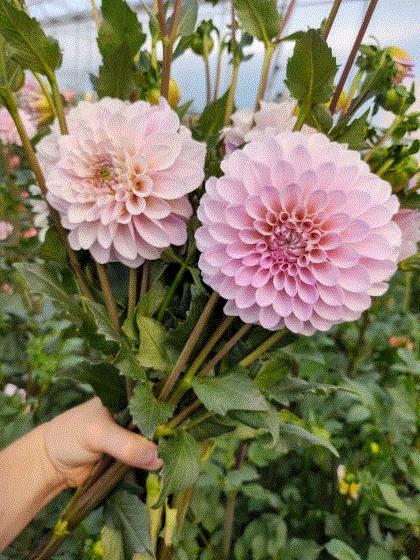
Sweet Nathalie is the poster child for seasonal color changes.
One of the things that Tater and I look forward to every fall is watching our dahlia field change colors. And I'm not talking about foliage! If you've grown dahlias for any length of time, you've probably noticed that some varieties look a lot different in October than they do in July or August.
One of my favorites, Sweet Nathalie, is a beautiful soft blush during the summer. But as night temperatures begin to drop, the outer petals develop these gorgeous lilac undertones. At least Tater and I think they're gorgeous ... but some of our florist clients miss the true blush tones from earlier in the season. Jowey Winnie is another great example. During the summer, its blooms are a beautiful sunset-coral color, but by October those same flowers can develop distinct lavender hues.
As much as I appreciate these seasonal transformations, they can create some challenges when selling to florists. Our customers often order specific varieties for weddings and events based on a particular color palette. A florist looking for warm coral dahlias might not be particularly excited to receive flowers with lavender undertones. And don’t even get me started on blushes! Honestly, Tater and I understand and we don’t blame them. When you're designing for someone's wedding, color consistency matters. But with outdoor production, we can’t necessarily control when dahlias decide to become chameleons.
So why do some of our favorite dahlias seem to change personalities as the growing season progresses? Tater and I decided to do a little research.
According to Dr. David Trinklein at the University of Missouri, dahlias often develop more vibrant colors during the fall because of the combination of warm days and cool nights. But there's quite a bit more science involved in this process than just cooler weather. The answer involves some fascinating plant compounds called anthocyanins and flavonoids. Buckle up and get ready for some plant science 101!
First of all, let's talk about anthocyanins. These are naturally occurring, water-soluble pigments responsible for many of the red, pink, magenta and purple colors we see in flowers. They're stored in specialized compartments within plant cells called vacuoles. The concentration of these pigments, along with the chemical environment inside the vacuoles, helps determine the color we actually see.
And here's where things get interesting! Anthocyanins belong to a larger family of plant compounds called flavonoids. Flavonoids include several different groups of compounds, including anthocyanins, flavones, flavonols, chalcones and aurones. While anthocyanins are responsible for many of the pink, red and purple colors, other flavonoids can contribute yellow pigmentation or modify the appearance of anthocyanins. Flavones and flavonols are often nearly colorless to the human eye, but they can interact with anthocyanins through a process called copigmentation. These interactions can influence the intensity and hue of a flower's color, sometimes shifting its appearance toward cooler violet tones.
And to make things even more complicated, flowers have another family of pigments called carotenoids. These compounds are responsible for many yellow and orange colors in flowers. Unlike anthocyanins, carotenoids aren't part of the flavonoid family. So, the final color of a dahlia isn't necessarily determined by one pigment. It's influenced by the types of pigments present, their concentrations and how they interact with one another. Even the acidity within the petal cells can influence the final color (think hydrangeas turning pink or blue because of the soil pH).
As noted earlier, temperature can influence the biochemical processes responsible for producing these pigments. Plants manufacture anthocyanins through a series of chemical reactions controlled by specialized enzymes. To be honest, to dive deep into these processes would be worth another Bloom Beat article on its own! But for the sake of simplicity, the production of these enzymes is regulated by genes that respond to environmental conditions, including temperature. Cool temperatures can encourage the expression of genes involved in anthocyanin production, resulting in greater pigment accumulation. Conversely, excessive heat can interfere with pigment production or increase pigment degradation, which may help explain why some dahlia varieties appear softer or more washed out during the summer. Sweet Nathalie is a great example of this.

Dahlia Color Changes (continued)
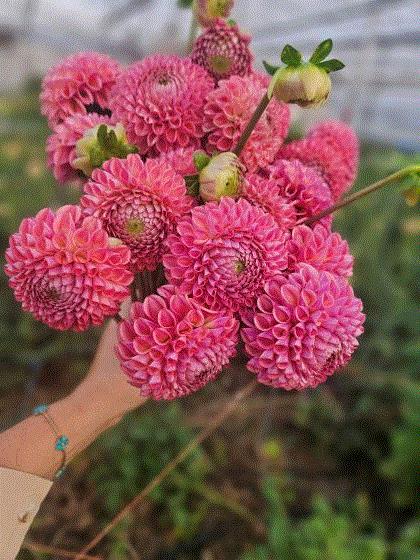
A fall handful of Jowey Winnie. She's a little more lavender than coral this time of year.
Temperature also influences the availability of sugars produced through photosynthesis. These sugars provide some of the building blocks necessary for manufacturing pigments and can influence the activity of pigment-related genes.
But there's a catch: Just because cooler temperatures can encourage pigmentation doesn't mean that colder is always better! When temperatures become excessively cool, photosynthesis and other metabolic processes can slow down, potentially limiting the plant's ability to manufacture and accumulate pigments.
And because anthocyanins and other flavonoids share portions of the same biochemical pathway, temperature can influence the balance between different pigments. This is particularly interesting when we consider varieties like Sweet Nathalie and Jowey Winnie, where we're observing an actual shift in hue rather than just a darker version of the summer color.
So what does the research tell us? A study published in October 2026 in Horticulturae investigated how different day and nighttime temperatures influenced flower development and pigmentation in the dahlia cultivar Hypnotica Tropical Breeze.
Researchers evaluated five temperature combinations, ranging from relatively cold to extremely warm. Plants grown at 68F during the day and 50F at night demonstrated the highest relative anthocyanin and flavonoid indices. The relative anthocyanin index under these conditions was approximately 2.7 times higher than in plants grown at 77F days 59F nights. However, plants grown under colder conditions of 59F days and 41F nights had considerably lower pigment levels. Researchers also observed reduced sugar and starch accumulation under these conditions.
What does this tell us? There appears to be a temperature range that favors pigment accumulation, at least in the cultivar researched in this study. And while moderately cool temperatures can encourage richer colors, excessively cold temperatures may have the opposite effect.
Another dahlia study published in The Horticulture Journal examined a dahlia cultivar called Nessho. Researchers found that low temperatures influenced flavonoid synthesis and contributed to a shift in flower coloration from dark red toward orange.
I think this is particularly fascinating because it demonstrates that not all dahlias respond to cooler temperatures in the same way. Some varieties become darker, while others may develop entirely different color characteristics. Hence the reason Tater and I call dahlias chameleons.
It's important to recognize that these researchers didn't specifically examine Sweet Nathalie or Jowey Winnie. We can't say with certainty which pigment changes are responsible for the lavender and lilac undertones we're seeing in our field. But the research provides some interesting explanations for why these seasonal changes may occur. For those of us selling to florists, this is something worth keeping in mind, particularly when filling orders for weddings and other color-sensitive events. After all, the soft blush dahlia that everyone fell in love with during July might have an entirely different personality by October!

Are Your Greenhouse Heaters Ready for Winter?
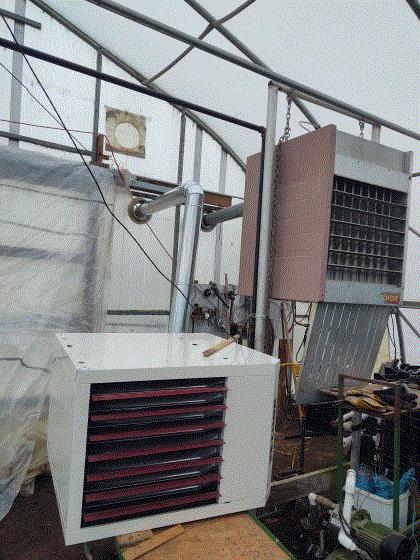
Throwback to Christmas Eve 2024 when an old heater took a vacation and we improvised with a new Reznor within three hours of failure. The joys of farming in the winter in Michigan. Honestly, this still haunts me!
While Tater and I have been enjoying the mild weather here in southeast Michigan, we know that winter is right around the corner. And if there's one thing I've learned from growing flowers in Michigan, it's that greenhouse heaters have an uncanny ability to malfunction on the coldest night of the year! Unfortunately, there's nothing quite like receiving a low-temperature alarm at 2 a.m. and realizing that one of your heaters has decided to take an unscheduled vacation.
Fall is the time to perform preventative maintenance on your heaters to minimize risk of failure AND boost efficiency. According to the University of Connecticut, proper heating-system maintenance can reduce your fuel consumption by as much as 20%. Heating is one of our highest production costs, and I think we can all appreciate the opportunity to save a little money!
Thankfully, our dear friend Dr. Garrett Owen from Ohio State University published an e-GRO ARTICLE on heater maintenance to give us all a starting point for fall heater maintenance:
Check Heater Mounting and Clearances
Over time, vibration and routine greenhouse activities can loosen mounting hardware. It's also important to verify adequate clearance between heaters and surrounding materials, including greenhouse poly, shadecloth, energy curtains, hanging baskets and temporary plastic walls. Always consult the manufacturer's specifications regarding minimum clearances to combustible materials and heater discharge.
Inspect Fuel Supply and Electrical Connections
Look at the fuel supply and electrical components associated with each heater. Dr. Owen recommends visually inspecting fuel piping for corrosion, damage or stressed connections while making sure manual shutoff valves remain accessible and clearly labeled. If you are using propane, make sure that tanks have fuel, regulators are protected from snow and ice, and delivery trucks can access your tanks during severe weather. Electrical connections and thermostat wiring need to be checked as well. Look for visibly loose or damaged wires and make sure service switches are clearly labeled.
Dr. Owen also recommends evaluating where your thermostats are placed in proximity to the heater. If a thermostat is positioned directly in the heater's discharge path, it may register temperatures considerably warmer than the rest of the greenhouse. This can cause short cycling or prevent backup heating stages from activating when needed.
Clean Heater Cabinets, Fans and Burner Areas
During the summer, dust, leaves, insects, spiderwebs and other debris can accumulate inside heater cabinets and around burner compartments. Be sure to inspect these areas before the heating season begins. Dust on fan blades can reduce airflow, and debris around combustion components can interfere with proper heater operation and ignition. Remove accessible debris according to manufacturer instructions, and have a qualified technician inspect and clean combustion components as necessary. In my experience, it’s money well spent!
Inspect Exhaust Venting
Another important step is inspecting the exhaust system. Be sure to check that vent stacks are securely attached, properly pitched and end outside the greenhouse. Look for rusted sections, disconnected joints or visible holes that could allow combustion gases to re-enter the growing space. Improperly vented heaters can expose employees to carbon monoxide and crops to harmful combustion byproducts.
Test Your Heaters Before You Need Them!
One recommendation I particularly appreciate is testing heaters before the first significant cold spell. After all, just because a heater worked perfectly last March doesn't necessarily mean it's going to start without any problems in November! Actually, I can promise with 90% certainty that not all of them will. Once routine maintenance inspections are done be sure to fire them a few times! Dr. Owen recommends setting the thermostat a few degrees above the current greenhouse temperature and observing the heater through an entire heating cycle.
Make sure the thermostat calls for heat, the ignition system works and that the burners ignite properly. And lastly, the circulation fan runs as intended. Pay attention to unusual noises, repeated ignition attempts or heaters that shut off prematurely.
Keep Spare Parts on Hand
One thing Tater and I have learned over the years is that certain makes and models of greenhouse heaters seem to be more prone to specific problems than others. For example, we've had particular heaters that seem to go through electronic control boards (or chips) more frequently than we'd like. And unfortunately, these chips seem to fail at a convenient time. But the good news is that if we have the part on hand it's an easy fix!
If you've noticed recurring problems with certain heaters on your farm, I highly recommend keeping a few compatible replacement parts on hand. While buying spare components requires a little money upfront, having them readily available can save valuable time when a heater quits working in January. Tater and I look at it as cheap insurance.
Don't Forget About Stopping Cold Air!
Maintaining your heaters is only half the battle. We also need to make sure we're not allowing all that expensive heat to escape too soon!
In this e-GRO ARTICLE, Dr. Owen discusses how cold air can enter through doors, vents and exhaust fans, and how an accumulation of unsealed openings leads to heat loss. Small gaps can create cold spots that hinder crop growth and quality. As we prepare our greenhouses for winter, Tater and I like to pay particular attention to doors, vent openings and the condition of the poly curtains for our greenhouse doors. Check for loose wiggle wire, damaged plastic, poorly sealing doors and malfunctioning vent louvers. For double-poly greenhouses, make sure inflation blowers are functioning correctly and are maintaining the appropriate air space between the two layers of plastic.

AFE Celebrates 65 Years!
This year marks an exciting milestone for the American Floral Endowment (AFE), as the organization celebrates 65 years of advancing the floral industry! AFE started in 1961, and has invested more than $24 million into research, scholarships, internships and educational programs.

In 2025, AFE awarded more than $750,000 to support 20 research projects addressing a slew of industry challenges including IPM, postharvest handling and emerging floriculture technologies. AFE also invested more than $139,500 in scholarships and internships for 40 students and more than $100,000 in educational grants to 24 organizations. And while these numbers are certainly impressive, I think the real value of AFE lies in its long-term commitment to helping our industry grow and evolve.
As AFE celebrates this remarkable milestone, Tater and I would like to personally thank the wonderful folks at the American Floral Endowment for their unwavering dedication to moving our industry forward. Their commitment to research, education and investing in future generations is truly invaluable, and our industry is stronger because of this!

Until next time!
Lindsay Daschner (and Tater)
Editor-at-Large—Bloom Beat
Owner—Forget-Me-Not Farms
This email was received by 6,144 of your fellow fresh-cut flower growers!
If you're interested in advertising in Bloom Beat, contact Kim Brown and she will hook you up!