Organic Fertilizer Aids Heavy Metal Extraction
New research looking at the potential of Bougainvillea spectabilis and Zinnia elegans to pull heavy metals out of soil has found that organic fertilizer can boost their phytoextraction efficiency.
The study,
“Enhancing the phytoextraction capacity of two ornamental plants by organic fertilizer in lead and aluminum contaminated soil,” was published in
Pakistan Journal of Botany. Researchers exposed these ornamental plants, in greenhouse conditions, to various levels of aluminum and lead, while also testing exposure with the addition of a 5% farmyard manure amendment. Both metals significantly impaired plant development, reducing height, leaf production, leaf area and biomass. Contamination also negatively affected photosynthetic performance, chlorophyll content, stomatal conductance and transpiration.
 Research indicates that organic fertilizer can boost the phytoextraction capabilities of zinnia and bougainvillea.
However, the addition of the organic fertilizer partially mitigated these effects, improving growth by as much as 28% while supporting physiological function. Metal accumulation in plant tissues increased with soil contamination levels, with shoots accumulating higher concentrations than roots. The addition of organic fertilizer enhanced metal uptake and movement into plant tissues, increasing translocation factors by up to 75% in bougainvillea and 72% in zinnia.
The findings suggest that organic amendments can improve both plant tolerance to metal contamination and phytoextraction potential.

Webinar: Sustainability with Metrolina
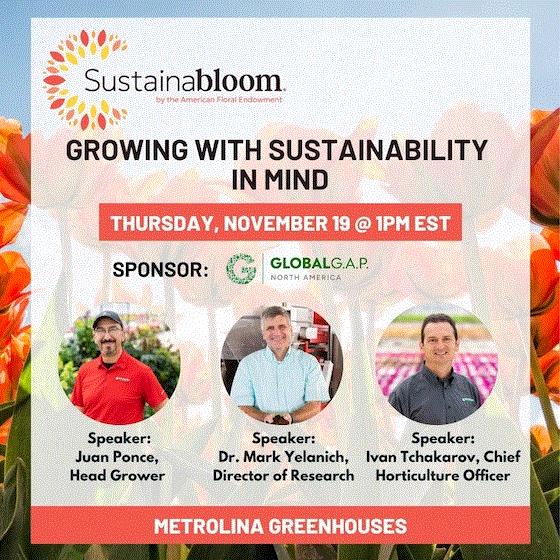
Sustainabloom is bringing you a webinar on sustainability that’s worth tuning into!
On November 19 at 1 p.m. Eastern, an all-star team from Metrolina Greenhouses in North Carolina will share how their sustainability efforts have evolved over time, from the first steps they took to more advanced strategies they use today.
You will hear from Juan Ponce, Director of Horticulture at Metrolina Greenhouses, Dr. Mark Yelanich, Director of Research and Development, and Ivan Tchakarov, Chief Horticulture Officer, as they talk about what prompted Metrolina to get started, how they decided where to focus, what they learned along the way, and how sustainability fits into day-to-day farm operations.
You will also learn how you can start small and build on your efforts over time, including tools such as sustainability planning and, where relevant, third-party certification.
Whether you’re just getting started or looking for ideas to take your current practices further, this conversation will offer a practical look at sustainability.
Hosted by Sustainabloom and sponsored by Global G.A.P. North America.
Register HERE.

College of DuPage to Offer Free Apprenticeship Education
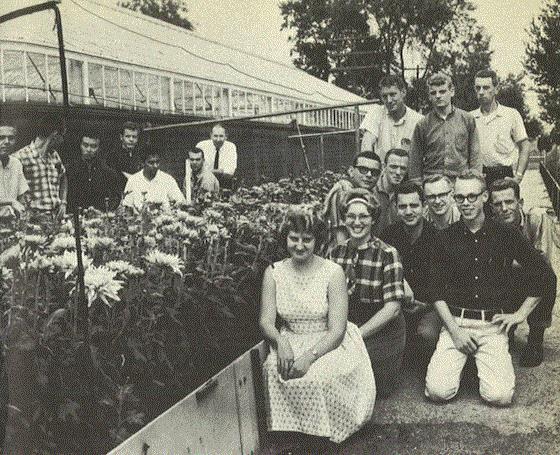
The DuPage Horticulture School class of 1964. Graduates still talk fondly about their experiences at the school. Now College of DuPage is recreating the concept.
When I moved to the suburbs of Chicago as a freshly graduated young writer, one of the first things I learned about in the lore of local (and national) horticulture were the important roles played by the College of DuPage in Glen Ellyn and the former DuPage Horticulture School. I've met a lot of DuPage Hort School alums over the years.
The DuPage Hort School was founded and operated by Ball Horticultural Company from 1963 to 1988. And the nearby College of DuPage has continued to turn out horticultural students over the years. But there’s a new program that gets a little closer to what the DuPage Hort School provided back in the day.
The College of DuPage just launched a new apprenticeship program that gives high school grads and young professionals a new way to earn an associate’s degree while gaining real-world experience. It’s a two-year program that includes four semesters of course work plus on-site paid apprenticeships at participating greenhouses over the course of two peak spring seasons.
Students who complete the course will earn an associate’s degree in applied science in horticulture, along with certificates in horticulture and greenhouse management.
But here’s the most alluring part: this program is free for the 16 students who will be chosen by the selection panel, an offer made possible by generous contributions from industry professionals. The only thing the students will have to worry about is transportation, food and housing on the College of DuPage campus.
“A lot of students are struggling to pay for tuition, books and fees, so this is a great opportunity for them to get a two-year degree basically paid for by the industry,” explained Brian Clement, department chair and professor of horticulture at College of DuPage. “This program is based off of the old DuPage Horticulture School model, which a lot of people in the industry are familiar with, and we're trying to bring that model back.”
Available to students in the U.S. and Canada, the College of DuPage is accepting applications now through December 4 for the Summer and Fall 2027 semesters. There are only 16 spots, so if you or someone you know will be graduating from high school in May or has one to three years of greenhouse experience and wants to pursue a career in horticulture, apply today!

Weeding with Lasers
While weed management may be one of the greater challenges of organic vegetable growing, Michigan State University and Oregon State University researchers are looking at how lasers might change that.
They recently received a $1 million grant from the U.S. Department of
Agriculture to pursue a four-year project exploring how to combine precision laser weeding with other organic weed management strategies, especially in relation to helping those transitioning to organic production.
“Organic growers rely heavily on cultivation and hand weeding, but repeated cultivation can disturb soil structure, reduce surface residue and stimulate additional weed emergence, while hand weeding is costly, labor intensive and increasingly difficult to sustain,” says Josh Miranda, assistant professor and MSU Extension specialist in the Department of Horticulture. “The overall goal is to better understand how laser weeding can help overcome weed management and labor challenges during the transition to organic production, reduce dependence on hand weeding, improve profitability, and make organic vegetable production more competitive, practical and scalable.”
They’ll be working with growers in Michigan and Oregon as they test laser weeding, develop integrated weed management frameworks and evaluate the cost benefits.
“Ultimately, we hope this can help growers successfully transition more acres to organic production and improve the viability and profitability of organic vegetable production in these regions.”
You can read more about the research in
this article from MSU.

Report from the MT Outpost

We’re solidly into what we call the shoulder season here at the Montana Outpost. Frosty mornings, golden grasses, sometimes frosted golden grasses. It’s the transition season: the month of soft golden light, however quickly it may wane.
The road to Yellowstone National Park has a long, vacant quietness to it these days, and seasonal businesses have shuttered for the long winter. But I’m stubbornly refusing to accept that this means our little rental cabin should be vacant. It’s a challenge: to convince folks they want to drive up into the mountains when the wildflowers aren’t springing up and it could snow at any time.
Last week, a photographer friend visited and I gave her the task of capturing the small vignettes that were a cozy vibe. Ignore the real estate photography. She nailed it. Partly because she understood the feeling: the value of slowing down, the lazy dog lounging, the words of a poem on an early November morning.
I like to think that I can take all my own photos, create all my marketing collateral, but here’s the reminder that a good artist can take it to the next level and bring a sense of authenticity to match.


Until next time,

Jennifer Duffield White
jwhite@ballpublishing.com
This email received by 26,841 loyal readers!
Want to be one of the lucky sponsors who reach those readers of GreenTalks? Drop Paul Black a line and he’ll tell you what a bargain it is!
GreenTalks® is a registered trademark of Ball Horticultural Company in the U.S.