New Audio Files Podcasts!
I uploaded two new episodes of Audio Files this week (the podcasts that are more like audiobooks, where I read articles you can listen to at your leisure.) Both are pretty timely (published in the November issue of GrowerTalks) and critical as we think ahead to 2027 bedding plant production.
Ep. 281 is an article written by Dr. Garrett Owen at The Ohio State University discussing ways to produce well-branched rooted liners based on research his team has conducted. Here’s an excerpt:
A well-branched finished plant starts with a well-branched rooted liner. Managing both stem elongation and lateral branching during liner production helps establish the plant structure needed for continued growth after transplant. A compact liner isn’t necessarily a well-branched liner and plants with limited lateral branching may require additional time, labor or PGR applications to develop the desired fullness during finishing. Therefore, growers should evaluate both young plant size and branching when determining whether liners are ready for transplant. Consider the following strategies when developing a branching program for rooted liners.
Ep. 282 is also focused on propagation, but from seed. Dr. Roger Styer is a long-time contributor on topics related to seed annual production—he even wrote our last Ball Redbook chapter on the topic. This month, he covers the stages of plug prop with best practices and expert tips for each. Here’s an excerpt:
A plug is a containerized transplant grown in the smallest container you’ll grow. That small size can quickly be affected by several factors that can either promote or inhibit germination, root and shoot growth. The goal of plug production is to produce pullable or transplantable plugs on time with a yield per tray of 85% or higher. Let’s look at those key factors in each stage of plug growth (Stages 0 to 4).

There are now more than 280 Tech On Demand podcast episodes (and more than 80 Audio Files) in the archive, covering a huge range of topics related to the professional greenhouse, garden center, landscape, nursery and CEA markets. Jump back in to get caught up or take a minute to subscribe—that way you’ll never miss an episode.
Editor's Note: Thanks to Prospiant Greenhouses and NurseryGuide.com (from Oregon Association of Nurseries) for sponsoring these episodes!

Koppert Corner: Scouting Cards are Not All Created Equal
Each month, I connect with my friend Heidi Doering, a technical services expert at Koppert, and she shares tips and technical information that she runs across during her many visits to client sites across the nation. This week, she’s explaining the importance of selecting the correct scouting cards for your specific needs.
Scouting cards are a technical product, and they're critical to effective insect pest monitoring. They're not all created equal, and the cards you choose can influence the accuracy of the information your pest monitoring gathers.
This matters when you hang cards as a visual reference of pest levels and base your IPM decisions on what you count, especially for thrips species. Hanging cards, returning to count them and then recording the results all cost time and labor. It's in an IPM manager's best interest to use the color and make of card that gives the most accurate weekly snapshot of pest levels in the crop. Below, I outline how cards differ and share links to some of the research on their various features.
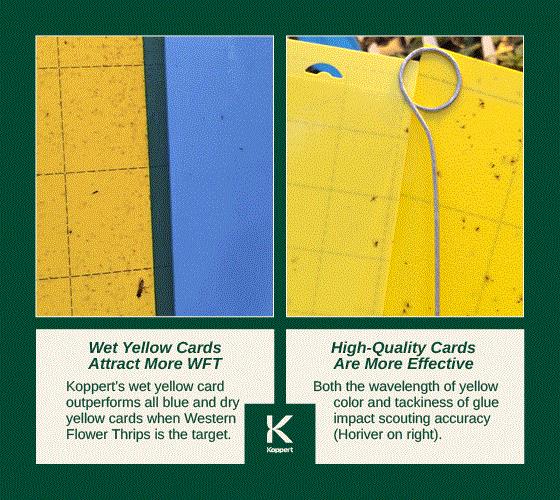
Scouting card design—what matters:
Wavelength of color. When visiting growers and scouting for western flower thrips (WFT) in particular, I’m most confident in thrips counts on Koppert’s Yellow Horiver Wetstick card, as it was specifically designed based on the wavelength of yellow that western flower thrips find most attractive.
Light reflection. A luminescent (reflective) glue has been found more attractive to WFT than a matte glue. The glue on “wet” Horiver cards reflects light and draws WFT to the card. Note: I typically see more fungus gnats on cards with a luminescent glue than a flat glue, so other insects may also be more attracted to a shiny glue.
Glue strength. Due to their morphology, WFT can fold their wings back and hold them out of range of a glue as they walk off a card. Neither thrips nor IPM techs love Koppert’s Wet Yellow cards, as the ‘Wet’ adhesive is the tackiest adhesive of any cards available. On the other hand, I’ve never seen a thrips walk off a Horiver card! Rollertrap works great for insect pests with large wings, but the less aggressive glue may not hold thrips securely enough.
Research has looked into the issues. The Royal Society reviewed a study on the wavelengths of color various thrips species were most attracted to. Scientific Reports looks at the haze/luminosity of glue on attractiveness to WFT.
The best way to determine the most accurate scouting card for your greenhouse is to try several in a side-by-side comparison test and see for yourself! Reach out to a Koppert IPM consultant for help setting up your own trial.

Josh’s Tip of the Week: Managing Humidity in Cold Weather
Usually I work with my buddy Nick Flax, a technical services expert at Ball Seed, to share a concern that’s come up during one of his numerous calls with growers across North America. This week, frequent contributor (and another member of the Ball Seed tech team) Josh Henry is taking over to share some timely info for your cold-weather greenhouse production.
PROBLEM: As seasonal temperatures decline and you keep your greenhouses closed to retain heat, humidity management becomes increasingly challenging. Excess humidity can lead to condensation on plant surfaces, prolonged leaf wetness, uneven temperatures and increased disease pressure. At the same time, excessive venting can waste energy and create temperature fluctuations.
JOSH’S TIP: Successful humidity management requires balancing heat, ventilation and air movement to maintain a favorable crop environment while minimizing energy costs and plant stress. Here are the factors you need to know:
Condensation. Relative humidity alone does not determine whether condensation will occur. Condensation develops when plants or greenhouse surfaces cool to the dew point of the surrounding air, which is the temperature at which the RH reaches 100%. During cool weather, glazing, structural components and crop surfaces can become cooler than the air, allowing free moisture to form on leaves. This creates conditions conducive to foliar disease development. Managing humidity is less about maintaining a specific RH and more about preventing condensation and subsequent leaf wetness.
Cool Weather. Warm air can hold more water than cool air. During the day, crops and substrate release moisture into the greenhouse through evapotranspiration. As temperatures decline overnight, relative humidity rises and the potential for condensation increases. Since greenhouses are typically closed to conserve heat during cool weather, moisture can accumulate inside the structure. Without adequate air movement and ventilation, the air can approach saturation by morning, particularly in cool, stagnant areas of the greenhouse.
Heat & Vent. Heating and venting may seem like opposing actions, but they can be effective when used together. Heating raises the air temperature and lowers relative humidity, providing an opportunity for moisture to evaporate from plants and greenhouse surfaces. Cracking the ventilation then exchanges the warm, moisture-laden greenhouse air with cooler outside air in a process often referred to as “burping” the greenhouse. Used strategically, heat-and-vent cycles can remove moisture while limiting the energy loss associated with leaving vents open for extended periods. Optimal RH targets depend on temperature setpoints, with RH increasing by about 2% for every 1 degree F drop in temperature.
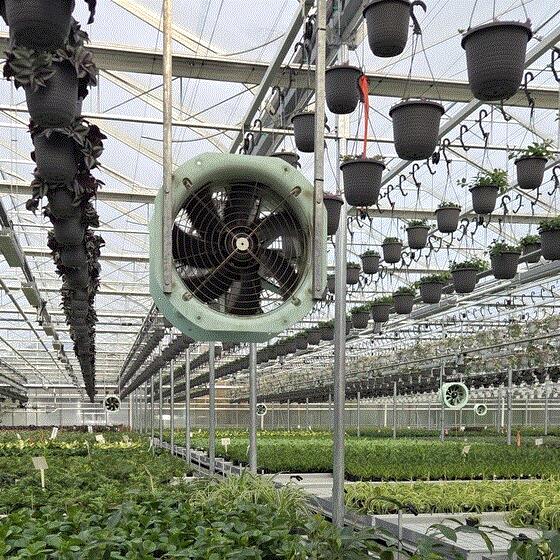
Horizontal air flow (HAF) fans help mix the air to distribute humidity.
Air Movement. Greenhouse climates are rarely uniform. Microclimates with cooler temperatures and higher humidity can develop near sidewalls, corners, doors, curtains and crop canopies. HAF fans help mix air throughout the greenhouse, reducing temperature and humidity differences between these areas. Consistent air movement also helps moisture evaporate from plant surfaces. However, HAF fans do not remove moisture from the greenhouse, so air movement needs to be combined with appropriate ventilation when moisture levels become excessive.
Crop Management. Environmental controls are only part of humidity management. Dense canopies, close spacing and excessive irrigation can increase humidity around the crop and extend drying time. As crops mature, airflow through the canopy can decline and foliage may remain wet longer after irrigation. Watering earlier in the day provides more time for foliage to dry before temperatures decline at night, while proper spacing helps improve air movement through the canopy and promotes uniform drying.
Energy Balance. The goal is not to maintain the lowest possible humidity. Excessive ventilation can increase heating requirements without necessarily improving crop quality. Instead, you should focus on preventing condensation and extended leaf wetness while maintaining reasonable energy efficiency. Combining sufficient air movement with appropriate irrigation timing and strategic heating and ventilation can help maintain a more uniform crop environment during cool weather.

More on Greenhouses in Cold Weather
I’m pretty sure we’ve all heard dad say (or said ourselves), “Close the door! What are you doing—heating the outdoors?” Well, Janeen Wright at Prospiant Greenhouses takes this one step further for an article in the November issue of GrowerTalks titled ARE YOU HEATING THE COUNTY? HOW TO REDUCE GREENHOUSE HEAT LOSS.

In the article, she lists 22 ways you can reduce greenhouse heat loss—22 ways! If you can’t find at least a few that require attention at your operation, I’ll be very surprised. Janeen writes that some of the biggest culprits are exhaust fan shutters and louvers not closing fully, gaps around roof and sidewall vents, drafty doors, poorly insulated foundations and cracks and seams in your glazing.
But potential heating inefficiencies can be related to all sorts of specific problems with each of those five areas, as well as malfunctions with technology like your heating system, sensors and environmental controls.
Janeen closes the story with eight long-term investments to consider that will lead to lasting energy savings. There’s so much great info in THIS ARTICLE. You definitely need to take some time to read it and share it with the decision-makers at your greenhouse.

Read PestTalks! JC Shares Tons of Timely Poinsettia Tips
With poinsettias coming into color and shipping season underway (yes, plenty of stores will have poinsettias next week!), this is no time to ease up on pest management. In the latest PestTalks e-newsletter, my fellow writer (but not-fellow entomologist) JC Chong offered a timely rundown in HIS LAST NEWSLETTER of what you should watch as finished plants come closer to heading out the door to your own retail or wholesale customers.
One of JC’s biggest reminders is to protect the bracts—something I’ve covered in this newsletter recently, as well. Even products you’ve used successfully before can cause phytotoxicity depending on cultivar, application rate or environmental conditions. His advice is simple. Test products on a small group before making a full application, especially once bracts have developed color.
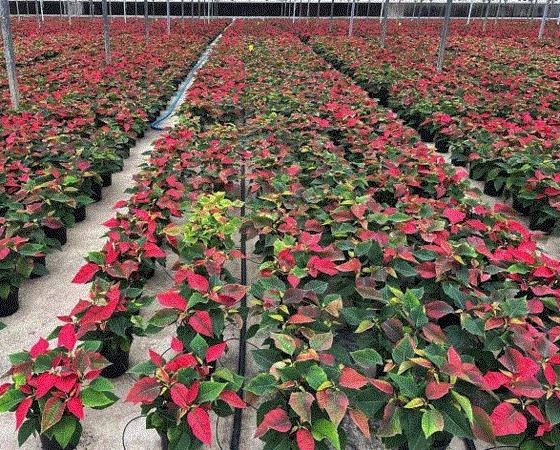
JC says the light green foliage can indicate Lewis mites
JC also covers late-season management of whiteflies, fungus gnats and Lewis mites, with specific recommendations based on how much time remains before shipping. At this stage, dense canopies can make spray coverage difficult, so product selection and application technique matter.
JC also hits on disease management, which can be a nightmare this late in any crop. He discusses Pythium, Rhizoctonia, Botrytis and powdery mildew—and shares fungicide recommendations for control. But his larger point is worth remembering: Once diseases have caused visible damage, treatments can’t restore plant quality.
If you’re finishing poinsettias right now, take a few minutes to read JC’s LATEST PESTTALKS NEWSLETTER. It’s packed with practical details that can help protect your poinsettias through shipping.

Finish Line ...
That was a lot of info so let’s keep this short and sweet. As you finalize plans for spring 2027, don’t forget to go back and review the industry’s absolute best coverage of California Spring Trials 2026. Your friendly neighborhood Ball Publishing Bobbleheads made dozens of videos, a week’s worth of newsletters, magazine articles and even a recap podcast during and following the event.
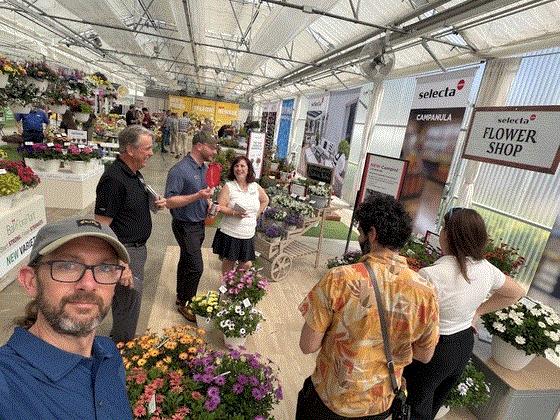
If you need to refresh on the cool new varieties to consider, ideas to change up your product mix or can’t quite remember what that new calibrachoa was called or the breeder it’s from—we have your back!
Talk to you next week!
Please feel free to send your comments, constructive criticism and topic ideas to me at bcalkins@ballhort.com.

Bill Calkins
Editor—Tech On Demand
This email was received by you and 25,394 other fine subscribers!
If you're interested in advertising in Tech On Demand, contact Kim Brown ASAP and she'll hook you up.