Growing With Sustainability in Mind
If you’re interested in how to grow your business with a focus on sustainability, you’re going to want to sign up for this upcoming webinar. Next Thursday (November 19), Sustainabloom and the American Floral Endowment is hosting a webinar featuring several employees from Metrolina to share their journey and how they decided to keep a focus on sustainability while growing their farm.
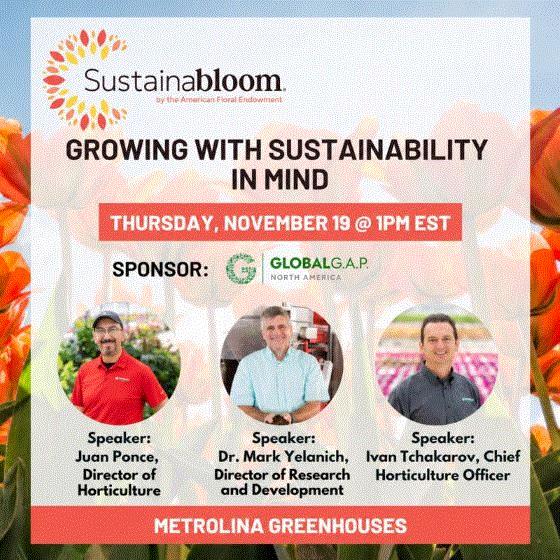
The panel consists of Dr. Mark Yelanich, Director of Research & Development, Juan Ponce, Director of Horticulture, and Ivan Tchakarov, Chief Horticultural Officer, each dedicated to sharing their personal stories and what they learned along the way. Plus, they'll talk about how sustainability fits into their day-to-day operations.
Some key takeaways you'll get:
-
Learn how floriculture growers can start with manageable sustainability practices and build on them over time
-
Hear lessons from a grower about what has worked (and what didn’t) and how sustainability fits into everyday decisions
-
Identify ideas and next steps that growers can adapt to their own operations, from simple changes to more advanced strategies and certification
Register for this webinar HERE.

IPPS Recap: The Conference
Martha Vilchez is an MS student in environmental nursery production lab at the University of Florida. Martha has been working with me for about three years between my time at UF and LSU and is finishing her program next month. As an IPPS veteran, I thought Martha would be a perfect candidate to give an update on the conference:
Returning to IPPS for the second time, this year in Houston, felt different in the best way. I got to reconnect with growers I met during my first meeting last year, meet new people and feel a little more at home in the conversations.
There was something interesting to take away from every talk, but three especially stayed with me. After spending the past two years researching sugarcane bagasse as an alternative substrate component, I was particularly drawn to the presentations on root development, substrate history and fertigation. They connected closely with my research while giving me a better understanding of how growers approach these topics in everyday production.
Dr. Kris Criscione’s presentation, “Integrated Container Rootzone Management for Improved Root Growth and Development,” reminded me of the importance of looking beyond shoot growth when evaluating plant performance. His research on cyclic irrigation showed how dividing daily irrigation into smaller applications can encourage root development, even when differences above the substrate are less noticeable. I particularly liked his practical message that growers who can't use cyclic irrigation throughout production may still benefit from using it during establishment. His discussion of wetting agents and ongoing research on auxin applications also showed how much more remains to be explored in managing established root systems.
Dr. Brian Jackson’s talk, “History of Substrates in the U.S. Nursery Industry,” was especially meaningful to me. Through historical photographs and publications, he explained how containers and growing media evolved together as growers transitioned from field soil to soilless production. Learning that sugarcane bagasse and other alternative materials were being investigated decades ago gave me a broader perspective on my own work! It reminded me how much progress we can make by just revisiting past materials with better research tools and a clearer understanding of their management requirements. And also that the internet doesn't have it all!
Seth Peed’s presentation, “Fertigation/Chemigation—Principles and Techniques,” reinforced that an effective fertilizer program begins with understanding the irrigation water. His discussion connected water quality, pH, alkalinity, irrigation uniformity and injection equipment. One point that stayed with me was that uneven water delivery also results in uneven delivery of injected nutrients. This related closely to my research on nutrient availability in substrates and emphasized that choosing a fertilizer concentration is only one small part of managing plant nutrition.
These presentations helped me see my research within the broader context of nursery production. They also reinforced what I valued most about IPPS: The opportunity to connect research findings with growers’ experiences. I left with new ideas, a greater appreciation for the history of our industry and a better understanding of how research can support practical improvements in production.

IPPS Recap: Tours
Alexis Hansen is an undergraduate student in Plant Sciences at the University of Florida and an aspiring nursery operator. She's been interning in my environmental nursery lab for the past year and had the chance to go to IPPS Southern Region Conference in Texas a few weeks ago. This is what Alexis had to say about the tours:
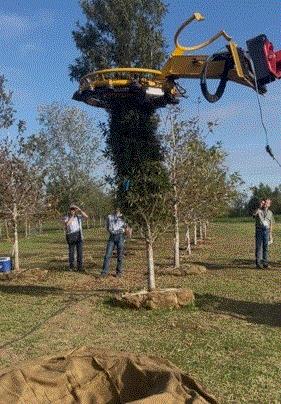
The first day of tours started at Everde Growers at their Glen Flora Farm, which primarily grows a variety of trees. At Everde, we talked about some strategies they were using to increase automation. Their automated pruners were one of the biggest time savers they've found in automation. They also transplanted large trees in 45-gal. containers on site using mulchers, rather than transporting them across the nursery.
Our second stop was at Greenleaf Nursery in El Campo. While on our hayride around the nursery, we drove between shadehouses and saw tropical plants and broadleaf evergreens.
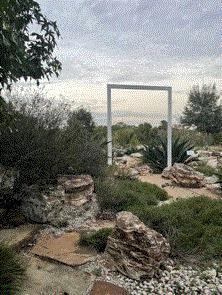
We ended the first day at Houston Botanical Gardens, which is a new garden that was formerly a golf course. Here they had an emphasis on education and had signs about different parts of the garden everywhere.
On day 2, we started the day at Twinwood Farms where we walked through their above-ground container trees and drove past their sod farm before watching how they prepare their in-ground trees for shipping. While at Twinwood, we also learned about another project the owner was working on called Wildtree, where he ships trees for improving wildlife habitats to attract deer.
Our second nursery of the morning was Creekside Nursery in Waller County. Creekside Nursery was a large property that had been divided into three sections; each section could function independently from the others. They had trellises throughout their container trees to prevent them from tipping. At Creekside, one thing they seemed very proud of was the tenure of their employees.
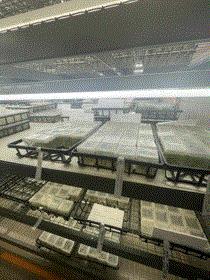
In the afternoon, we toured Magnolia Gardens Nursery. We started at the tissue culture lab and learned about their propagation, liner shipping and protocols for successful pest- and pathogen-free tissue culture propagation. Tissue culture allows them to produce more plants with a higher success rate than using traditional propagation methods. Recently, they've been working on being able to produce citrus liners to replace trees infected with Citrus Greening disease. Across both days of tours, I noticed that most places were using acid injections in their water.
Overall, the tours were an interesting opportunity to see how different productions were managing the same challenges in growing plants and innovating to create better plants more efficiently.

New Horticultural Apprentice Program
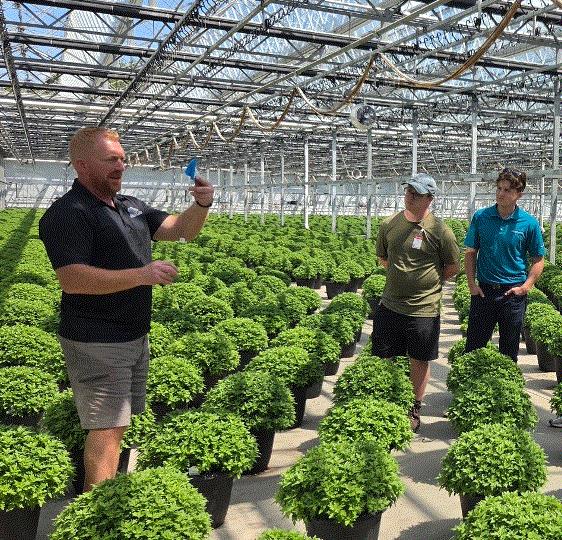
Here's a great new opportunity for young professionals and high school students interested in the ornamental industry. The College of DuPage has announced a program that lets students earn an associate’s degree while getting hands-on, real-world horticulture experience.
The DuPage Horticulture Apprenticeship Program is a two-year course that combines four semesters of classroom-style education during the summer and fall, with paid work opportunities with participating greenhouse operations during the spring. Students who complete the course will also earn certificates in Horticulture and Greenhouse Management. What a great opportunity for those interested in furthering their education, but seeking a hands-on approach.
Even more great news, the program is free for the 16 students chosen for scholarships. The only thing students need to provide is transportation, food and housing. While working in the greenhouse or nursery, housing will also be provided in addition to a salary.
Dr. Nathan Jahnke, culture research manager for Ball and one of the industry members involved with this program, said that horticulture college programs typically require classes during the spring—the best time to earn experience. And it’s challenging to find work in a greenhouse during the summer after the peak season. This apprenticeship program helps students work around that.
The College of DuPage is located in Glen Ellyn, Illinois. This program is available to students in the U.S. and Canada. Applications for upcoming semesters are open through December 4.
There are only 16 spots, so if you or someone you know will be graduating from high school in May or have one to three years of greenhouse experience and want to pursue a career in horticulture, apply today!
More information can be found HERE.

ProGreen Expo Program is Live
This past February, I was able to fly to Denver, Colorado, and participate in the ProGreen EXPO. It was my first time at that show and I had a blast. Such a fun environment and great attendance at my talk (also others)! I remember getting so many good questions that it stuck with me. While I won't be going this coming year, I still think it's a great opportunity for folks in our industry, especially if you’re in the Mountain West area.
For a regional show, the education sessions of ProGreen are incredible—seriously, I think I counted over 100 different educational sessions. I know I say this a lot, but you can definitely find something here for everyone. I really suggest bringing your team here and letting them hit the education sessions.
On top of the standard education sessions, the keynote presentation is a topic I think we can all associate with: How to stay inspired when you’re so darn tired, by Christine Chasen. Christine is an award-winning speaker and author who's energized audiences with her talks for decades. I’m sure we can all use some inspiration to keep focused during this delightful fall weather that makes it so easy to forget work and go outside and have fun. Not that I'm speaking for myself in any way ...
Check out more about ProGreen’s educational program HERE.


Think big,

Jeb Fields
Editor-at-Large
Nursery & Landscape Insider
This has been received by 31,202 of the hardest-working horticulturists in show business!
If you're interested in reaching more than 31,000 readers who eagerly await every Nursery & Landscape Insider (and surely read every word!), contact Kim Brown ASAP and she'll hook you up.