11/15/2008
Easter Lilies: Target Date April 12
Bill Miller
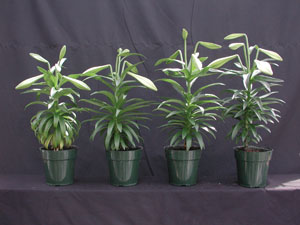
Easter 2009 is April 12 and is considered a medium Easter date. The following dates apply for proper timing: planting, mid-December; emergence, January 5-10; flower initiation, January 20-24; and visible bud on March 2. If earlier scheduling and/or cold storage is needed, Fascination applications are essential.
The most important technique to flowering Easter lilies is the six-week cold-moist vernalization period. Vernalization causes the Easter lily growing point to become reproductive earlier after the warm forcing temperatures begin. An overly lengthy vernalization can reduce both flower count and the number of leaves on the plant. Maintain a soil temperature of 62 to 63F (16 to 17C) until emergence. Use leaf counting until visible bud, then rely on a bud stick to time until flowering. Graphical tracking is an essential tool for following height and plant development.
Depending on your schedule, you may have an opportunity this year to increase bud count with a mid-January temperature manipulation. Bud initiation typically occurs the third week of January when leaf counting begins. Reducing greenhouse temperatures during flower bud initiation (about January 15-25) can result in more buds. Night air temperatures of about 50F (10C) with 60F (15C) days for seven to 14 days during flower initiation are effective for increasing bud count.
Fascination
Fascination, a 1:1 mixture of gibberellin 4+7 (GA4+7) and benzyladenine (BA), is labeled by Valent for the prevention of greenhouse or postharvest leaf yellowing. Fascination is used widely on lilies, and most North American crops are treated with it. It results in significant improvements in postharvest quality by reducing leaf yellowing and significantly improving flower longevity. Both effects are almost completely due to the GA component of the product. Recipes for the preparation of Fascination sprays are given in Table 1.
The problem with Fascination is that the gibberellin that retards leaf senescence and improves flower longevity also causes stem elongation. This happens when the GA is applied when stems are actively elongating. Since Easter lily stems elongate throughout their development, Fascination can lead to unplanned elongation when applied to Easter lilies.
Other Important Tips
Maximize light levels. Easter lilies are a high-light crop.
Avoid strong negative DIFs, which can result in leaf yellowing. The best approach is a constant day/night temperature, giving a zero DIF, thereby reducing stretch to a large extent.
Sumagic sprays are effective for height control in the 3 to 10 ppm range. Use a 2 qt./100 sq. ft. spray for best uniformity.
Watch carefully for ethylene. Both continuous exposures or short-term events can cause flower abortion and injured growth.
Lily postharvest performance is maximized by fertilizing up to the point of sale. A final leaching to remove salts is OK, but do not terminate fertilizer early, as is done with mums and poinsettias.
If cold storage is necessary, time the last Fascination application to be within two weeks of the start of storage. Earlier applications are less effective. Whole plant sprays just prior to cold storage do not cause stretch.
Bill Miller is a professor of horticulture at Cornell University.