3/30/2015
Feeding The Need
Jennifer Polanz
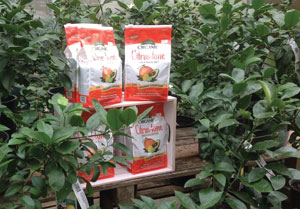 Pictured: Cross merchandising plant food formulations with their corresponding plants will not only boost sales, but help customers be more successful in the garden.
Your customers clamor every year for beautiful plants in a vast array of colors, shapes and textures. But what about the stuff that keeps those plants healthy and happy? With the vast majority of customers only claiming to be casual gardeners at best and completely uninterested in “gardening” at worst, they’re most likely skipping over some vital elements of plant care.
So how can garden retailers keep their customers successful? Fortunately, the plant food category has more options than ever before that retailers can offer to consumers. That, however, can be a double-edged sword.
Going Green
In all the interviews I conducted for this story, everyone had the same take: organics are a growing portion of the plant food segment. More companies are getting into the mix and there are formulations for every type of product, from edibles to roses, perennials, annuals, houseplants and more. According to Ann Molloy of Neptune’s Harvest Fertilizer in Gloucester, Massachusetts, consumers are driving the trend of more specific formulations.
“Feedback we’re getting from garden centers and trade shows is that the requests are coming from consumers,” she says. “People are talking in chat rooms about things they’d like to see. We pick up on that and say, ‘Hmm, maybe we can fill this void.’”
Her company piggybacks with Ocean Crust Seafood to take the remnants of the fish being filleted and process it into organic fertilizer. They’ve been doing it since the 1980s, a time when there were very few people in the organic plant food market.
“Now it’s huge—it’s a consumer-driven thing. Consumers come in [to the garden centers] looking at organics and now the demand is huge. They’ve been forced to start looking at the products out there.”
John Harrison of Espoma Co. agrees. His company has been around even longer in the organic market—for 86 years, to be exact. He’s been around the industry for 31 of those and has seen organics ebb and flow through the years. But this time, it’s different.
“It sure feels real this time,” he adds. “We see just about all new product introductions from companies into the field are in the organic area. It continues to be a hot trend.”
Niche products are surging, according to John Jordan, product marketing manager at Winchester Gardens. Product like effervescent tablets, fertilizers with live organisms and soil amendments as fertilizer are just a few. Winchester even recently introduced Fairy Dust Fertilizer as a way to use an existing trend (miniature gardening) to create a unique product in the marketplace.
Chance Finch, general manager of Nature’s Source Plant Food, says the niche of organic plant food has been averaging around a 10% to 12% growth over the past few years and continues to gain steam.
“I believe growers and consumers alike are demanding organic/sustainable plant foods/fertilizers,” he says. “Less chemicals into our environment and bodies.”
The Double-Edged Sword
While more formulations helps vendors and retailers sell more product, they also can be confusing to the inexperienced gardener. That’s where things become tricky. How can vendors and retailers help consumers navigate the plant food aisle?
My sources had a couple of key tips. “Simplifying their plant food category—i.e., fewer products on the shelf—will help consumers,” notes Chance. “I believe fertilizers have become too complicated for consumers simply because there are too many options.”
Another hurdle becomes education. Staff members need to be trained before they can make recommendations to customers, John says. Espoma offers a free certified dealer program, which is an online video training on various categories, plant foods and lawn foods. The videos are less about specific Espoma products and more about the ins and outs of organic plant food. Currently, more than 700 stores are certified with upwards of 1,200 associates trained. Any retailer who carries Espoma can find the training in the dealer portion of the website.
“Training and giving staff the knowledge about plant food builds confidence,” John adds. “They’re going to sell more product for you if they’re confident. They may not be willing to engage a customer in conversation if they don’t know much about it. If you train them, they’ll do so with confidence.”
Product Placement
The wall of products, while easy to merchandise, is not what’s going to help sell plant food. It may be one aspect of merchandising, to give consumers one spot to find what they need, but cross merchandising is essential, particularly for product-specific formulations like, for example, rose food or houseplant fertilizer.
“You need to merchandise with the live goods so they get that message,” John emphasizes. “You make more sales, which is always good, but it helps the gardener who takes the plant home be more successful. The gardener who gets good results is going to keep coming back.”
And as Chance said earlier, reducing the amount of products and streamlining the category makes it easier for consumers to make their choice.
“I feel we create complexity for consumers by trying to fill shelf space in the fertilizer category. I’d recommend choosing your vendor partner(s) and limit your offerings,” he reiterates. “Fewer partners will help the garden center dial-in with their partner to focus on education.”
GP