12/1/2024
What Consumers Really Want
Wendy Komancheck
=
Natives and nativars—or native cultivars—have made headlines over the years and not always in the positive. But growers, breeders and garden retailers—spurred on by continuing consumer demand—have found room in the residential landscape for both natives and nativars that attract pollinators and other wildlife, as well as meet the homeowner’s needs.
The research team at Mt. Cuba Center near Wilmington, Delaware, studies native plants and their cultivars for “horticultural and ecological value, highlighting the ecosystem services native plants provide.”
I talked with two researchers there, George Coombs and Sam Hoadley, about their native and nativar trials, including plants that will be going to market in 2025. They both agreed there are examples where nativars could work better for the homeowner’s needs.
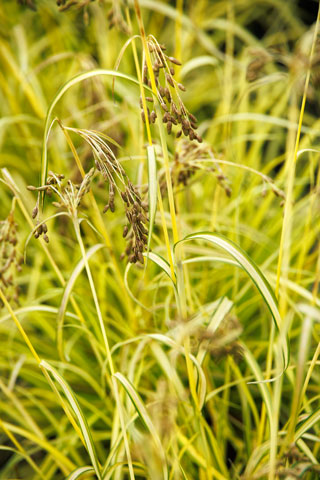
Pictured: An example of a nativar, Stars and Stripes bullrush (Scirpus pendula) from Monrovia sets off fireworks-like clusters of flowers in the summer and is adapted to seasonal flooding and mild drought. Photo courtesy of Monrovia.
For example, gated communities and Homeowners Associations (HOAs) may have strict rules concerning natives and nativars are a compromise to the debate.
“In many cases, they’re a little more compact,” said Sam. “The color might be a little more vibrant; there’s less disease. These plants are less wild.”
I also talked to Wyatt Page, assistant garden center manager at Gill Garden Center & Landscape Co. in Corpus Christi, Texas, who noted, “You don’t have to plant your entire landscape in [nativars], but you mix in true natives that you like with some of the nativars and even non-landscape plants. I think it makes it a lot better for homeowners who … have smaller spaces to landscape in. And a lot of times that works great.”
Native and Nativar Education
Everyone agreed that educating your residential customers about the benefits and uses of natives and nativars for their landscapes is essential. It can also help you dig a little deeper into why customers are interested in them.
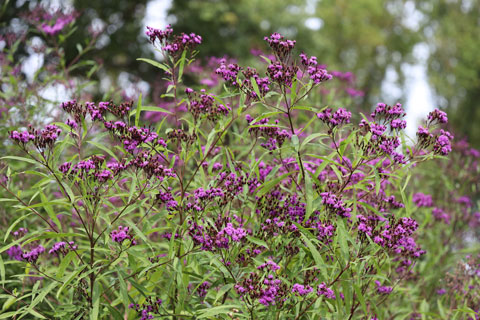
Pictured: Native to portions of the Mid-Atlantic, Midwest and South, Vernonia gigantea, or giant ironweed, can be a challenge at 10-ft. tall, but its late summer and fall blooms are a major attraction to pollinators. Photo courtesy of Mt. Cuba Center.
George from Mt. Cuba Center said, “I think in-person workshops are great. One of the things I found really compelling when I was learning about native plants several years ago was understanding why people cared about them.”
Wyatt gives talks and hosts educational events about natives and nativars consistently at Gill’s.
“I gave a talk in September about native alternatives for common landscape plants; it’s a great way to show people plants side-by-side. Here’s an Asian jasmine groundcover. If you want to plant something that will be a lot more beneficial to pollinators, here’s Frogfruit,” he explained.
One of their regular education events is a native tree workshop in November. “We try to get a bit more specific—sometimes not just a broad spectrum of natives, but the kind you can take action on,” Wyatt said.
I reached out to Katie Tamony, CEO and trendspotter from Monrovia, to get her take on natives and nativars, and she told me workshops, webinars and other ways of getting customers to participate in native plant education are essential for garden centers to embrace. “Education starts with store staff responding to a customer who asks, ‘Where are your native plants?’
“Before directing them to a display, take the opportunity to explore what interests them about natives because they may be most interested in perceived features of native plants,” she added. “An example of exploring and educating may look like this: ‘What interests you about natives?’ ‘When you say native, do you mean waterwise? Climate appropriate?’ Let the customers’ response help you identify what they need. Also, be aware that native plants bring out passionate perspectives and debates, and be prepared to have your definition of what you at the garden center consider native.”
 Another great way for garden centers to highlight these beneficial plants is to plant natives and nativars in their landscapes so customers can see them in their natural habitat. Customers can experience how they mature throughout the growing season and imagine those plants in their gardens.
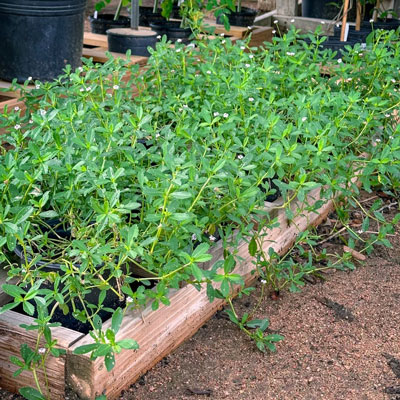
Pictured: The team at Gill Garden Center & Landscape Co. often puts natives side-by-side with ornamental options to let customers choose. For example, this Frogfruit (Phyla nodiflora) as an option for groundcover. Photo courtesy of Gill Garden Center & Landscape Co.
Information with Every Purchase
We often talk a lot about natives and nativars on the East Coast and Midwest, but the Southwest has unique needs, and that’s why I contacted Esmeralda Rubi Carrasco, COO at Ponderosa Cactus in Tucson, Arizona. Since Arizona’s climate is more arid, she weighed in about substituting cacti and succulents for those Midwestern favorites. Additionally, Arizona has monsoons and dry seasons, but it’s not the same climate that the “Midwest winterbirds” who flock to Tucson experience back home.
“We have different events throughout the season, so now it’s fall time and we do succulent workshops,” Esmeralda said when I interviewed her in October. “We create dish gardens, but in the process, we make sure that’s a learning opportunity and we’re focused on pushing out all of the information possible so they (attendees) will know exactly how to take care of their plants.”
Esmeralda and her team hands out brochures on sustainable gardening with natives and nativars when customers buy their cacti and other landscape succulents, making sure they understand the benefits of what they’re buying. But the discussion starts before the purchase.
“We have a full conversation with our customers when purchasing a plant,” she noted.
The team at Ponderosa Cactus asks their customers questions like:
Where are you planting this plant? How does it fit in your landscape?
Where is it going (in the garden) and what is that location’s sun’s orientation?
How frequently are you willing to water the plant?
“We try to get all of that information so that we’re giving the right information to them to take care of it because the last thing we want—and this is in our values—is having a dead plant coming back to us just because we didn’t give the information that allowed the customer to take care of it properly,” Esmeralda explained.
Esmeralda not only is well-versed in the local natives and nativars, but she also has a master’s degree in landscape and a doctorate in business, which allows her to be a knowledgeable consultant to HOAs and to provide in-home consultations.
Many winterbirds, as Ponderosa affectionately refers to people from the Midwest who head south for the winter, don’t understand that the plants they use at home aren’t waterwise in Arizona. She noticed that many customers still want crepe myrtles, which are water hogs in the Southwest desert. She advises HOAs and their homeowners on what plants are waterwise and which do not conserve water, and in the Tucson area, at least, the HOAs are receptive to natives that conserve water.
“I work with a lot of HOAs and I try to help them with their plant list. They (homeowners with crepe myrtles) can have it in a potted container. And a lot of people do end up potting their high water usage [plants] in a container,” Esmeralda said. “So with HOAs, they don’t care too much about what’s in the containers, but they do care about what is in the ground and what the different water usage is right then and there.”
Nativars: What Works and What Doesn’t
Sam back at Mt. Cuba Center said native cultivars work better in a formal garden than in a naturalistic setting because of their more controlled breeding.
“I do think cultivars make sense based on where you’re planting them. It’s not everywhere, but maybe in the more formal, traditional landscapes, cultivars have a place. And we find that even if cultivars, in some cases (not all) might have less ecological value than the straight species or the wild type plants,” said Sam of the nuance with nativars. “It’s generally not a black-and-white conversation of all or no value. Sometimes cultivars have a little bit more, or they’re more or less equal, but a native plant is a positive addition to the landscape.”
 It also goes back to the consumer’s use of the plant. Nativars can be mixed in with natives to provide ornamental value while the natives handle the wildlife needs.
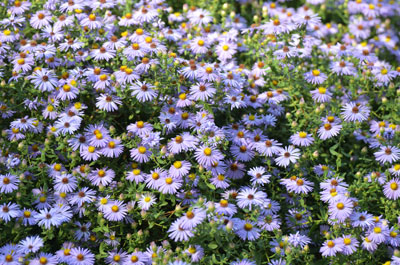
Pictured: Twilight Sky aster (Symphyotrichum oblongifolium) is a native plant that throws out hundreds of lavender blooms with yellow eyes for pollinators to enjoy in the fall. Photo courtesy of Mt. Cuba Center.
For example, George discussed the double-flower coneflower (Echinacea purpurea) and the density of its flower petals. However, this cultivar lacks floral parts that provide nectar and pollen, making it more beneficial for ornamental use than for wildlife.
“A lot of cultivars are not that [lacking in floral parts], but people should be paying attention to these differences,” he explained. “When looking at native plants and planting them for wildlife, you want to be careful about why that cultivar was selected.”
Wyatt explained that in Texas, many native plants look messy in the wild and homeowners don’t necessarily want that in their gardens. Instead, the cultivars Gill sells, such as a Texas sage cultivar that stays close to the ground with green foliage and a growth habit of 4 ft., still attract pollinators. Comparatively, wild Texas sage (Leucophyllum frutescens) can get up to 8-ft. tall.
The Texas sage nativar (Leucophyllum langmaniae Lynn’s Legacy) blooms heavily and is a butterfly host. Wyatt said the Texas nativars don’t always do quite as well as native Texas sages regarding pollinators, though.
“You can still have some of the benefits to wildlife, but it will also make it an attractive landscape. You have brighter colors and blooms, which many people want,” he explained. “You don’t have to plant the entire landscape in that, but you can mix true natives with some of the nativars and even non-landscape plants.”
Katie from Monrovia summed it up best when she said, “Knowing what benefit the gardener is looking for opens up a wider selection of plants and supports biodiversity in the garden. That wider selection can help meet their specific needs and help them feel more successful.
“The most important thing we can do is reassure gardeners that planting gardens with climate-appropriate plants—both native, nativar and non-native—is a great contribution to the environment.” GP
Wendy Komancheck owns The Landscape Writer and is a proud Garden Communicators International member. She writes for green industry trade magazines and content for lawn care, landscape and gardening services. You can email her at wendy@landscapewriter.com.