11/28/2025
Creating a Plug Bar
Benjamin Futa
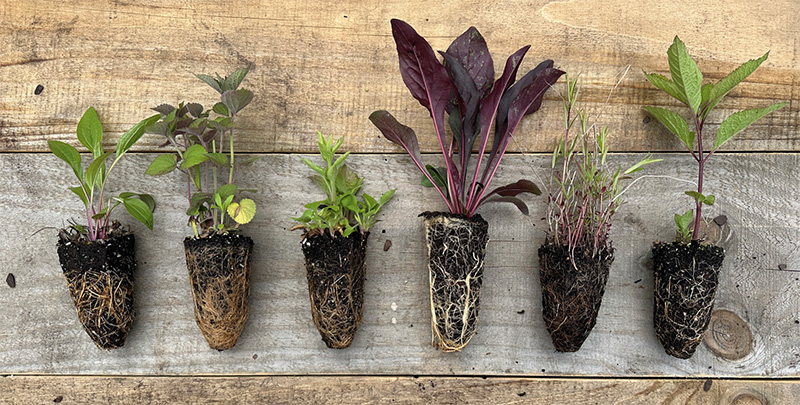
The Botany & Co. Plug Bar debuted in 2025 after several years of incubating a successful pop-up sales model. The idea grew from my early work with landscape-ready perennial plugs in public gardens, where I experienced firsthand how plugs could quickly and affordably establish thriving plant communities with a fraction of the inputs.
Bringing that approach to retail aligns with our mission today to empower more people to grow more plants in more places—offering gardeners an accessible, sustainable and professional-grade alternative to traditional 1-gal. plants.
The Shopping Experience
This is where the nuance of brick-and-mortar retail truly comes into play. In 2025, we spent the season observing customer behavior and fine-tuning how shoppers interact with the Plug Bar—especially since most had never encountered plugs before. Simple instructional signage and a demo tray helped demystify the process, while reused and resized 32-cell trays proved to be the “Goldilocks” packaging: substantial enough to showcase the plants, but compact and easy for customers to handle. With clear signage and consistent packaging, most shoppers navigated the bar independently—asking not how to buy, but what to plant where.
We’ve found the greatest success by curating plug offerings around phenology—what’s blooming or relevant right now. Our approach is simple: If a customer has a gap in their garden, anything available on the Plug Bar will help fill it. This strategy keeps the selection intuitive and timely, especially since plugs aren’t always visually descriptive of their mature form. Some of our best-sellers have been monarda and penstemon in spring, allium and liatris in summer, and asters and goldenrods in fall—each season offering plants that connect directly to what gardeners are experiencing in real time.
The Power of Display Gardens
If space allows, a small display garden can be one of the most effective sales tools for plug programs. Even planting just a few representative species near the retail area helps customers visualize growth habits, mature size and companion pairings—bridging the gap between tray and garden. At our shop, we’re developing a 6 ft. x 70 ft. border adjacent to the retail space, along with lush plantings outside our gates that visitors walk through on arrival. These living displays do double duty: they educate, inspire and consistently drive plug sales.
Education has been a powerful driver of plug sales for us. Our Lawn Conversion Workshops, held each spring and fall during prime planting seasons, rely heavily on plugs for success—and attendees consistently become our most engaged Plug Bar customers. The connection is clear: when people understand why and how to use plugs, they feel empowered to take on larger, more ambitious planting projects. Knowledge translates directly into confidence—and confidence drives sales.
The Important Questions: Price vs. Time vs. Profit Margin
“How much is instant gratification worth to you?” became a common question at the Plug Bar this year. The decision between gallon plants and plugs ultimately comes down to price and patience. While our gallon plants start at $15 and climb to $25 to $30 (or higher for specialty selections), plugs retail at a flat $5 each—with costs averaging $1.70 to $2.30. That pricing delivers strong gross margins of 57% to 64% and simplifies the buying experience: every plug, every time, $5. By comparison, our gallon margins hover around 50% to 53%—acceptable, but less efficient, especially in a market resistant to higher price points.
Considering Broader Impact
Let’s imagine a customer visiting with $50 to spend.
They could purchase between two to three 1-gal. plants within our current pricing structure above (at a 50% margin). In contrast, they could purchase 10 landscape-ready plugs at a higher margin. It’s a win for both parties—the business and the customer.
This seemingly simple adjustment increases our impact as garden retailers by a factor of three to five. This is literally empowering more people to grow more plants in more places, in action.
Maximizing Square Footage
From a sales-per-square-foot perspective, plugs outperform traditional gallons by a wide margin. A 1-gal. plant retails around $15, with roughly four fitting per square foot—about $60 in potential sales at a 50% margin. By contrast, 16 plugs fit in the same space at $5 each, generating $80 per square foot and a higher 57% to 64% margin. Combined, that efficiency makes plugs up to 70% more profitable on a per-foot basis. They’re also easier to handle, faster to price and simpler to stock—key advantages for any high-turn retail environment.
Another often-overlooked advantage of plugs is risk management. Losses are inevitable in live plant retail, but when a plug fails, we’re out $2 instead of $6 to $10 or more for a gallon plant. That smaller unit cost cushions the impact of inevitable shrink and makes it easier to experiment with new varieties or display formats without fear of major loss. In short, plugs lower both the financial and emotional stakes of plant retailing—an efficiency that adds up over time.
Furthermore, plugs that aren’t moving as fast as you need them to can always be potted up into gallons. Yes, this takes more time and resources, however, in about six to eight weeks, you’ll still be able to sell that gallon at a higher price point and (in theory) recoup those costs. In this way, plugs offer two opportunities to sell the same plant.
Offering Plugs Online
Adding plugs to our online shop has been a game-changer, allowing customers to essentially build their own garden kits and shop with confidence. E-commerce solved early season challenges around inventory visibility and care questions, while also letting us showcase compelling photos of mature plants—overcoming one of the few (minor) drawbacks of plugs: their modest appearance at point of sale. Each order is assembled to specification for quick, convenient pickup and the format has proven to be a hit. Online retail also gives us flexibility for seasonal flash sales and clearance events, helping us manage inventory transitions smoothly through the growing season.
Retail-Ready Stock
Not all plugs are created equal. Through trial and error, we’ve found the best success with 32-cell trays—dense enough for efficiency, yet substantial enough for strong root development and shopability. When sourcing from wholesale growers, look for descriptions like “landscape-ready”—these are effectively retail-ready plugs with the roots and durability needed for customer handling. Many growers cut back their plants regularly to promote root growth, which actually works to our advantage as retailers: those firm, hardened stems act as natural “handles,” making it easier for customers to lift and shop without damage. Stonehouse Nursery in Berrien Springs, Michigan, grows some of the best plugs for retail in our region.
Most garden centers are already familiar with plant patents and royalties, but it’s worth underscoring how they apply to plugs. When you purchase a patented plug from a wholesale grower, the royalty is paid at that point—you don’t need to collect it again from retail customers. We also make it a practice to tell our growers that our plugs are destined for retail sale; this transparency helps them flag any varieties that aren’t suitable for plug-format retail or adjust orders as needed.
Making the Case
I believe selling landscape-ready plugs in brick-and-mortar retail settings represents a massive and untapped opportunity for garden retailers, especially as the demand for native and climate appropriate plants increase and people continue to search for affordable, attractive and successful methods to replace conventional lawns with something better.
The product exists, the market exists, the demand exists—what’s lacking are the spaces. If you own a brick-and-mortar retail space, I hope you’ll consider adding plugs to your product offerings for 2026 and beyond. And I’d love to hear about your experiences, too, and I’ll keep sharing forward what we’re learning. GP
Benjamin Futa is Founder and CEO of Botany & Co., a retail garden center in South Bend, Indiana. He can be reached at ben@visitbotany.com.
Want to learn more and ask questions? GO HERE to sign up for Ben’s webinar on the topic!