11/28/2025
Creating the Oasis
Jennifer Polanz
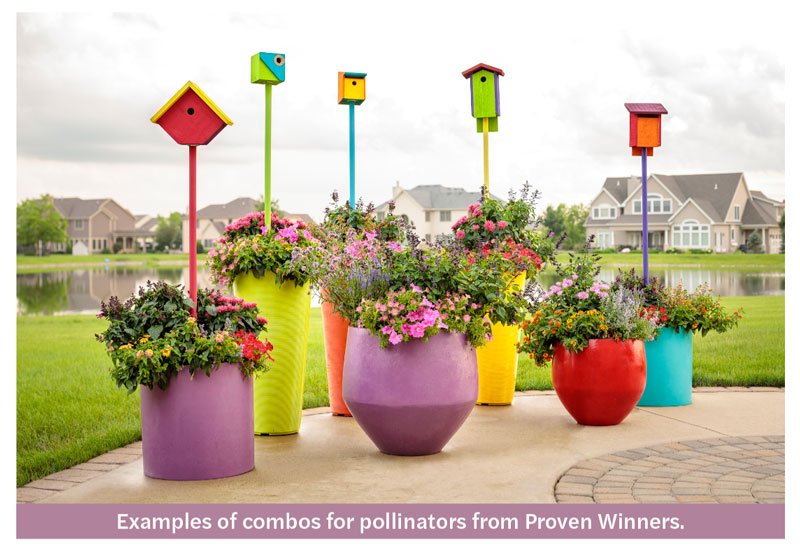 Protect pollinators through plants. It’s one of the best messages we have in our industry to encourage planting diverse ecosystems that help the environment. And it’s one that continues to resonate throughout the country, resulting in increased perennial sales with a focus on native plants and cultivars. Our industry has an opportunity to broaden the discussion to include more plants and all the components needed to create a healthy, beautiful ecosystem for pollinators. Here we’ll talk about lots of plants, as well as add-ons to create a supportive environment and promotions that can bring more people into the mix, all to help build on the success you’ve already had with this category.
Katie Tamony, Chief Marketing Officer at Monrovia, has been watching this movement grow for a while.
“Our research that we do with consumers—and we really do a lot of in-depth research every year—just continues to show interest in pollinators across ages, across demographic groups,” she said. “It’s a macro trend that just continues to grow, which is great. And within pollinators, you know, it started with the bees, but we’ve really seen an interest in hummingbirds increasingly as a sort of unsung pollinator that’s getting more attention.”
One of the beautiful things about this topic is all the different ways people find their way to creating habitats for pollinators. There was a story in October in The New York Times about a Bee Festival in Wichita, Kansas, and it quoted an operations specialist for the U.S. Army Reserve, who began keeping bees after hearing James Hetfield (the lead singer of the metal band Metallica) talk about beekeeping on Joe Rogan’s podcast. He was at the festival looking for more native plants for his bees. The audience for pollinators is wide and diverse, and the entry points are almost endless. So what can we tempt them with?
Let’s Talk Plants: Annuals
I’m starting here because there’s lots of opportunity here to expand with multi-season blooms. For example, a new introduction from Dümmen Orange for 2026 is Summer Bees Dahlia, a vibrant bi-color bloom with open centers that attract bees and butterflies. According to Marta Maria Garcia, head of product management, marketing and retail, this intro has excellent branching, an upright habit and blooms May through August. It’s ideal for pots, large containers and mixed plantings.
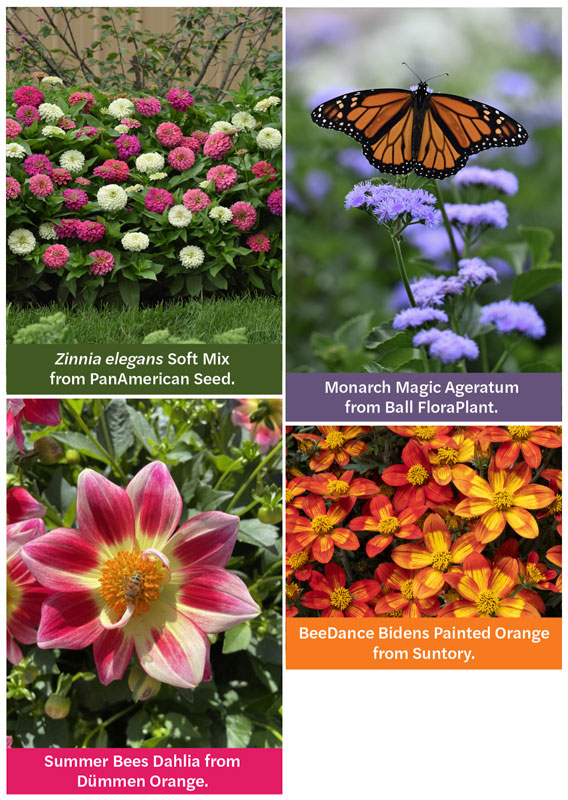 Ball FloraPlant introduced Monarch Magic Ageratum this year, which has received rave reviews for being an absolute Monarch magnet, said Marketing Manager Stephanie Vincenti. Because of it’s popularity, they’re going to inventory a large portrait tag, a hanging basket lock tag and a pot sticker to elevate it even more at retail. Product Manager Sarah Swofford Hernandez added annuals like celosia and salvia that attract bees, while cuphea and lantana are hummingbird favorites. Ball FloraPlant is introducing Mystical Salvia in white and blue for 2026, as well as three new colors for the Shamrock series of medium-vigor lantana: yellow, lavender and yellow glow (a bicolor).
The new Aromagica Purple Heliotrope from Proven Winners, introduced this year to retailers, performed well in trial gardens attracting pollinators, said Marketing Communications Manager Kate Spirgen. It features dark purple blooms on rugose dark green foliage.
“That’s a unique one we’re seeing a lot of buzz about,” she said (I see what you did there, Kate).
Another new one that I personally love is Oenothera Superlophus Sunglow, which is derived from the native Texas primrose. I wrote about it in November in the Stuff We Love section, and Kate said it’s a pollinator attractor, too, along with being drought and heat tolerant.
Suntory Flowers introduced its bee magnet, BeeDance Bidens, about 10 years ago (has it been that long?) and this year they came out with Painted Orange, a new color that really does look painted. It joins Yellow Improved and Painted Red Improved, and they’re all favorites of the bees and butterflies.
One plant that does double duty (or maybe even more) is zinnia, and PanAmerican Seed introduced Zinnia elegans Hot Mix for this year, adding to that a Soft Mix (Pink, Rose and White) and a Full Mix (White, Cream, Lemon, Yellow, Orange, Scarlet, Pink, Rose).
“In my mind, zinnia is just the quintessential butterfly flower,” said Robin Ruether, Senior Project Manager at PanAmerican Seed. “You just picture that monarch sitting on that open flower.” Zinnias are easy to grow and make great cut flowers, too, providing multiple opportunities.
Another new introduction the team at PanAmerican Seed is excited about for 2026 is Always Sunny Gold, a landscape sunflower that pumps out a ton of blooms and is sterile, as in no pollen.
“I have gotten the question, ‘If it doesn’t have pollen, does that mean it’s still pollinator friendly?’ And the answer is, yes, it is very pollinator friendly because it has a ton of nectar,” Robin said.
It’s an important distinction and one that might need further explanation. Consumers may be passing up great pollinator attractors when they see pollen-free or sterile in the description. Another example is Syngenta Flowers’ new lantana, Bandolista Pink Lemonberry, which is a sterile variety designed to ensure maximum flowering, but is also pollinator friendly due to the nectar it provides.
 More Plants: Perennials
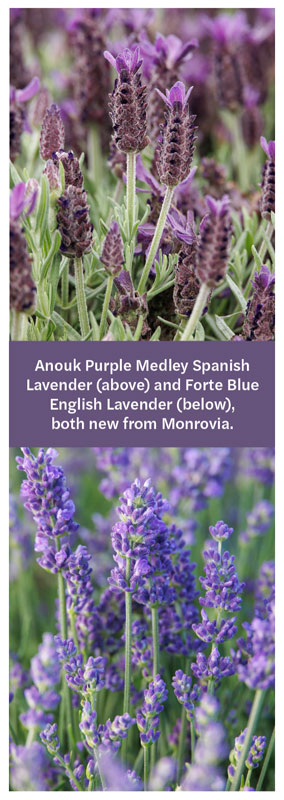
Of course, perennials are the faves of pollinators and there are lots of great new introductions here for 2026. One of those mainstays is lavender, and Monrovia has new additions in both Spanish and English, and they’re promoting them through Lavender Week, which takes place the week after Mother’s Day (May 11-18, 2026), Katie said.
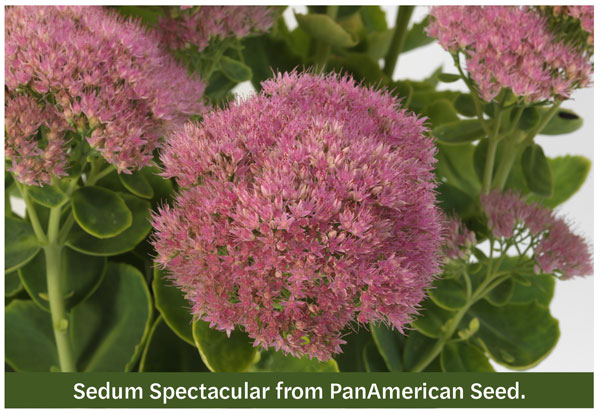
One plant that’s not always thought of in the pollinator discussion is sedum, but PanAmerican Seed Product Development Manager Marcus Jansen noted their new Sedum Spectacular is often covered with pollinators and makes a great sales addition for late summer/early fall blooming. The problem is, in the past, it’s been hard to get it to flower for spring sales.
“The beauty of Sedum Spectacular is that with a little daylength manipulation from the grower, you can induce these into flower for those Mother’s Day sales,” he said. “That way, you can have flowers on them at retail. Consumers are going to know what they’re getting.”
 Dümmen Orange also has a new lavender series for 2026 called La Diva Berry, which flowers early in the spring as bees emerge. Marta Maria said this series features extra large bracts (the “flags” or “bunny ears”), and with a medium, compact habit, works well in containers. “While Spanish lavenders aren’t typically known for cold hardiness, the La Diva Berry Series provides an excellent early season color option for consumers and pollinators alike,” she added.
At Walters Gardens, Marketing Manager Andrew Jager said they have a new rudbeckia, Treasure Trove, for 2026. It’s highly disease resistant and floriferous, with excellent landscape and retail container presence. He noted the discussion around pollinator attractors links them to native plants. “A good amount of our pollinator push leans into this overlap,” he added, and feedback has shown retailers want programs that support both natives and cultivars.
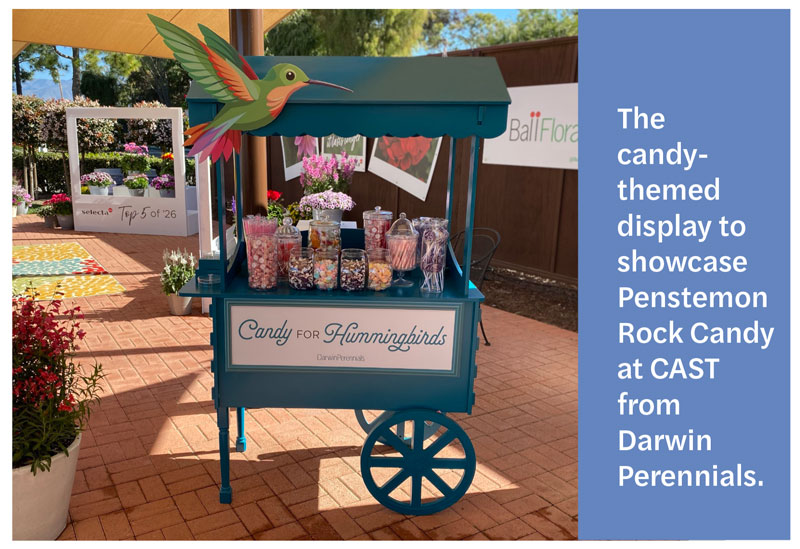
 Darwin Perennials introduced new colors into the Penstemon Rock Candy series this year—Coral and Pink Improved—and to celebrate they promoted it with an adorable candy-themed display at CAST and Darwin Perennials Day (mark your calendars for Wednesday, June 17, 2026 in The Gardens at Ball). Rock Candy is a more compact series, said Marketing Specialist Marion Meesenburg, while the new Mountain Treats series has a medium habit and comes in the following colors: Light Pink, Fuchsia, Lavender, Red and Rose. A taller option is the new Summit Sweets Ruby. All the penstemon series are beloved by hummingbirds.
And Don’t Forget: Shrubs
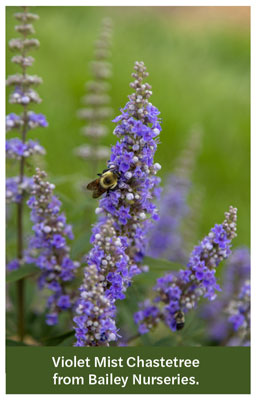
There are so many great options for multi-season interest and larger displays of blooms here. For example, Bailey Nurseries’ Violet Mist Chastetree provides both pollen and nectar for visitors.
“In our trials, Violet Mist Chastetree has been one of the most frequently visited compact shrubs for warm climates,” said Marketing & Communications Manager Ryan McEnaney. “And with its ability to rebloom, that extends the season for pollinators to interact.”
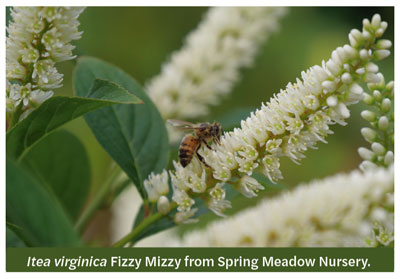
 Some consumers want the pollinator attraction, but in a neater form, and that’s where cultivars like Itea virginica Fizzy Mizzy from Spring Meadow Nursery comes into play. Fizzy Mizzy, a compact shrub, attracts a wide range of pollinators, including bees and butterflies, with its fragrant, nectar-rich spring and early summer blooms, according to Natalie Carmolli, Public Relations Specialist for Proven Winners ColorChoice shrubs.
Vining plants also are important and Monrovia has Goldflame Honeysuckle, which can be pruned to a shrub shape or left to vine as a cover for trellises, arbors or fences. This features tubular flowers the hummingbirds love.
More Than Just Plants
When looking at this segment, it doesn’t just encompass plants, but rather a whole ecosystem. You can help customers by pairing up products that are organic or natural.
 “When customers pick up pollinator-friendly plants, they’re already investing in the environment,” said Jaime Brunner, Brand Manager at Espoma. “Retailers can help them go one step further by offering the right soil, fertilizer and habitat-building products to ensure those plants truly thrive.”
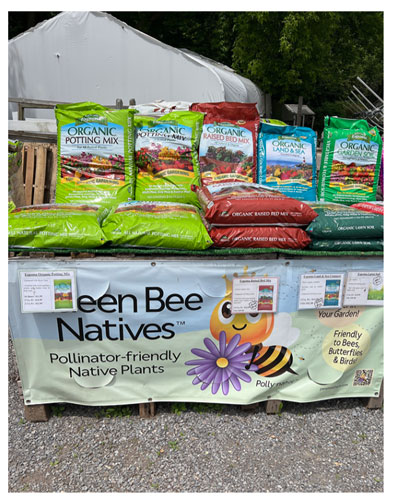
Espoma’s organic potting mixes and garden soils make a great add-on to pollinator plant sales, as well as the organic fertilizer options like Bio-Tone Starter Plus, Flower-Tone or Plant-Tone.
“Visual education—like before-and-after photos or videos of pollinator gardens in bloom—can really inspire customers to recreate the look at home,” she added. “When retailers highlight products that are both effective and environmentally responsible, they’re not just selling supplies—they’re helping protect biodiversity and strengthen community values around sustainability.”
Other products that add to the mix include bee houses, bat houses, bird baths, butterfly puddling stones, biological control products and beneficial insects.
Strategies and Promotions
One concept that resonated through all the interviews I did (and, as you can see, I did many) was the idea of creating pollinator collections that spanned multiple seasons and incorporated a variety of colors, bloom types and diversity of plants. By offering plants with different bloom times and types, you can create nearly year-long ecosystems for many types of pollinators. Since they all like different colors, you can play with color schemes in displays, too. Another important consideration is the life cycle of pollinators to offer host plants plus nectar.
 Education is super important, and experiences like workshops and classes can be a fun and informative way to expand the plants that customers think of as pollinators. One of the biggest challenges is talking about natives versus cultivars, and many I talked to suggested working with the customer to understand their goals and expectations first. That could drive them toward straight species or cultivars.
I talked to Megan McMullen, a buyer at Homestead Gardens in Maryland, about their Pollinator Month program in June because these efforts showed a significant increase in perennial sales. Prior to last year they had pollinator events and festivals, but in 2024 they had their first Pollinator Month promotion that featured events, activities for kids and adults, giveaways, education and more.
This year they started their programming in March, she said, with a workshop featuring Plant By Number, a program where customers picked the pollinator plants that would go in their garden and creates a landscape fabric design of where the plants should be planted. In May, customers picked up their design and bought the plants to go with it. They could still change their minds at that time, but had the knowledge to pick something different.
“When they came in, even if they changed their minds, they sort of had a better idea of what they were looking for,” she added. “That was a really fun collaboration with Plant By Number.”
For the June promotions, they partnered with local conservation organizations and had talks about every aspect of pollinator plants because, again, multiple points of entry.
“We’re trying to do lots of different kinds of activities in engagement throughout and then that, of course, layers with the marketing and the giveaways and the promotion,” she said. “It’s a big effort in June and then sort of throughout the year it is still relevant, so we talk about it a lot. Marketing is always still touching on these plants and how to support pollinators using the selections that people make.”
Megan noted when I talked to her in September that she was pre-booking plants then for next June’s promotions, and then in January she’ll meet with the hardgoods buyer, marketing team, education team and others to plan out everything needed for Pollinator Month.
“The secret sauce of our success is the communication of our different departments,” she added. “So marketing, working closely with education, working closely with the buyers and then working closely with our general managers to implement this.” GP
Monrovia’s Bee a Winner Contest
This contest, which independent retailers can sign up to participate in, has grown about 10% in participation every year for the past four years. There are two phases, depending on where you are in the country, with two different sign-up deadlines. Monrovia will give out free pollinator plants, as well as two grand prizes of a $500 garden center shopping spree. GO HERE for details and to sign up.
Myth #1: Pollinators are only bees, butterflies and hummingbirds.
Pollinators come in many forms, including flies, beetles, wasps, moths, bats and birds.
Source: Xerces Society
Myth #2: Pollen is the reason pollinators visit plants.
While pollen transfer is a very important job for pollinators, it isn’t the only reason they visit plants. Pollinators need nectar for energy.
Source: Michigan State University
Myth #3: Pollinators like all bloom colors.
Different types of pollinators prefer different colors:
Bees: Yellow, blue and purple flowers, as well as ones that reflect ultraviolet light (they can’t see red)
Butterflies: Red, orange, yellow, pink and blue flowers
Hummingbirds: Red, orange and purple-red colors
Flies: Green, white, yellow or cream flowers
Moths and bats: Light-colored blossoms that open at night
Source: UC Agriculture and Natural Resources