1/30/2026
Using Shrubs in Containers
Ellen C. Wells
Combination containers are like desserts in a restaurant: People love them and will order them even if they (or their car trunks) are full. It helps that they’re a high-margin item for garden centers. The work you put into creating combos is well worth the effort on the other side of the register.
You might make a premium container even premium-er with the addition of a shrub or two (or even three). These four-season elements can elevate both a container’s appeal and its price tag. We spoke with four designers experienced in using shrubs for container designs to gather shrub recommendations and tips for success at the garden center.
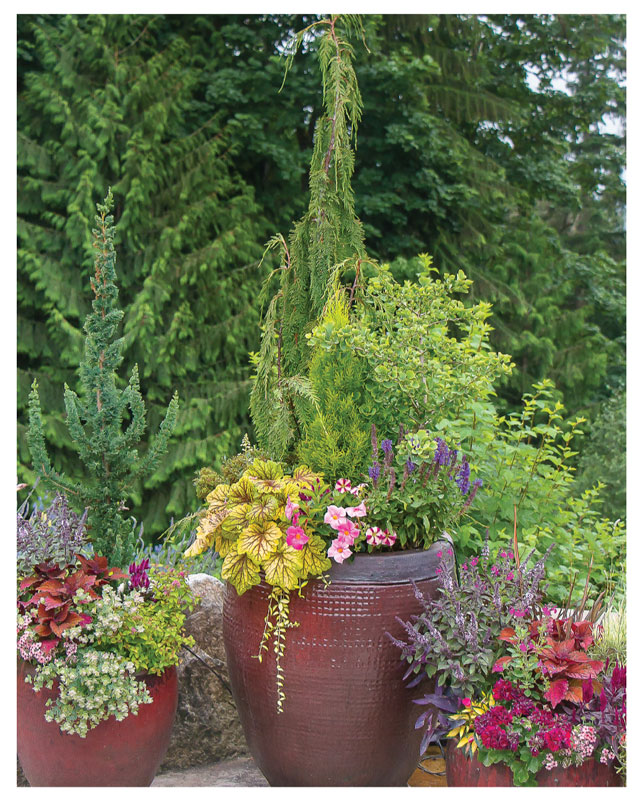
Center pot: Weeping Alaska Cedar Green Arrow, Lemon Cypress Wilma Goldcrest, Ginkgo Jade Butterfly and Heuchera Delta Dawn. Photo courtesy of Christina Salwitz.
Christina Salwitz
Christina Salwitz, aka the Personal Garden Coach based in Oregon, has been using shrubs in containers for longer than she can remember. She uses evergreens aplenty in containers for several reasons. First, they give a container structure and color through fall and winter when other plants just “disappear.” They also represent value for the homeowner who can use them in pots then move them into the landscape or use as a hedge, turning a seasonal display into a long-term investment. And we can’t forget about all the texture they bring to a combo—evergreens are some of the most diverse shrubs to use while also providing four seasons of interest.
Christina’s Favorites:
Chamaecyparis obtusa Nana Gracilis, or Dwarf Hinoki Cypress. “It grows extremely slowly in pots, so, that’s easily a 10-year plant, depending on the size of the pot,” Christina said.
Juniperus squamata Blue Star Juniper as a standard. Christina uses this for two reasons: 1) It’s a great example of her “small butt, big head” or small root ball, bigger canopy preference for container shrubs, which provides a good scale in pots; and 2) the standard form allows for “anything that I cram around the base to show off really well without the whole shrub getting eaten up by whatever else you put in it.”
Cryptomeria japonica Black Dragon. She loves Black Dragon’s very dark green foliage and said the plant takes really well to shearing if you want to make a conical Christmas tree-esque shape with it. Christina said these evergreens also make a great hedge: Start them as 3-gal. shrubs in combo containers and as they grow bigger over the year, the homeowner can then start a nice low hedge with 5-gal. Black Dragons.
Tsuga canadensis Golden Duchess Eastern Hemlock. “This would be a good shrub if you have a bit more shade,” Christina said. “It’s very soft and that’s a consideration if somebody might be brushing past the container.”
Salix integra (Dappled) and Salix purpurea (Blue Arctic) Willows. Christina loves these two in containers for their beautiful, soft “fountainy,” almost trailing habit. She pairs them with dark foliage shrubs such as purple smoke bush, black sambucus and hydrangeas.
Christina’s Shrubs-in-Containers Tips
- Make sure that you’re accommodating the size of the root ball to the size of the pot. If that’s not possible, group more plants into that container.
- Only use good-quality potting soil in containers. Do not add topsoil, landscape fabric, upside‑down pots—just potting soil—for optimum root health and drainage.
- Think about the plant’s life beyond the pot. Plan for its eventual use in the landscape. Conifers and shrubs in pots shouldn’t be throwaways, as they’re too expensive. Ask customers if this will stay in the pot for several years or will be moved into the landscape within the year.
 Leigh McGonagle
Leigh McGonagle runs Poplar Point Studio, a garden and landscape company in New York’s Finger Lakes region. This fine gardening firm creates dozens of high-end containers of all sorts and for all seasons. Being located upstate, Leigh finds that using shrubs that provide winter interest is key. She leans heavily toward items that can be left in all four seasons, but will sometimes swap out the statement shrub for a large tropical in summer. She has a nursery space to hold clients’ shrubs for a season, which makes the swapping practical.
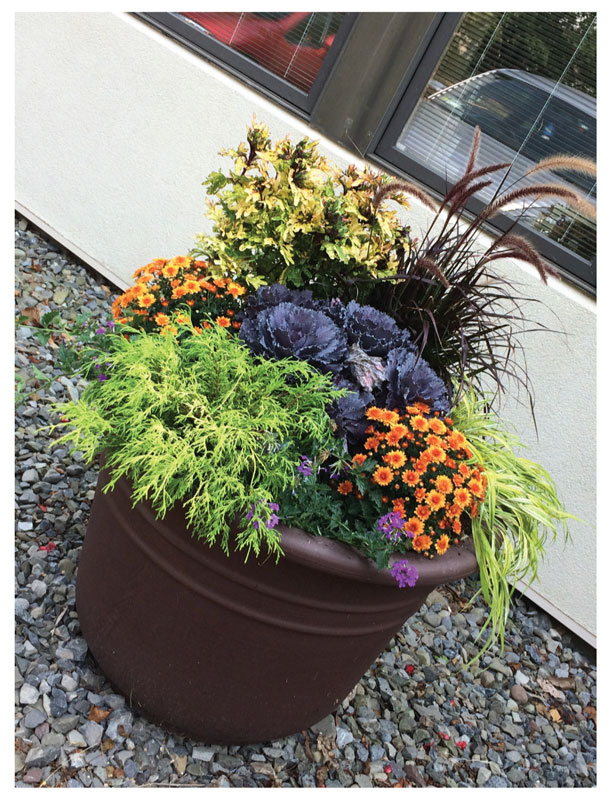
Chamaecyparis Lemon Lime Lace is the shrub in this container, along with component plants purple verbena, rust-colored mums, Hakonechloa Aureola, purple fountain grass, coleus and dark-leaved ornamental cabbage. Photo courtesy of Leigh McGonagle/Poplar Point Studio.
Leigh’s Favorites:
Cornus sericea Red or Yellow Twig Dogwood. “We use red or yellow twig dogwoods because often for winter arrangements we’ll just cut those stems anyway,” Leigh said. “Might as well use them in containers and then they’re a nice neutral backdrop for any color palette you want in the summer because it’s just green leaves at that point.” Using plants that have a dual purpose seems to be a recurring theme when it comes to shrubs in containers.
Specimen evergreens such as a Chamaecyparis. Leigh loves to work with the cypresses with chartreuse colorings. She’ll plant these singly in containers and group “friends” around it to provide seasonal color. “In winter, it’s the only thing out on the porch and it’s still so stunning.”
Sambucus nigra Black Lace Elderberry. Shrubs that she uses mostly for summer include this purple fringy-leaved shrub. “It is a stunning foliage and texture plant,” Leigh explained. “It is a nice thing to switch up, instead of just having, an evergreen shrub in the container. It’s something that has a really interesting texture or color
Candy Corn Spirea. Leigh loves this spirea because it displays all three foliage colors at once in fall—green, yellow and pinkish tones on leaf tips. “It’s such a good blend with fall,” she said. “And those will make it through frost. It has really good foliage texture.”
Leigh’s Shrubs-in-Containers Tips
- Shrubs still need consistent, thoughtful watering. “Most evergreens aren’t going to show water stress until way too late,” Leigh said. “They’re going to look good until they don’t.”
- Refresh soil, prune roots and feed. “If you keep shrubs in containers, you’re more tempted to not refresh the potting mix as frequently.” Refreshing soil also gives you the opportunity to root prune. And don’t forget to fertilize!
- Frame the purchase of shrubs in containers as an investment. “These are plants that are going to give your customers years and years of return, if they take care of it right.”
 Steph Green
Steph Green of Contained Creations in Richmond, Virginia, treats shrubs in containers as tough, structural “two-year tenants” rather than permanent residents. She chooses varieties that are hardy at least two zones colder than her own, recognizing that roots in pots face harsher winter conditions than those in the ground. Steph stresses the importance of scale: A shrub that’s too small in a big pot “looks absurd,” so she aims for instant gratification—full, satisfying compositions from day one that continue to improve over time. Her focus is on foliage, form and texture rather than flowers, layering shrubs with companions in lush, “squish-and-stuff” combinations.
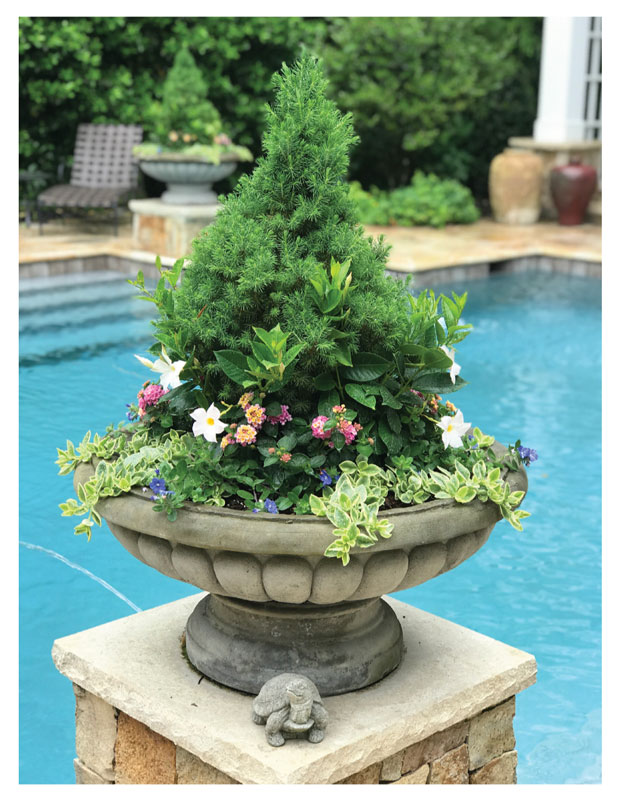
Dwarf Alberta spruce with dipladenia, lantana, evolvulus and dorotheanthus.
Photo courtesy of Steph Green/Contained Creations.
Steph’s Favorites:
Dwarf Alberta spruce (Picea glauca). “This is a classic structural feature shrub for one to two years in a pot before it outgrows the container,” Steph explained. She prefers to use the 2-qt. sized Tiny Tower Dwarf Alberta Spruce in window boxes because it’s more petite and densely packed than the typical dwarf Alberta spruce.
Blue Pacific trailing juniper. Blue Pacific juniper is one of her favorite evergreen trailers to create a spilling effect in mixed containers. “It’s great for mixing texture and color between evergreens and perennials in a window box,” she said.
Mini Touch Holly. “These are lovely spheres covered in petite green leaves,” Steph said. “Making them a great proxy for boxwood.” She encircles them in containers and window boxes with English Ivy and other trailing plants to create a classic look.
Roman Candle Podocarpus. Steph loves the upright stature of this slim evergreen. Its lance-shaped leaves start out variegated and mature to rich green. “Skirt this with some flowering annuals in soft yellows and whites for a soothing, but unexpected combination,” Steph suggested.
Steph’s Shrubs-in-Containers Tips
- Give clear guidance to customers about watering. Stress the importance of evenly moist soil with fewer, but deeper, waterings instead of frequent “splashes.” And tell them to water through the winter, especially in milder climates!
- Match plants by light and water needs. This might be obvious to garden center staff, but customers must be reminded to combine shrubs and companions with similar light and moisture requirements. This is especially true for evergreens that don’t like sitting in wet soil, but must stay hydrated.
- Explain scale and proportion for shrubs in containers. A common mistake is choosing shrubs that are too small for large pots. Steph recommends using the container’s height as a sizing guide. For an 18-in.-tall container, aim for a shrub that reaches roughly 18-in. tall and wide for a full, mounding look. For a taller, more vertical effect in the same pot, choose a shrub that grows 24- to 36-in. tall.
Andrea Parker & Michelle Fields
Andrea Parker and Michelle Fields of Growing Green in St. Louis, Missouri, treat shrubs as both season-long structure and multi-season interest when used in containers. They’re willing to experiment with what works (they’re currently trialing crape myrtles in containers, for example), but they’re practical: The shrubs they use must not only suit the light and fit the container size, but also hold up to Midwest weather. They lean on foliage color, texture and bark, not just blooms, for containers that look spectacular over many seasons.
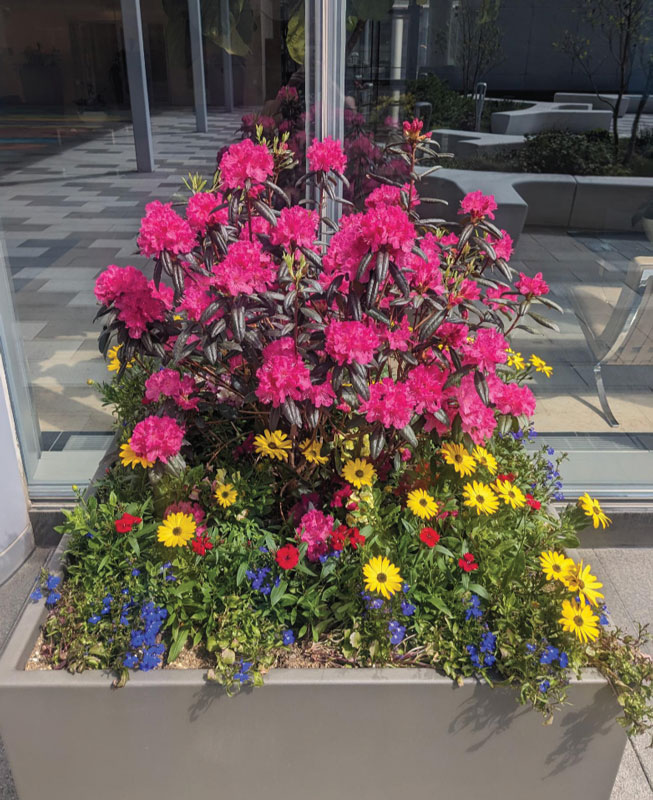
Rhododendron PJM Landmark with component plants. Photo courtesy of Andrea Parker.
 Andrea’s and Michelle’s Favorites:
Juniperus horizontalis Wiltonii (Blue Rug juniper). For cascading shrubs with winter interest, their go-to for containers is juniper Wiltonii. They both find that it does much better in a container than the Blue Pacific.
Rhododendrons. These early bloomers add that pop of color spring so desperately needs. The PJMs, in particular, are quite winter hardy in the Midwest and have performed quite well for Andrea and Michelle.
Crape myrtle (Lagerstroemia). Andrea and Michelle are actively experimenting with it as a summer centerpiece in large containers. Although it’s more of a late-summer bloomer, they’re trialing a variety with a plum-colored foliage that would be attractive all season long. They see it as a multi‑interest shrub with purple leaves for summer, purplish-pink flowers later in the season and attractive bark that can carry the planting through more than one year.
Andrea’s and Michelle’s Shrubs-in-Containers Tips
- Consider the container size. “This is a pretty important point,” Andrea said. “You’re not going to be able to put a giant shrub in a shallow bowl, for instance.”
- Design for contrast in texture and color. This is especially true for pairing evergreens together. “Make sure you have a lot of texture and color changes,” Michelle said. For example, they’ve planted three evergreens in a container—a bird’s nest spruce, a mugo pine and a pyramidal boxwood—that “look really smashing together.” GP