3/31/2026
Fertilizer = Healthy Plants
Ellen C. Wells
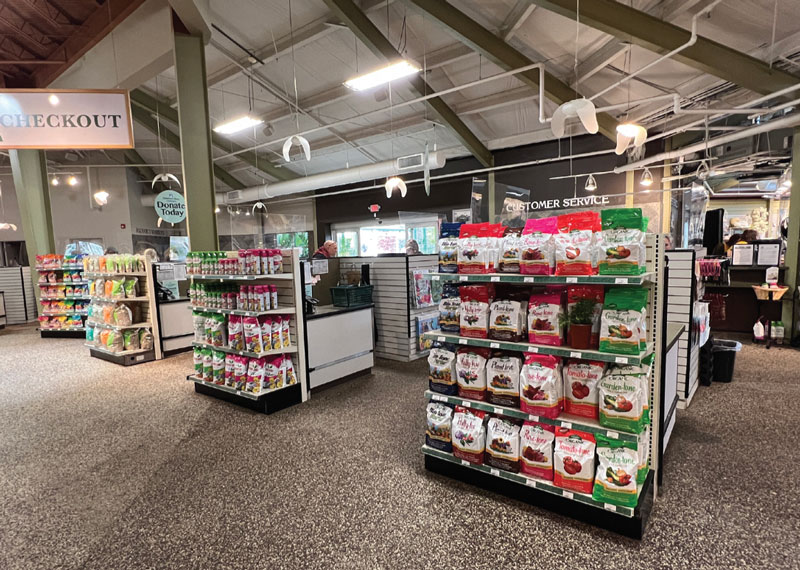
Walk into any garden center in spring and you’ll see customer carts loaded with colorful perennials, annual combos, hanging baskets and some patio tomatoes. What you won’t always see is fertilizer on those carts to help keep those plants looking professionally lush and fresh.
Fertilizer products, like the Espoma ones shown here at Petitti Garden Center in Avon, Ohio, make a great add-on at the checkout.
“Most people don’t fertilize like they should,” said Mark Highland, Founder and President of Organic Mechanics Soil Company. “I think the average American who is into gardening or likes gardening doesn’t know that fertilizer is necessary.”
Even when garden center staff are proactive in asking if customers need fertilizer to keep their new purchases going strong, resistance creeps in.
“Most people brush it off and say, ‘Oh, yeah, I have it at home’ … they just think the garden center is trying to sell me more stuff,” Mark said.
The perceived upsell is just one of the hurdles retailers face when not only selling plant fertilizers and food, but also when communicating the importance of feeding plants in general. But industry experts agree that reframing plant fertilizer as plant health—not an add-on—is both an educational and a sales opportunity.
Fertilizer Is Not Optional
“Fertilizing is a critical element to success,” said John Harrison, Sales & Marketing Manager of Espoma. “From the outside looking in, it looks complex. It doesn’t have to be. That’s why the store-level team can help cut through that fog.”
 At its core, fertilization isn’t about pushing growth; it’s about basic biology.
“Plants are autotrophic, which means they gather their food from the sun. But that’s not everything,” explained Alison Reeve, Product Development Specialist at Mycorrhizal Applications. “They don’t get everything from the sun and so we still need those building blocks, those nutrients, to help not only grow plant tissue, flowers and fruits but also to be able to create secondary metabolites that help stave off pests, diseases and the impact of drought stress.”
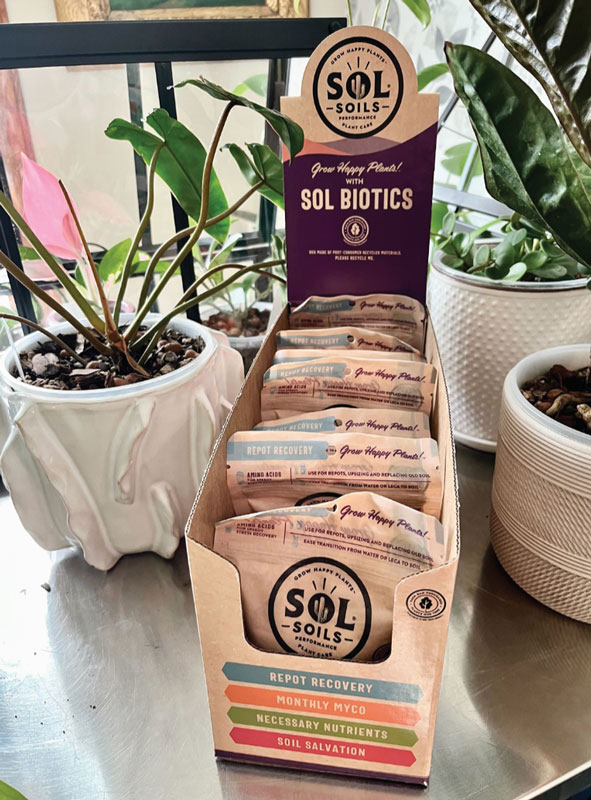
Sol Soils’ Biotics mini shelf display offers explanation of the product and is small enough to be an impulse item at the register.
Mason Day, Vice President of Business Development at JR Peters, which makes Jack’s Fertilizers, often frames it in human terms: “How would you feel if you just drank water and didn’t eat food every day?”
He added, “It’s not ‘What fertilizer should we be feeding?’ Instead, it’s ‘You have to fertilize. Period.’”
For retailers, that’s the message shift: from product choice to biological necessity.
Containers Up the Challenges
When planting in containers, many consumers assume the potting mix they use is a “one-stop shop,” containing everything plants need to grow for a few months, if not the whole season. That’s far from the case.
“When you start with a potting mix, that’s just basically the substrate for the roots to anchor itself in while in a container,” Alison said. “It might have a little starter charge in it, but really, it doesn’t supply everything that plant needs going forward. And so we really, really have to supplement with food.”
 Mark echoed that idea. “Plants need food, and in a pot it has to come from you versus in the ground where there should be enough minerals for the plants,” he explained. “When anything is growing in a pot, the only way to get nutrients is by providing fertilizer. Everything has to be within that pot.”
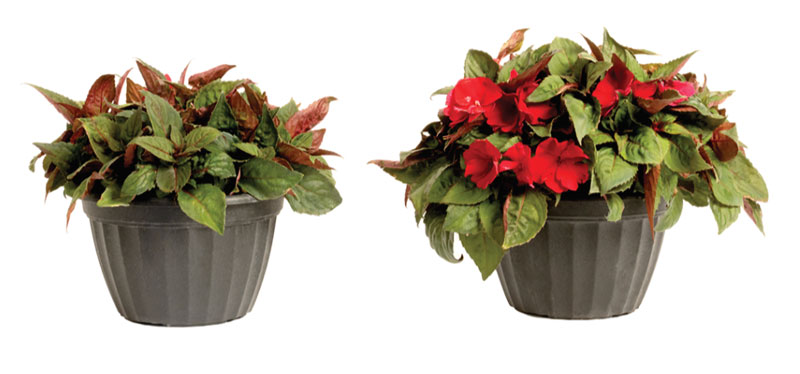
Magic Gardener is a new retail product that promotes plant health with mycorrhizae. The impatiens in the photo show one not treated with mycorrhizae (left) and one that has been treated (right).
Meanwhile, growers are feeding constantly before plants ever reach retail, creating big and beautiful plants. It’s a point that consumers aren’t necessarily aware of. As Mark mentioned, “Growers and retailers are fertilizing at almost every watering, so when the person gets it home, those nutrients have to be replaced.”
 Selling Systems > Selling Products
“At a garden center level, it’s about telling the story,” Mason said. “Tell them, ‘For us to sell you this plant that looks amazing, we have been feeding it every single time we water. If you want your plant to continue to look this amazing, you’ll need a fertilizer.’”
Too often, he noted, messaging becomes seasonal and SKU-focused.
“Sometimes what happens is at the garden center level, the content becomes, ‘Which fertilizer should you use this spring?’ And, really, it should be, ‘Hey, this is why fertilizing plants is important in general.’”
The shift is from product to helping maintain that plant’s growth through the summer. Demonstration is one of the strongest tools retailers have to relay that message.
“You have to explain to folks that there’s a quantitative benefit [to fertilizing] that’s recognizable when you do it,” John said. “We have garden center customers that have displayed plants fed and unfed, and you can see the difference when you’re in the store.”
 Mason agreed that side-by-side comparisons are powerful and don’t have the same upsell connotation as the “Would you like fertilizer with that?” checkout message. For Mason, garden center staff need to visually present the results of fertilizer, as in “This basket is what it’s going to look like if you feed it all summer and this is what it’ll look like in a month if you stop feeding it entirely.’” Visually presenting the “fertilizer-no fertilizer” difference is well worth the sacrifice of a handful of plants.
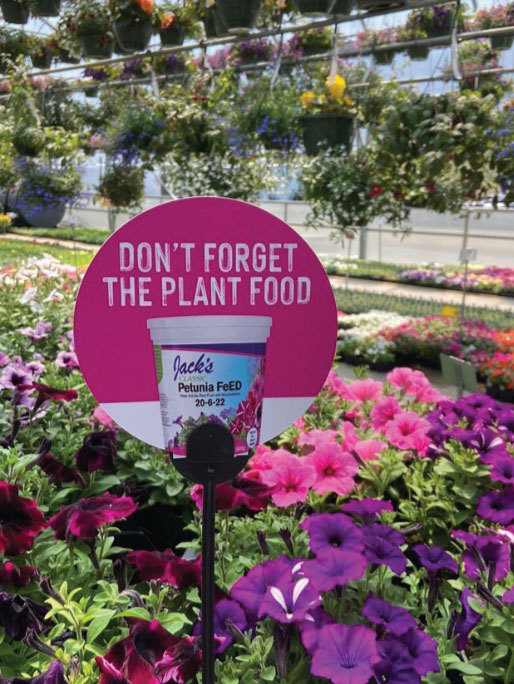
JR Peters offers point-of-purchase hanging basket tags, stake tags (like pictured), banners and more highlighting the importance of feeding plants with Jack’s plant food.
Mark’s favored way of communicating the economics of using plant food is bundling and guarantees: “The message is, ‘If you buy this soil amendment, plus this fertilizer, we will guarantee the plant for X amount of time, and you’re spending less than $20 to guarantee that all of your plants will do well all summer. It’s a very small cost per plant.’”
Demystify Without Talking Down
Fertilizers aren’t the only things that help plants grow. Consumers are confused not just about NPK, but also about soil additives and biologicals, and if one replaces the other. Labels mention mycorrhizae and beneficial microbes, which can unintentionally suggest nutrition is already “in the bag.”
“There can be marketing on some potting soil bags that makes it seem like you don’t need a fertilizer,” said Travis Thein, founder of Sol Soils. “If you want to have plants that live for years and show you beautiful blooms and fruit, you have to add nutrients for those plants to be able to do that.”
Biologicals play a role by supporting nutrition, not replacing it. “Sometimes plant food comes in the form of microorganisms to help break down and make those nutrients more available to the plants,” Alison explained. “The addition of mycorrhizal fungi can help capture more of the soil profile than a plant can physically capture through its own root system.”
It’s symbiosis. For a plant’s best performance, you need one and the other, not one or the other.
Travis used a vivid analogy for mycorrhizae. “My soil science friend likes to talk about them as little invisible umbilical cords or extension cords, grabbing moisture and nutrients from further away,” he said. And that soil and definitely that potting mix need an extra boost of food for growing plants.
The clear retail message here is that fertilizer supplies nutrients, and biologicals help plants access and use them. One doesn’t eliminate the need for the other.
Training and Trust
Ultimately, fertilizer success hinges on staff confidence.
“It begins with the people who are on the floor talking to the customers,” John said. “It starts with those folks really believing in the products they’re selling.”
The customers’ trust of the staff is already there. “Typically we have garden center customers that trust the core staff because they’ve never steered them wrong.”
And educating customers doesn’t have to happen only at the register or on signage. Travis has participated in numerous garden center-hosted seminars all about soils and nutrition, and said, “It’s less about an upsell and more about ‘I’ll teach you what we know and let you decide.’”
Video is another method of sharing the knowledge. “If you can demo to people on your website, it takes a lot of the anxiety out of understanding fertilizing,” John noted. “When you see somebody doing it and say, ‘Gosh, that’s pretty easy. Even I can do that.’”
At the end of the day, fertilizer isn’t about pushing product. It’s about delivering success. When garden center staff confidently communicate that message through demonstration and training, fertilizer stops being an upsell and starts being plant health. GP
Five Retail Tactics to Make Fertilizer a Success
Show fed vs. unfed: Side-by-side displays visually prove value.
Tell the grower story: Be transparent—“Yes, we feed every time we water.”
Bundle for success: Pair plants with recommended fertilizer and soil amendments, and consider guarantee programs.
Train the team: Short videos, vendor resources and required mini-trainings for staff build confidence.
Lead with why, not which: Shift marketing from “Which fertilizer should I buy?” to “This is why plants need to be fed.”