3/31/2026
The Ultimate Inspiration
Jennifer Polanz
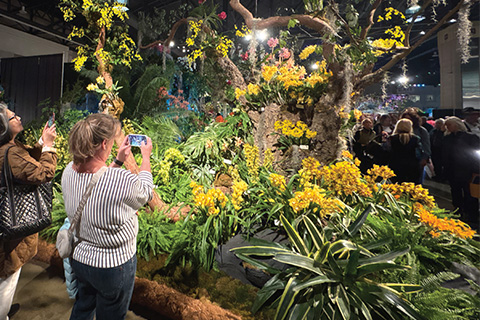
Experiences drive traffic, inspire customers and (hopefully) make them more likely to spend on the plants they love. In a continued quest to better understand what drives that inspiration and how to capture it at a retail setting, I hopped in the car at the end of February and headed to the Philadelphia Flower Show.
Visitors were quick to pull out phones to video and photograph dramatic installations, as well as take selfies and group photos.
It’s been high on my list to visit for a while and it did not disappoint. With an estimated 235,000 visitors this year—traveling both domestically and internationally and most with their cameras out taking pictures and video—it’s clear what the Pennsylvania Horticulture Society (PHS) is doing is working to attract and inspire. The largest and longest-running flower show in the country (PHS began hosting it in 1829), the displays, activities and marketplaces span around 500,000 sq. ft., or nearly 12 acres. The show attracted people of all walks of life, and all ages, making it a wonderful day-long (or multi-day) adventure for many who’ve been cooped up by a colder-than-normal winter.
“It’s been so gloomy,” said Evanna from New Jersey, who I chatted with while she and her friend, Bri, were taking a break outside the show floor. Bri said her favorite section was the orchid display. “We were coming as a group of friends getting together,” Bri added. “To me, the theme really stood out.”
 That theme, “Rooted: Origins of American Gardening,” gave the show structure, showing multiple aspects of gardening in the U.S. and providing historical context for plants and methods for planting. And while both Evanna and Bri said they wouldn’t consider themselves gardeners, they did say they were inspired by the show. Here are a few other exclamations I overheard while walking through the installations: “Wow!” “What a treat.” “Where should we take the group photo?” “It’s amazing.” and “I think I might get lost in here by the end of the show.”
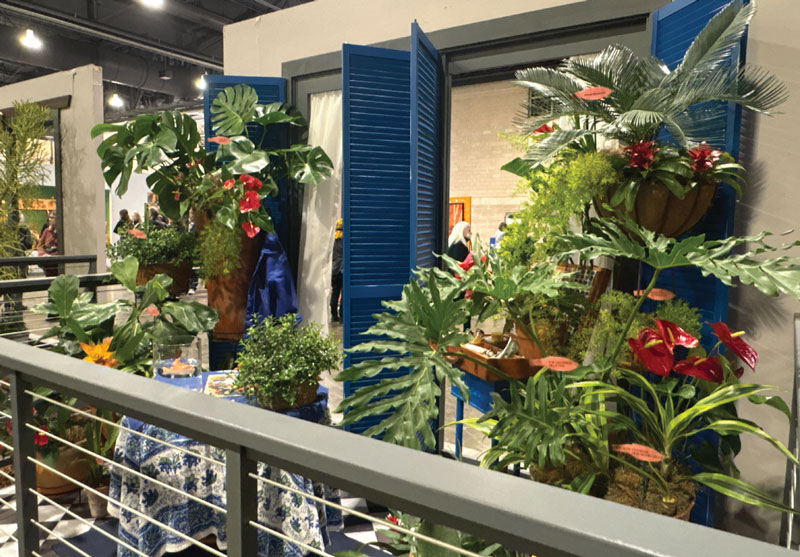
The show highlighted a number of ways to use indoor and outdoor plants and cut flowers in small spaces, like this balcony.
For Seth Pearsoll, creative director and vice president of the show, inspiration is certainly part of the goal, and gratifying. “At its most basic core, if people come, they have a great time, they learn something. They feel that they’ve been served as a customer with garden knowledge, inspiration and value, then the proposition is being met,” he said, adding they have multiple goals with the show, including raising funds from the proceeds that they can use for their community outreach efforts, and continued education and training.
 “Beyond that, I want people to be surprised at how this comes together. It sort of breaks your brain when you do the math and you’re like, ‘Wait, it’s winter, we just had a blizzard, yet there’s 12 acres of these massive flower gardens,'” he said. “I like that moment for a guest. But if you’ve been visiting us every year, as people in the region do, I hope it’s sort of like, ‘I don’t know how they top it every single year. How do they do this, right?’ That’s a really special feeling.”
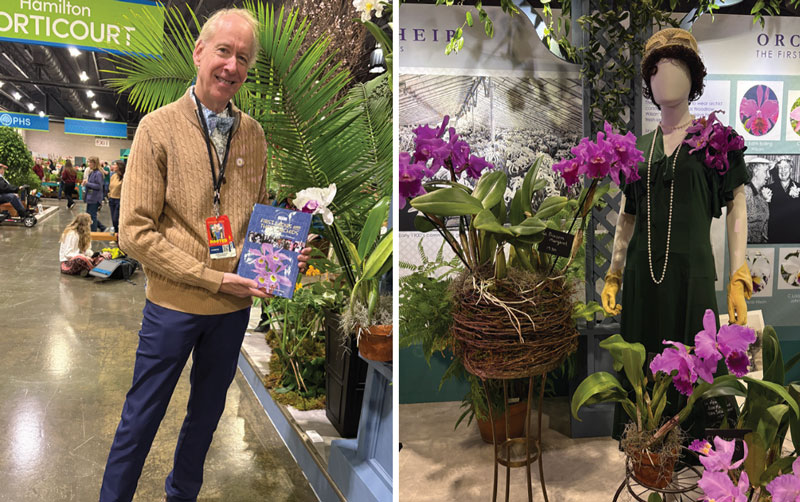
Arthur Chadwick with the book he wrote about the First Ladies and their namesake cattleya orchids (left) and part of the display on the topic, which won an award at the show.
Capitalizing on Inspiration
The show is structured with an intuitive pathway you can follow or it allows you to break off and meander. Most of the installations have signage to explain their intent, whether it’s designers, companies or works of art. Many have plants identified throughout the displays to educate, as well as inspire. Show volunteers hand out a printed program upon entry that includes show highlights, a map, a list of activities and previews of other PHS events and activities.
 Which makes me wonder, is this something that can be replicated at destination garden centers? Perhaps not a paper program, but a QR code leading to a webpage that treats each visit like a special activity, where specific plants in bloom are highlighted, along with events for the week and specials?
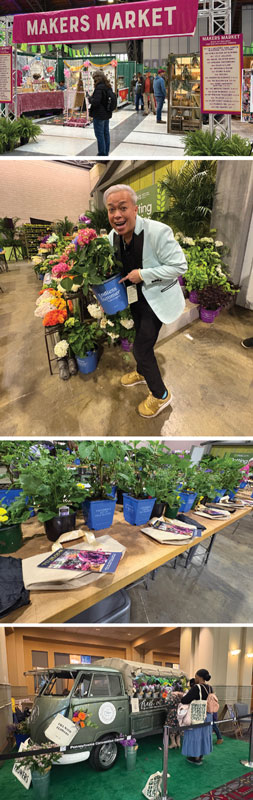
There were numerous activities at the show, including Tu Bloom’s super popular Potting Parties.
And while most of the displays were stunning and inspiring, there were some that had an outsized historical meaning, as well as being beautiful. One such display was created by Arthur Chadwick and Fran McDermott of Chadwick & Son Orchids, where they highlighted the tradition of America’s First Ladies and their cattleya orchid corsages. Did you know the last 19 First Ladies have cattleya orchids named after them? The first three were done posthumously, but starting with First Lady Lou Henry Hoover (wife of Herbert Hoover), the orchids were presented to them during their husbands’ presidential terms.
Fran and Arthur won a silver medal for their display at the Chelsea Flower Show, and brought it to Philly for this year’s show, which in part celebrates America’s 250th anniversary. Here, they won the Emile H. Geschick Memorial Award for distinctive orchid displays. It was particularly tricky to make sure the orchids were in bloom for the show.
“You never know how many orchids you’ll have,” said Fran, who’s a floral designer at Chadwick & Son. Their display included mannequins showing off some of the First Ladies’ clothing fashions with their cattleya orchids, as well as White House memorabilia, all designed to replicate the White House conservatory.
 This brings a greater meaning to the plants within the display and there were several that highlighted the historical meaning of plants. There are people interested in plants in a broader context and this year—our 250th anniversary—is a great time to explore that meaning further. Burpee, for example, has seed collections highlighting a variety of gardens grown by American icons like Thomas Jefferson and Martha Washington. Many of these historical sites have extensive records on the plants grown during that time (I myself have taken a deep dive into George Washington’s gardens at Mount Vernon, even visiting them a couple of years ago).
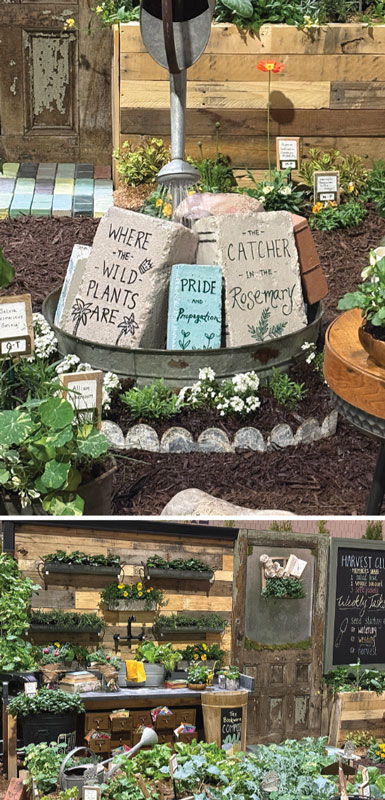
The Gather & Grow Bookshop Garden was a creative and fun installation from the Monmouth County Vocational FFA Chapter. I loved their hort-themed books (my fave was “War & Peas.”).
A Creative Boost
The best part about the show is that it wasn’t just visual, it was also tactile. There were so many ways to interact with plants—here’s just a short list of what I saw:
- Tu Bloom’s lively Potting Parties, which he hosted four times a day for most of the show. Attendees paid to receive design help (and riff with him) while they put together mixed containers using plants from Bailey Nurseries, Suntory Flowers, PanAmerican Seed’s Cool Wave Pansies and more, as well as materials from Organic Mechanics Soil, Corona Tools and Oasis Forage Products.
- A flower crown bar where guests could put together headwear, which I saw people wearing all over the show
- A bouquet truck where visitors could put together beautiful fresh flower bouquets
- An area where visitors could build their own terrarium
- Tables where guests could create floral handbags, hand-painted vases, custom tote bags or bucket hats
- A “tea room” where you could make your own loose-leaf tea blend
- An area designated for custom candle-making and home fragrance projects
There were also educational sessions that ran throughout the show (the ones I sat in on were well attended with lots of questions), as well as two marketplaces where visitors could shop for everything from live plants and cut flowers to candles, home decor, gardening products, food, clothing/accessories and more. And when I say people were shopping, I mean I rarely saw someone on the first actual day of the show (not including the member preview) who didn’t have a bag, a bouquet or were wearing something they created. Anecdotally, the inspiration seemed to be translating to purchases. Inspirational, indeed. GP
Behind the Scenes
It takes a tremendous amount of work to put this show on, and first off, I have to tip my hat to the Pennsylvania Horticultural Society’s entire staff, the designers who create these gorgeous installations, the more than 3,000 volunteers and the growers who force a multitude of plant material to make sure there are blooms to be enjoyed by the masses in late February and early March.
I got an email from Lloyd Traven of Peace Tree Farms, who I didn’t realize forced a lot of the plant material used by several designers, as he’s done for many years. He’s also involved in the PHS Hamilton Horticourt section where plants are submitted by gardeners of all skill levels for judging.
“We forced the material this season for the Central Feature of PHS (the entrance gardens), Susan Cohan, Jennifer and several other florist planters, and the award-winning Kelly Norris garden,” Lloyd wrote. “We ship many truckloads of forced material down the week before the show opens. Nothing happens in the gardens without forced material since it is in the dead of winter!”
I asked show Creative Director Seth Pearsoll for a rundown on how the more than 50 installations come about. He said it’s a combination of a call for submissions and also legacy designers (some have been a part of the show for generations). The show also incorporates horticulture schools, both high school and college, as well as the PHS Hamilton Horticourt of judged plant material from a variety of competition classes.
So how does it all come together?
“They (installation designers) select their own plans because they’re designing their own spaces,” Seth explains. “All the gardens are being judged. So, basically, we give everybody a very loose brief or a prompt. People begin designing their gardens.”
They provide a list of plants to the show and that gets run through the nomenclature committee to ensure proper signage, and then everyone works together in the months ahead of the show to ensure the plants are forced and delivered on time, with designers ultimately responsible for their sections. Of course, not all the material makes it the whole show. Seth said often the perennials and shrubs do just fine for the nine-day run, but annuals and bulbs typically need a refresh by midweek.
“It’s a special thing. It’s a one-of-a-kind event. This has so many different kinds of people in the world of horticulture and gardens and plants,” Seth said. “They all contribute in some way. You’ve got the audience element, this international element ... so it really is this puzzle piece of our industry.”