4/30/2026
Summer Sizzle
Andrew Bunting
As we head into summer, there will undoubtedly be periods of extended drought. For gardeners, this means choosing plants that are not only beautiful, but resilient under stress. Incorporating heat-tough perennials into the landscape reduces reliance on supplemental watering, supports long-term plant health and creates gardens that are better adapted to shifting climate conditions.
There are many plants that are relatively drought-tolerant, and many that can also be included in xeric gardens, gravel gardens or water-wise gardens. These plants are often characterized by adaptive traits such as succulent leaves that store moisture, deep tap roots that access water below the surface or fuzzy, and silver foliage that reflects sunlight and reduces water loss.
 Tough Grasses
The deep-rooted grasses of the Midwestern prairies are outstanding plants for withstanding drought-like conditions. There are many excellent ornamental grass selections that have been made. Garden Designer Jeff Epping, who’s often called the “gravel guru,” uses Little Bluestem (Schizachyrium scoparium) in his designs. As the name would suggest, the strict upright foliage is blue, but can also have hints of pink and red. Turning orange-red in the fall, it’ll also maintain its form for most of the winter.
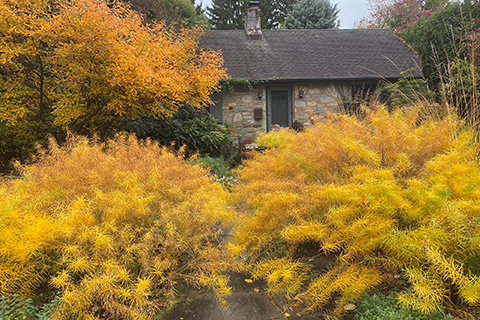
Amsonia hubrichtii
Richard Hawke, director of ornamental plant research at the Chicago Botanic Garden, also recommends Schizachyrium scoparium, as well as Prairie Dropseed, Sporobolus heterolepis and Bouteloua gracilis. Sporobolus heterolepis is a very versatile ornamental grass, with its clump-forming habit and narrow leaves that turn golden in the fall. In mid-summer, airy flower heads are produced that have a fragrance that’s been described as similar to buttered popcorn. Bouteloua gracilis Blonde Ambition is a new selection of the Blue Grama grown for its clumping upright foliage, and sprays of flowers and seed heads that look like eyelashes. Bouteloua prefers well-drained soils and arid conditions. Additionally, Muhlenbergia reverchonii Undaunted (rose muhly) has billowing, cloud-like pinkish-red flower heads.
Together, these resilient grasses bring structure, movement and seasonal interest to the garden while thriving in the toughest summer conditions.
 The Euphorbias
At home in my gravel garden, where the granite gravel is 4- to 6-in. deep, I grow several different euphorbias. The Burrow-tail Euphorbia, Euphorbia myrsinites, has blue-gray leaves on stems that clamber over the ground and striking chartreuse flowers in the early spring. E. myrsinites serendipitously self-sows throughout the gravel garden. If I don’t want it in a particular part of the garden, then I simply pull out the seedlings.
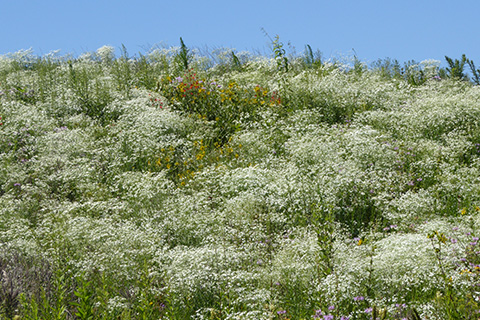
Euphorbia corollata
Both Miner’s Merlot and Blackbird have tufts of upright foliage with purple leaves. Atop the foliage in the spring, there are sprays of yellow flowers. At the nearby Chanticleer Gardens, they grow the very architectural Euphorbia characias subsp. wulfenii in their gravel garden. This euphorbia will take on shrub-like proportions in California gardens, and in Eastern Zone 7 gardens, they make a statement in the garden once established. This evergreen euphorbia has stout upright stems that have large clusters of striking chartreuse flowers in the early spring.
In the east, protecting from wet conditions during the winter and providing excellent drainage is encouraged. Euphorbia corollata, the flowering spurge, is an upright perennial reaching 3-ft. tall and is covered with small white flowers in the summer. This native to the Midwestern prairies will self-sow in the garden. All euphorbias have a milky sap and are truly deer-resistant in the garden.
With their bold forms, distinctive foliage and remarkable tolerance for heat and dry conditions, euphorbias bring both resilience and architectural interest to water-wise plantings.
 Desert-like Plants
For the most heat- and drought-exposed sites, gardeners can look to plants adapted to true desert conditions. Many of these species, including a surprising number of hardy cacti and yuccas, are well suited to Mid-Atlantic-area gardens when grown in sharply drained soils.
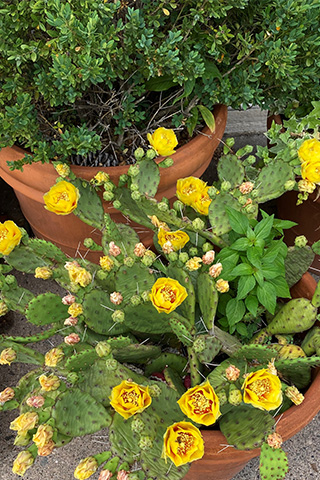
Opuntia humifusa
Plantings can include some very tough water-wise plants, such as native cacti. There are a host of cacti that are native to the western U. S. that are perfectly hardy in the Mid-Atlantic, too.
The prickly pear (Opuntia humifusa) is native to the East Coast. It’ll clamber and spread, and in late spring, it produces an abundance of bright yellow flowers. At the Pennsylvania Horticultural Society’s Meadowbrook Farm, just north of Philadelphia, we showcase many species of hardy cactus, including Opuntia and Cylindropuntia.
Adam’s needle (Yucca filamentosa) is an evergreen and very spikey foliage plant. As it grows, it develops a very deep tap root, whereby it requires minimal to no supplemental watering. Tall spikes of flowers arise at the base of the leaves in late spring. The flower spikes can reach over 6-ft. tall and are covered in pure white, bell-like flowers. Color Guard is a cultivar that has variegated leaves with a yellow center and a green edge. This selection is great for winter interest. Yucca glauca starts out as a perfect sphere of very spikey leaves that are blue-green. As it matures, it develops a trunk and, in the Mid-Atlantic, can reach over 10-ft. tall, which creates a very desert-like feel to the garden.
 Stalwart Perennials
One of the most impressive of all the perennials is Amsonia hubrichtii. Amsonia develops a tenacious root system over time, and in the spring, upright stems emerge covered in narrow leaves, which give it a fine texture in the landscape. In May, it’s covered in skyward-facing, star-like, pale blue flowers. In the heat and drought of the summer, it’s unwavering. In the fall, it has exceptional golden-yellow fall color. Like the euphorbias it, too, has milky sap that makes it unappetizing for browsing deer.
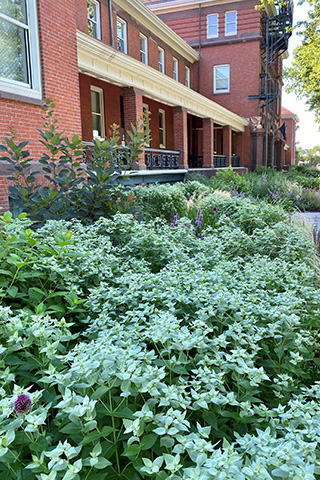
Right: Pycnanthemum muticum
The mountainmint (Pycnanthemum muticum) is excellent for its ability to survive long periods of drought. It’s touted as one of the very best perennials for attracting myriad pollinating insects. When it’s in flower, it’s literally buzzing with native bees, flies and wasps. This colonizing perennial is noted for its silvery-white bracts that support very tiny pale lavender flowers. While the flowers are fairly inconspicuous, they’re a magnet for pollinators. Because of the mint-like fragrance of the leaves, it’s proven to be deer resistant in the garden.
Lavandula x intermedia Phenomenal is one of the very best lavenders that thrives in many gardens. This perennial is undaunted by dry conditions and drought. Silvery evergreen leaves are an ornamental characteristic throughout the year. Spikes of purple flowers in the summer give an added ornamental quality.
 Water-wise Sedums
Sedums are among the most reliable and adaptable perennials for hot, dry conditions, valued for their ability to thrive in shallow soils and exposed sites. Their succulent foliage allows them to store water efficiently, making them ideal for green roofs, gravel gardens and other low-input landscapes.
Sporobolus heterolepis
On a recent visit to Emory Knoll Farm, which is a wholesale nursery that features plants for green roofs, I observed an impressive array of drought-tolerant sedums that thrive in hot, dry, low water conditions, including Sedum rupestre Angelina, Sedum spurium Red Carpet and John Creech, S. sexangulare, S. album and S. kamtschaticum.
With periods of drought becoming more commonplace in American gardens, it’s important to have knowledge of those plants that’ll not only withstand, but thrive in these conditions. The aforementioned list is a nice cross-section of plants that gardeners can use in their “tool box” to combat these extremes in the garden. GP
Andrew Bunting is the Vice President of Horticulture for the Pennsylvania Horticultural Society (PHS). Visit PHSonline.org.