6/1/2026
Bringing Customers Back
Edited by Jennifer Polanz

Every year when we sit down to read the nomination forms for our Green Profit/The Garden Center Group Young Retailer Award, I’m always impressed at what young people are accomplishing in our industry. They’re taking on leadership roles within their organizations and often times working to better the industry as a whole. It’s really exciting to see and this year was no different. In this award’s 21st year, we have three finalists who exemplify what it means to take on responsibility and grow within an organization, looking at the bigger picture for their retail operations. I’m proud to announce them as our finalists for 2026. Of course, every year we also ask them to write an essay (usually during a very busy time) to help our judges in their selection process and this year the question was:
What are some strategies you think independent retailers can use to cut through the noise and entice customers in for repeat visits this year—particularly in off-peak times—and why do you feel that way?
Read on for their thoughts, and join us Monday, July 13 at the Unplugged Event at Gaswerks during Cultivate’26 to find out our winner!
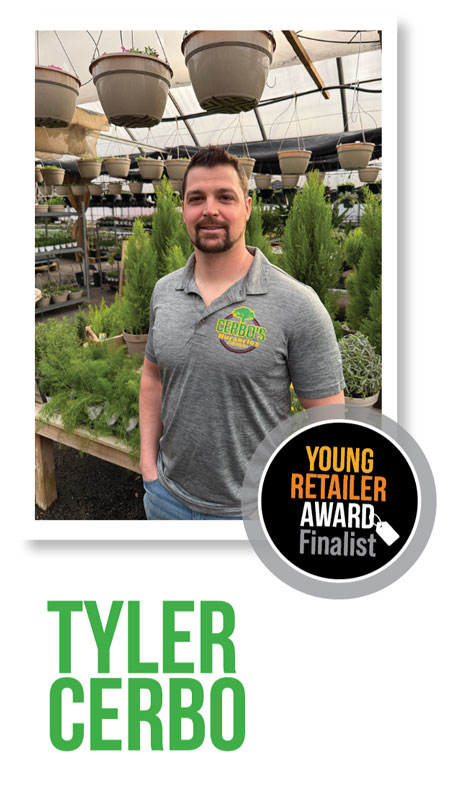 Tyler Cerbo
Age: 33
Title: General Manager
Operation: Cerbo’s Parsippany Greenhouse & Garden Center, Parsippany, New Jersey
Spring is the best time of year for our industry and predictably always will be. It’s the iconic season for what we do. Weather begins to turn, new plants begin to grow and we once again welcome in our loyal customers that support our passion for this business.
The “Spring Rush” is an almost indescribable excitement, but how do we cultivate that in other times of the year? How do we increase our transaction counts and profitability in those tough off-peak season months so we’re not losing what we worked hard to earn in spring? While the weather is out of our control, there are ways we can be a year-round resource to our communities.
The famous rule of 80/20 is no stranger to the green industry: 80% of our business comes from 20% of our customers. While generally a true statement, most garden centers report the average customer visits just two to four times per year. Furthermore, IGCs average just over 50% of their annual revenue in Q2 with six months or less being profitable (Garden Center Group Reporting 2025). Increasing customer visits year round is key for growth and a sustainable business. Three key areas come to mind to entice customers to revisit more frequently and help out with tough cash flow valleys. These are: diversifying offerings, curating a space with year-round appeal and effectively retargeting your market.
Just as a wise investor diversifies their portfolio, we too can broaden our products and services to meet the needs of each season and alleviate cash flow valleys. Find product lines that have appeal all year long. Houseplants have always been a staple for year-round sales. This group of customers has 12-month purchase potential and can be incentivized with some off-season events. Roughly four years ago, inspired by Aroid Greenhouses, we held our first “plant swap” for our houseplant customers to come in and exchange plants in a flea market-style environment. We now do three to four plant swaps per year in the slower seasons and each one has grown in attendance (and sales). This has in turn helped build a houseplant community that shops our store more frequently.
What other product lines can you sell to diversify your offerings? Summer produce? Fresh cut flowers? As a company in the Northeast, we naturally came upon the ice melt category a few years back and it’s become a game changer for our Q1 business. Our customer base also needs ice melt in the winter when it snows, so why not buy from us? It was a new line that fit our customer needs in a time of year when we don’t typically see them in our store. One word of caution here: Pursuing product diversity is great, but not if it comes at the expense of another profitable revenue stream. A good example of this in our family’s business is outdoor furniture. While this might be a good venture for some IGCs, for us it’s a historically low turnover line that occupies a lot of real estate—something most of us need for other critical product lines and customer parking.
While companies typically compete on price and quality, IGCs have a unique opportunity to also compete on experience. Our spaces can be havens and sanctuaries for customers to come enjoy and shop. The more we tweak and improve our space from season to season increases the likelihood of drawing our customers back in for another visit. Consider running events and providing workshops as an opportunity to get more foot traffic during slower seasons. Kid-friendly activities can be an added bonus, especially when school is out and parents are looking for experiences to share with their children.
If having a diverse offering and attractive space is the engine to your business, then marketing it is the fuel. We spend plenty of time and money advertising to get a new customer in the door, but often overlook the value of re-targeting our current customer base. Customer rewards programs that capture contact information can be a huge boost to staying connected with your customers year-round. Think of all the effort you went through to get them in your store—don’t miss that opportunity to get them on your email list or text campaign letting them know about your next event or new product. Newer platforms can now track customer purchasing habits and re-target them based on their preferences. The more specifically you can target their needs the better.
While we can’t make a second spring happen in our businesses, we can do a lot to recreate some of the same energy. IGCs are hot spots in local communities. Take advantage of what’s unique about this business every chance you can. We have so much more to offer than what our customers see in spring.
Meet The 2026 Judges
Bill McCurry—Green Profit columnist and owner of McCurry Associates consulting firm
Kate Terrell—President of Wallace’s Garden Center in Bettendorf, Iowa (and former YRA nominee)
Danny Summers—Executive Director of The Garden Center Group
Brandon Kirby—Partner Business Development, Rainbow Gardens in San Antonio, Texas, and 2025 YRA Winner
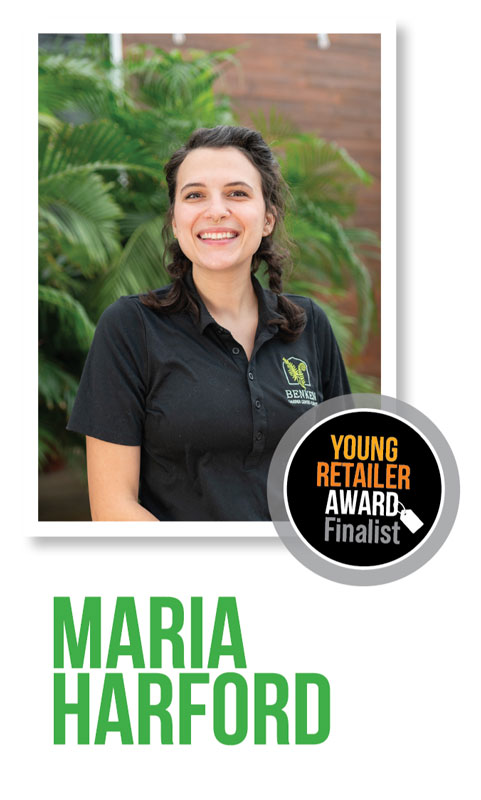 Maria Harford
Age: 32
Title: Garden Center Manager
Operation: Benken Garden Center & Florist, Cincinnati, Ohio
When we greet customers in the spring, it’s not uncommon for them to tell us that they’re in their “happy place.” It makes sense, with our patio filled with blooming annuals and colorful hanging baskets. It may surprise some, though, to hear that winter is similar. People are looking to get out of the house, and the garden center is somewhere they can go to be around life and nature and greenery, even when it’s cold and gray outside. I think we as independent garden centers really need to embrace that “happy place” and become not just somewhere people go to buy something, but a place where they go to do something or learn something.
The event team at Benken Garden Center has spent a lot of time, particularly over the past couple of years, scheduling out and planning a variety of classes and workshops. There are, of course, the standard porch-pot planting workshops each season and wreath decorating in the wintertime. Since we also have a full floral department, we host flower arrangement classes. We partner with local artists who connected with us through our winter Maker’s Market to lead pottery classes and printmaking classes. We host a yoga class once a month, taught by a former employee, and tasting events with a local coffee shop. These workshops connect us to the community and bring in people who maybe haven’t shopped with us before, but will now think of us when they’re looking to send some flowers or plant a landscape at their new house.
Benken has been running for nearly 90 years. Over that time, we’ve become a part of many families’ traditions. For the past 25-plus years, we’ve hosted an annual Winter Open House when we’re fully stocked and ready for Christmas. Trees, wreaths, greens, poinsettias and giftware are all set up, and kids can visit with Santa. There are workshops for adults and kids, and many local families come back year after year. Easter is similar, with a visit from the Easter Bunny and classes to kick off spring. We have photos of some of the same children from five years ago who now are coming with their younger brothers and sisters as the family grows. We see those same families come in throughout the year when it comes time to plant up their spring garden or pick out a new houseplant.
Every year in late winter we spend a whole day celebrating houseplants with sales, paid workshops and free educational lectures. Obviously, the houseplant industry had a boom during the height of the COVID-19 pandemic, but we still have plenty of houseplant hobbyists riding that wave. It’s really incredible to see a whole city (and beyond!) worth of plant enthusiasts come together for a day. Staff members lead most of the workshops and lectures, so customers see exactly who to come to later when they have questions. They learn to see us as the experts and as a resource.
That also means that you need to invest time into educating your staff. If customers can’t trust that your staff are there to provide them with accurate information, how are you any different from a big box store? Our grower does an incredible job (special kudos to the hanging basket combos that I fall in love with again every April), but the most beautiful plants in the world can’t go very far if staff are unavailable or unhelpful. Have educated staff available to answer the questions the customers have and teach about the questions they don’t think to ask.
Don’t discount the importance of being friendly, welcoming and engaging to guests who come in at any time, whether it’s during peak spring business or the slow times in January. I’m proud to have a great core group of people on staff who are not only great with customers, but also get along well with each other. No one likes to visit any business where the employees look miserable just being there. And when your employees actually care about what they’re doing, they’re more invested, and that shows in the ways they do their jobs.
Give guests an experience: A beautiful place to spend their time, friendly people to talk to, staff available to answer their questions. The spring customer with a cartload of annuals is great, but they may only come in once a year. They’re no more or less vital to your success than your regular who comes in to browse houseplants every other week throughout the rest of the year or the customer who makes a girls’ night out of every workshop you host. By becoming an engaging part of the community, the community will come to you.
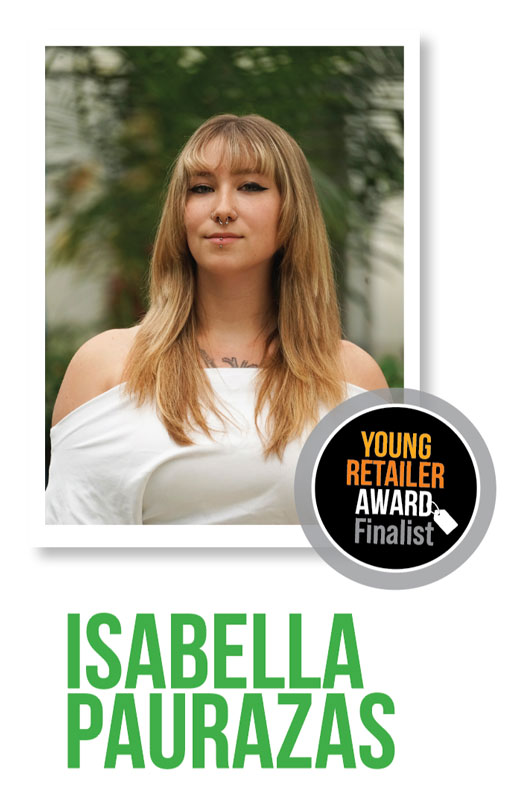 Isabella Paurazas
Age: 23
Title: Retail & Tropicals Manager
Operation: Willow Greenhouse, Northville, Michigan
Modern horticulture faces its most anomalous dilemma so far: In order to prevail within a society where continuous stimulation is available at the swipe of a screen, the industry must evolve at its quickest pace yet in order to maintain relevancy. The trend cycle’s wheel continues to turn, churning out new sensations and crushing the hesitant garden center underneath it. In order to cut through the noise of fads new and old, retailers must position themselves as reliable community foundations that are here to stay by strengthening their ties to their customers.
In the era of rising costs and tighter purse strings, the pursuit for a public sanctuary where one can commune free of financial burdens grows difficult. Despite this challenge, garden centers with indoor real estate during the off-season are ripe with third-space potential, making this time of year perfect for low-cost activities. Classes, workshops and consultations are the perfect occasions to increase foot traffic. Events such as these generate excitement for the season to come and ensure that one’s business remains in consumers’ sightline rather than falling to the periphery.
This is also an opportune time to transform previous staging areas into lounges, venues or atriums available for public use or private rentals. In doing so, garden centers and greenhouses alike open their doors to new potential customers and sales. Businesses residing in colder climates have the ability to market their spaces as tropical reprieves where people can escape the elements. Shelves stocked with alternative products, such as ornamental houseplants, are now shoppable to consumers who may have otherwise turned away from or avoided indoor cultivation. This, coupled with time-sensitive coupons or promotions, welcomes consumers into one’s space and exemplifies all that it has to offer, even in the dead of winter. This method has proven particularly successful at Willow Greenhouse’s own garden center, as we schedule numerous events throughout the week when winter pushes us inside. Sales data over the past year has shown us that off-season events generate two to three times the daily revenue when compared to the typical day within the same time frame. These events rotate with the season change, therefore diversifying what activities we offer our customers so they’re encouraged to return for more.
Furthermore, garden centers are rich not only in venue space, but also in knowledge, thus allowing them to become an educational pillar within their community. By positioning one’s business as a safe haven for accurate information, you further establish your credibility and become the resource your consumers consistently return to. This repertoire can be expanded upon through the partnership with local businesses, plant societies and garden clubs who bring with them their own unique clientele and outreach. Translate these resources into online posts and one’s business can be elevated from a brick-and-mortar storefront to a digital archive accessible to anybody with a screen and searchable on any browser. What’s more, educating one’s customer base on the additional realms of gardening increases both their agricultural horizons and a business’ sales potential. Catering to newfound interests such as vegetable gardening, houseplant rearing, cultivar breeding or native restoration ensures that customers are shopping year-round.
Moreover, establishing your niche unlocks an unforeseen loyal customer base while setting yourself apart from local competitors. This is particularly true when one’s niche is accessible year-round, whether it be rare tissue-cultured plants, unique hybrids, reliable nativars or pesticide-free specimens. The digital age has granted consumers the ability to have plants from an entirely different state land at their doorstep by the end of the week. However, working with volatile products creates a wide margin of error during shipping, and hobbyists and professionals alike agree that accessible, local plants prevail over online shopping. Stocking items unavailable at nearby greenhouses or big box stores ensures that your business is the first choice for that product. Over the past year, I’ve introduced a line of uncommon, tissue-cultured tropical plants into our greenhouse. Since shelving them six months ago, these species’ sales now account for approximately 14% of our tropical net sales within that time, and these products average a 10% to 20% higher profit margin than other tropical products. As a result, these plants have become a staple for our shelves, as they’re highly sought after, and our area lacks other growers specializing in them.
Through my experience as both a hobbyist plant keeper and retail grower, I’ve come to understand the monumental practices through which independent storefronts can revolutionize their commercial appeal and customer retention. The aforementioned methods are not simply theoretical assumptions, but rather dependable programs that I myself have executed and they’ve continuously been proven fruitful. My team and I are endlessly rewarded by these efforts, and the satisfaction is exemplified by our returning customers and financial growth. As a result, we’re provided the chance to expand our operations and product selection. Now, more than ever, our loyal clientele is present and satisfied year-round—a privilege we haven’t always been afforded. GP