6/30/2026
Solution for the Silver Tsunami
Bill McCurry
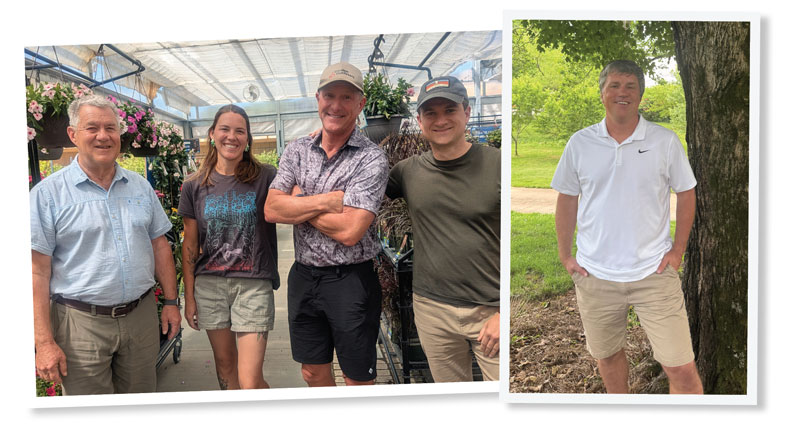
Garden Outfitters (GO) is trying to solve the challenge of the “Silver Tsunami,” otherwise known as retiring owners closing their garden centers.
Ken Klopp (left) and Sid Raisch, McKenzie Lain, Ken Lain and Owen Raisch (right).
GO’s goal is charting a bright future for the industry by delivering scalable operations, boosted purchase power, improved consumer engagement and brand impact, bundled with an owner’s liquidity event. They aim to do this by applying insights gathered from decades of work experience both with and as industry outperformers, combined with recent technology advances that fundamentally change retail economics.
GO’s leadership team consists of three industry veterans: Ken Lain (president, owner of Watter’s Garden Center), Sid Raisch (consultant, Advantage Development) and Ken Klopp (marketing expert, creator of The Perfect Plant), who have decades of experience. The next-generation includes Owen Raisch, a founder/operator experienced in applied technology and scalable business systems, and McKenzie Lain, the 2024 Green Profit Young Retailer of the Year (general manager, Watter’s Garden Center). Their various ages and experiences allow strategies supporting a cross-section of customers and employees.
The Goals
What GO calls the “Operator Equity Advantage” is the main thrust, bringing together independent garden centers that will continue to be the lifeblood of the industry and the source of new products for their communities. With local ownership still significant, they harness entrepreneurial drive and create owner liquidity, while efficiently delegating the boring and cumbersome back-office functions nobody ever really got into this business to do.
GO contrasts the traditional private equity firms as “cost cutters,” bleeding organizations with the ability to flip the business and get quick profits. The new owners are willing to overpay, based on short-term profits that may not be sustainable. GO’s vision is to improve value with “Operator Equity,” focusing on “yield” or growth. By building the team, marketplace and the engaged customer bases, the organization becomes worth more. This gives economic gains to the owner and to GO. Every deal can evolve differently to meet the needs of the garden center ownership.
Where it May Work Best
An example is an owner who’s a few years from desired retirement. GO brings the owner partial liquidity, plus shares in the overall GO business, while alleviating burdensome administrative chores. GO resources help increase sales and, most importantly, profits. The increased profits and partnership with other similar retailers means the original owners have heightened value in their remaining GO investment. The owner gets a larger return upon retirement.
GO’S vision is for localized experiences combined with specialized and inspirational plant experiences. They know that customers return to places that embrace them, give them a peaceful environment and promise new gardening joys. The aura of good value is critical.
GO is best understood as an operator-led ownership platform. It uses familiar acquisition tools in a more owner-aligned way. Participating retailers may receive liquidity and, in many cases, hold equity in either the broader GO business or their own business, rather than simply selling and walking away. The goal is to preserve strong local identity, while developing the next generation of store leadership.
When the owner retains the real estate, they can continue to own the property and eventually reap capital gains from the sale, while enjoying the rental income. If they want more liquidity, GO can arrange a real estate purchase and lease back.
A benefit of the owner staying on is to avoid immediate changes impactful to customer or employee loyalty. Improvements should lead to increased profits and lessen tedious functions. Attention should go to customers, sales and profit growth.
In this century, most garden centers cut back their advertising dollars before discovering social media wasn’t going to be “free” forever. This is another area where syndicating high-quality content among similar retailers gives outsized returns for the dollars invested. It takes commitment, knowledge and perseverance to win market share. At local garden centers, most customers only spend money from one or two paychecks a year. GO’s model generates interest in participating more often, resulting in more customers who spend from more paychecks, which creates more store traffic and year-round engagement.
When there’s total ownership of customer data, AI can target messages to those who would benefit from them. This reduces irrelevant messages (spam), which cause “unsubscribe” messages or high “unopen” rates, while transactions and profit slip further.
Private branding is a proven technique for building satisfied returning customers. Some older generations see “private label” as cheap stuff. Those who’ve grown up with Costco know Kirkland, a larger brand than Nike, Coca-Cola or United Airlines. GO’s philosophy isn’t to abandon existing brands. They believe, “Good vendors make us all better. We’re destined to be partners together.”
Smaller stores have heart!
GO believes a consortium of them also has more muscle to lift their business to greater heights. Together their model is both financial and a cultural reclamation. It’s bringing the local independent garden center the authority and presence to be their community’s outstanding leader. It creates an environment where the next generation of employees (and potential managers or owners) love what they do. Too many young people see their overworked elders and say, “I want a work/life balance, which I obviously can’t get as a manager/owner of this company.” By removing administrative tedium, GO proves the younger generation doesn’t have to be slaves to the business as the older generation was.
To most investors, smaller garden centers don’t have a business to sell. Instead, they have a job to sell, which isn’t appealing to investors looking for work/life balance. If your current operations aren’t large or financially viable enough to support an outside investor, GO offers consulting/coaching services to help you grow profits to a workable level.
GO can provide liquidity for more senior people to fully or partially retire before the “younger generation,” who see their path blocked by their elders, is ready to retire themselves or quit in frustration.
If you’re looking to retire completely, the best time to start is around five years before your retirement. If you want to build your team and your business as a more effective retailer, the best time to start is today.
For the owner/operator who feels stewardship toward their employees, their community and their family’s legacy, GO believes they offer a solution allowing enjoyment of the growing legacy success, while also providing necessary liquidity.
It’s refreshing to see industry veterans taking a fresh approach to resolving significant industry challenges. GO goals are significant, but not guaranteed. We wish them the very best of success in keeping the independent segment healthy and in building customer connections with strong financial growth.
More information is at TheGardenOutfitters.com. GP
Author’s Note
This article is based on interviews with five industry leaders whose statements share a vision for the largest ownership transition in garden center history. We appreciate their vision as an alternative to the damage an industry-wide Silver Tsunami would cause, but the validity of their plans has not been verified. Readers should investigate all options independently and seek competent counsel.
Bill McCurry is the owner of the consulting firm McCurry Associates. Please contact him at wmccurry@mccurryassoc.com or (609) 731-8389.