7/31/2026
Attracting Hummingbirds
Andrew Bunting
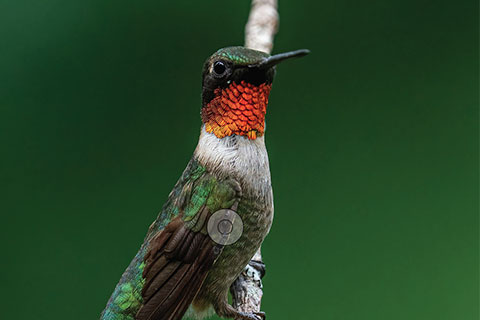
Editor’s Note: Due to space constraints, we could not fit the hummingbird portion of Andrew’s story on plants to attract birds in the July issue, so we made it a separate article for August.
Gardens can serve as far more than ornamental spaces; they can also function as important habitats to attract many beautiful birds, including a fan favorite: hummingbirds.
Photo credit: Skyler Ewing
Hummingbirds seek out nectar-rich flowers that are often tubular in their shape and have vibrant colors. Native to North America, there are several native hummingbirds, including the Ruby-throated Hummingbird, Anna’s Hummingbird, Rufous Hummingbird, Black-chinned Hummingbird, Broad-tailed Hummingbird and Calliope Hummingbird.
In spring along the East Coast, many migratory birds travel north through the region. Dozens of warbler species journey from Central and South America, stopping in the region before continuing to breeding grounds farther north in the United States and Canada. One of the most anticipated arrivals is the Ruby-throated Hummingbird. These tiny birds spend the winter in southern Mexico, Central America as far south as Panama, and parts of southern Florida before migrating north each spring. Their breeding range extends across much of the eastern half of the United States and into southern Canada. In large shrubs or small trees, they construct delicate nests roughly 2 in. in diameter, typically positioned 10 to 20 ft. above the ground. The nests are built from plant fibers, soft materials such as dandelion down and spider silk, and are often camouflaged with lichens.
Plant Options
To attract hummingbirds to your home garden, earlier-flowering vines are an essential nectar source for the arriving Ruby-throated Hummingbirds in the spring. In general, the Ruby-throated Hummingbird is attracted to brightly colored flowers with tubular shapes. There are many selections of the native coral honeysuckle, Lonicera sempervirens. This twining vine grows best on a fence or a trellis and will flower best in full sun. Major Wheeler is a PHS Gold Medal recipient with coral red flowers blooming in late April to early May. John Clayton has sulphur-yellow flowers and Cedar Lane has more narrow leaves and carmine-colored flowers.
Also blooming in late April to early May is the crossvine, Bignonia capreolata. Tangerine Beauty is a Gold Medal recipient with reddish orange flowers. The crossvine occurs naturally in the Southeastern states and west to Texas, but is perfectly hardy in the Mid-Atlantic. It’s a self-clinging vine that’s able to attach to buildings, fences and tree trunks. It has narrow, semi-evergreen leaves that can turn an attractive purple in the fall. The tubular flowers occur before the leaves come out. Flowering can be so dense that an entire wall can be covered in a floral display.
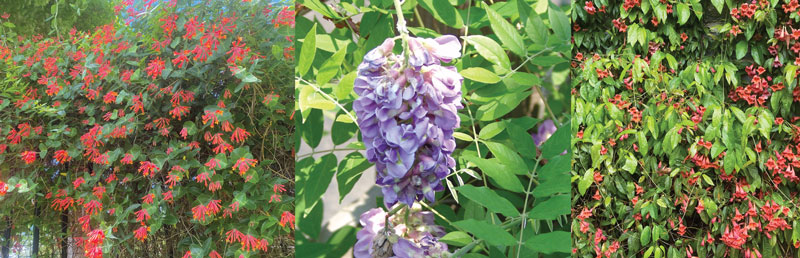 Lonicera sempervirens
Wisteria frutescens Amethyst Falls
Bignonia capreolata
Finally, there’s also a native wisteria that can be considered for attracting hummingbirds. Wisteria frutescens Amethyst Falls has pendant trusses of fragrant, lilac-purple flowers that appear in May and cover the vine. Like the lonicera, it’s a twining vine and will also thrive in full sun.
There are many other excellent plants that attract hummingbirds. On the West Coast, consider the California fuchsia (Epilobium canum) with its scarlet tubular flowers. Hummingbird sage, Salvia spathacea, has evergreen foliage and produces magenta flowers. In the East, bee balm (Monarda didyma) is one of the popular hummingbird-attracting plants. There are many nectar-rich cultivars with whorls of tubular flowers, including Jacob Cline with vivid red flowers.
The woodland, wild columbine (Aquilegia canadensis) has spur-like flowers of red and yellow and is an important nectar source as hummingbirds are migrating from the south to the north. There are also many cultivars of the Eastern penstemon, Penstemon digitalis, with tubular white flowers, including Husker Red, which has purple foliage.
Even the smallest garden, patio or planting bed can play a meaningful role in strengthening local biodiversity. Gardens rich in native trees, shrubs, grasses, vines and perennials not only support birds, but also sustain pollinators and countless beneficial insects that contribute to a healthier ecosystem. GP
Andrew Bunting is the Vice President of Horticulture for the Pennsylvania Horticultural Society (PHS). Visit PHSonline.org.