8/31/2026
Trials and Eras
John Friel
Late July found This Space strolling the Penn State Extension trials at Landisville. It may surprise you (it did me) to learn that this quiet rural setting is among the world’s oldest flower trials, celebrating its 90th birthday this year. I wasn’t surprised to see over 1,000 varieties of annuals and perennials from 30 breeding companies.
En route to the trials, I was sidetracked by an “Idea Gardens” sign. It proved a providential detour, packed with themed plantings.
The Potager Garden was a French-style kitchen garden blending form and function. Corn, potatoes, onions, carrots and pole beans co-existed happily with ornamental annuals and perennials. The perfect liaison: Nasturtium, the prettiest salad garnish ever.
The Pollinator Garden contained the natives you’d expect: pycnanthemum, phlox, coreopsis, helenium, monarda etc., plus surprises like red-twig dogwood and scutellaria. It’s part of Dr. Doug Tallamy’s brainchild, Homegrown National Park (HNP). The idea is simple: Plant natives, remove invasives. The implications are enormous: A fraction of America’s lawns, converted to nature-friendly habitat, would cumulatively constitute America’s largest national park.
HNP is a multi-faceted non-profit with numerous ideas about how to help ourselves and nature simultaneously. This year, I took the Mosquito Bucket Challenge. The problem: Mosquitos breed in stagnant water. Cure: Eliminate as many such murky pools as possible, even tiny ones, then create one smallish reservoir —e.g., a bucket—and treat it with a “dunk” that kills only mosquito larvae, unlike pesticides and UV traps that murder moths, butterflies and more.
It sounds almost too easy, but it’s actually made my deck a nicer environment: I’m getting bitten a lot less. But I digress.
In the best trials, plants are expected to (mostly) fend for themselves. The trial program itself can’t do that; it takes lots of hands-on organization and maintenance. For many years, PSU’s trials were managed by Extension Agent Alan Michaels, then taken over by an old friend and colleague, the late Sinclair Adam, who died unexpectedly in 2023. It still felt odd to not see him here.
But while I checked out third-year echinaceas, along came the new flower trials manager, Sarah Mitchell—another old friend and ex-colleague. Between Sinc and Sarah, the massive job was capably handled by Interim Manager Krystal Snyder. Kudos to all, and to the volunteers, especially Master Gardeners, who keep things tidy and organized.
Fave finds:
Eutrochium fistulosum JoJo from Kind Earth Growers. This compact Joe Pye is allegedly sterile. Hence, no seedlings popping up, and it’s very long-blooming: early July to hard frost. The genus is better known as eupatorium. Growers are slowly, grudgingly changing, years after taxonomists made the switch. Online, you’ll find it more often by its old name.
Echinacea rows included some splendid selections, especially Bull Plant Genetics’ red-flowering varieties.
Sedum Cherry Fizz from Terra Nova: Historically, dark-leaved sedums tend to have floppy, bird-nesting habits. This impressive exception features healthy, neatly mounded, deep red/bronze foliage.
Gaillardia Guapa series, an award-winner last year, still impresses. Guapa is Spanish for “pretty.” It fits.
Those that didn’t emerge for Year 3 tell a story by their absence: Many original block-of-six plantings are down to three or four survivors.
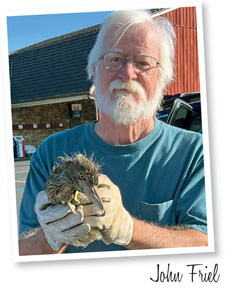
Speaking of survivors: At Landisville, someone mentioned the critter in the pic atop this column. The one that’s not me is an immature black-crowned night heron, one of about a dozen birds I’ve taken to Raven Ridge Wildlife Center. This migratory species (genus Nycticorax) breeds nearby. Without human intervention, chicks that fall from the nests are doomed: They can’t fly or feed themselves, are often injured, and their parents aren’t coming to the rescue. Nature isn’t deliberately cruel, just massively indifferent.
It was downright exhilarating to learn that the latest one was successfully nurtured to healthy adolescence and released back into the wild. Yay, Raven Ridge! Oops, digressed again.
The Trials include a small trade show, plus speakers, continuing education credits, guided tours and a pretty good lunch. Consider adding it to your 2027 calendar. GP
John Friel is a freelance writer with more than 40 years of experience in horticulture.