9/30/2026
All in on Christmas
Photos & Story by David Williams
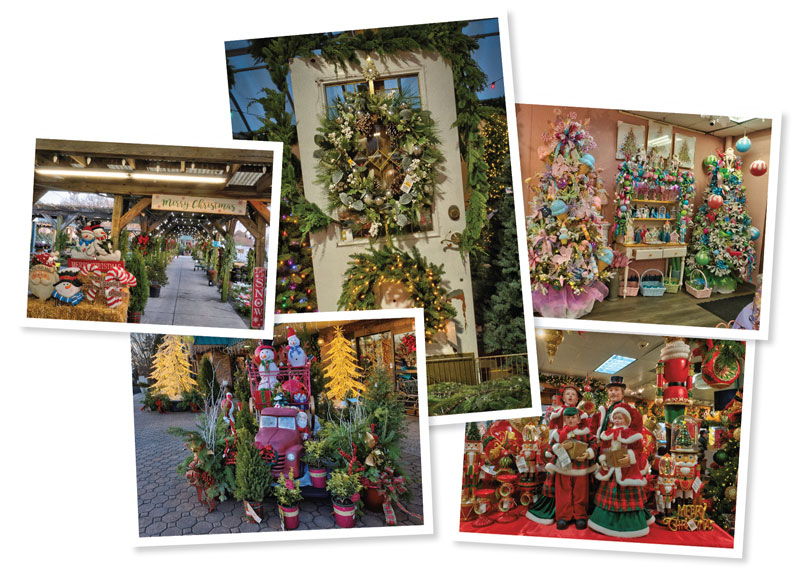
When I sat down with Sandy Noten-Heuman and Jackie Noten-Hudson at Bob’s Garden Center early last December, Christmas was everywhere. Dozens of decorated trees filled the shop, themed rooms glowed with color and the greenhouses were packed with poinsettias. A few days later, FOX 29 Philadelphia came through the Egg Harbor Township, New Jersey, store for a morning walk-through to show its viewers what Bob’s had created. Customers were seeing the finished product, but what they probably didn’t realize was that Sandy, Jackie and their team had been working on it for months. Christmas at Bob’s starts around July 1.
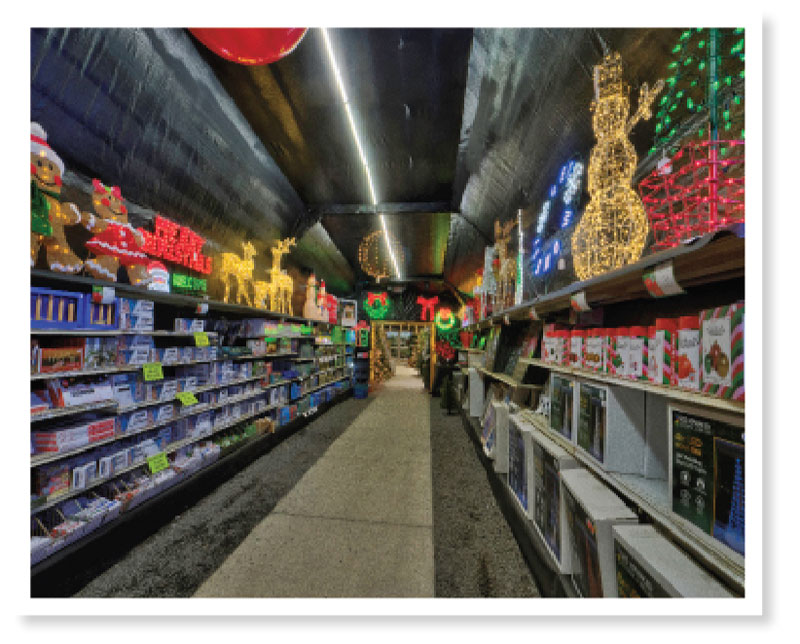
Left: At Bob’s Garden Center they offer everything for Christmas, including Santa, the Grinch, a light tunnel, photo opportunities, themed rooms, decorated trees, live goods and more. For Small Business Saturday, they even leaned into the Grinch with a “Don’t be a Grinch. Shop small business” theme.
I’ve known the family for decades and my relationship with Bob’s goes back to when I first graduated from college. At the time, our family nursery was a broker for Monrovia Nursery and my father assigned me a handful of accounts. Bob’s Garden Center was one of them. I was told I would be dealing with the owner and that I should call her “Mrs. Bob.” I was a little intimidated, and probably a little scared, but I quickly realized that Mrs. Bob was an amazing businesswoman. More importantly, she treated me with respect, even though I was just a kid right out of college. It took me years before I was comfortable calling her Mercedes.
Mercedes loved Christmas retail, but she was also always looking for ideas. Years ago, Mercedes and Sandy would join us on Garden Centers of America tours, visiting garden centers around the country. They were never just along for the trip; they were looking at products, displays, fixtures and merchandising ideas, always thinking about what might work back home. Today, the places they find inspiration have expanded, but the curiosity Mercedes had is still part of how the team operates.
 Creating a Successful Christmas
Christmas now represents roughly 20% of Bob’s annual sales, so this isn’t a small seasonal department. A lot of garden centers dabble in Christmas and gifts, but we’ve always felt that if you want a department to be successful, the customer has to know you’re serious about it. That doesn’t mean overbuying—there’s a big difference between having depth and simply owning too much inventory. A successful department needs a plan, enough product to make an impact and a story that helps the customer understand what you’re trying to create.
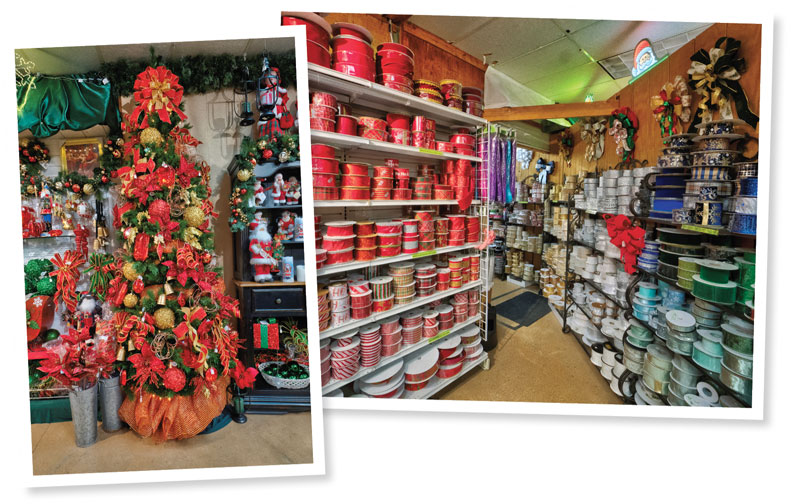
Right: Customers can see oversized bows on the trees—each one is handmade by team members. They can also purchase whole spools in the ribbon room and have team members make custom bows for them.
At Bob’s, that process begins in July. Spring hardgoods start moving out, areas are cleared, gondolas are cleaned, leftover Christmas merchandise comes back out and new product begins arriving. Some employees concentrate on pricing, while others work through inventory and get merchandise into the right areas. Sandy, Jackie and members of the design team decide where the major themes will live and how the colors will flow. Then the decorators start putting it all together.
There are about 50 decorated trees throughout the Christmas shop. Sandy would like to cut that number back a little; Jackie may need some convincing. That kind of friendly disagreement seems to be part of their process. They may both like a theme and still disagree about where it belongs. One may want the Grinch in one area, the other somewhere else. Eventually, something gets moved, somebody gives in and the store continues to evolve.
Their ideal would be to have most of the Christmas shop finished by October 1. Customers are decorating earlier and the higher-end Christmas customer Bob’s is trying to reach is often thinking about the holidays well before Thanksgiving. That also puts pressure on receiving. Vendors may want to hold shipments until more of an order is complete, while Bob’s would rather receive 80% early than wait for 90% if that delay costs selling time.
 The Display Process
One of the things I like most about the way Sandy and Jackie merchandise is that the displays usually begin with an idea rather than just a group of products. One area becomes a Christmas Palace. Winter Woods gets its own personality. They’re trying to tell a story, then find the merchandise and props that bring it to life. Some of those props don’t come from expensive fixture companies, either. They’re constantly looking on Facebook Marketplace for furniture and display pieces. Fireplaces have been picked up for less than $100 and one especially good piece came from the side of the road.
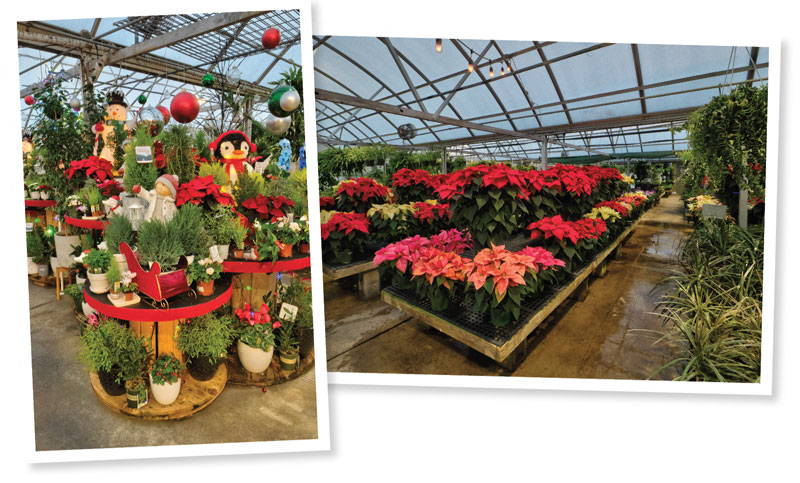
Left: Bob’s carries a large selection of poinsettias, from traditional reds and whites to novelty colors, including plants that have been dyed and glittered. With all the ornaments, artificial trees, ribbon and themed rooms, walking into a greenhouse full of poinsettias is a nice reminder that this is still very much a garden center.
The ribbon area is another good example of how Bob’s turns product into inspiration. They carry a huge selection of ribbon in different widths, colors, patterns and textures, enough that it almost feels like a department of its own. Every oversized bow on their decorated trees is handmade in-house, and customers can have a custom bow made from any ribbon in the store. A roll of ribbon sitting on a shelf is one thing, but when customers see that same ribbon worked into a dramatic bow with ornaments, floral stems and a tree topper, they can picture what it might look like in their own home. The trees aren’t just displays—they help sell the product.
Sell the Experience
Atlanta Market is a major part of the planning process, and I asked Sandy and Jackie how long they like to spend there buying Christmas products at the January event. Sandy would happily spend 10 to 12 days; Jackie thinks seven is plenty. Anyone who’s spent serious time at Atlanta Market can probably understand both answers. They make appointments with major vendors, walk the showrooms, photograph displays, and look for colors and ideas that keep repeating. They also photograph many of the products they purchase so that months later when boxes arrive and everyone is trying to remember why something was ordered or where it was supposed to go, they have those pictures to go back to.
 Just because something is trending doesn’t mean Sandy and Jackie automatically chase it, but they’re willing to embrace ideas they believe can work for Bob’s. The oversized bows are a good example. They saw the look gaining attention, adapted it to their own trees and took it a step further by making every bow in-house. When you’re buying Christmas months in advance, the goal isn’t just to follow a trend, but to turn it into something customers associate with your store. Sandy summed it up well during our conversation: “We’re really trying to sell the experience.”
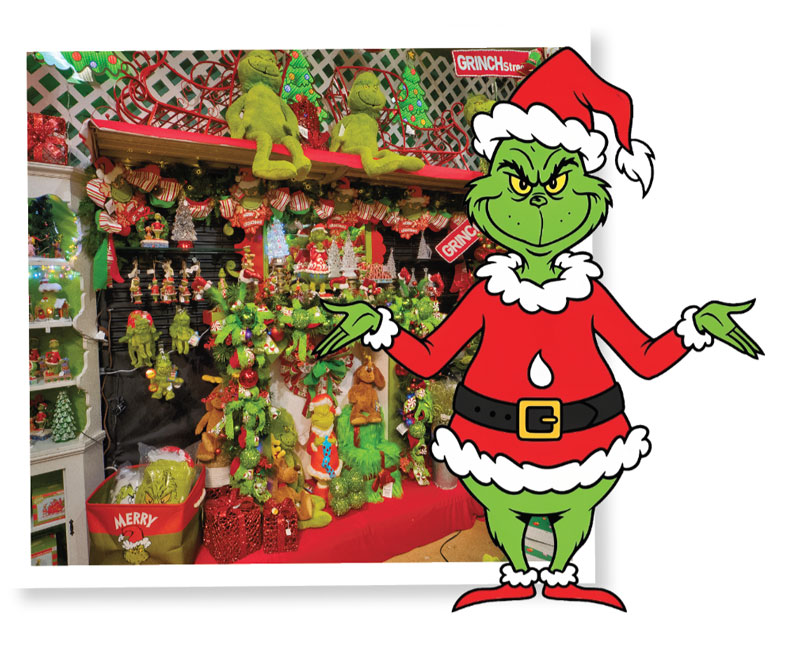
Right Grinch merchandise has been a strong seller for Bob’s.
Bob’s has also discovered something interesting about its customer base: Their Christmas customer is often not their spring customer. They’ve looked at purchase history and found people who shop heavily during Christmas, but rarely appear during spring. At the same time, some of their strongest spring plant customers are barely visible at Christmas. A serious Christmas department may not simply give your existing customers another reason to visit—it can bring an entirely different group of people through the door.
Artificial trees are another interesting part of the business. At Bob’s, artificial trees now generate more revenue than fresh-cut trees and Sandy noted that some of their higher-priced artificial trees were among the first to sell.
Sandy and Jackie are also not afraid to reduce categories that are no longer earning the space. Department 56, once a major business for them, has been scaled back considerably. Gingerbread may get less room because it didn’t perform as strongly as expected, while Grinch merchandise has been strong. Being all in on Christmas doesn’t mean being committed to every category forever—it means watching the customer and being willing to change.
I kept thinking about how that search for ideas has evolved since Mercedes was doing the buying. By the time customers are walking in with the latest look they saw on Instagram, Bob’s Christmas shop has already been planned, bought and built. Sandy and Jackie would much rather be the garden center creating the display that someone else photographs and wants to recreate next year.
 That’s the thread that connects Mercedes to what Sandy and Jackie are doing today. The tools and merchandise are different, but the instinct to keep looking, learning and bringing ideas home is still there. They still travel, visit garden centers and notice the unusual fixture, interesting product or display that makes them stop. Then they figure out how to make it feel like Bob’s.
I told Sandy and Jackie that I thought their mother would be proud of what they’d done with Christmas and Bob’s Garden Center. They agreed and you could tell that mattered. A few days later, FOX 29 from Philadelphia was walking through the Christmas shop, showing its viewers what Bob’s had created. Philadelphia is about an hour away, so having a television station make the trip says something about the destination Bob’s has become. I have a feeling Mercedes would have enjoyed that.
Left: They created this light tunnel to sell their lights and it’s dramatically increased sales.
There’s a lot other garden centers can take away from what Bob’s has built. Start early, keep looking, have enough depth to tell the customer you’re serious, build displays around a story instead of simply filling shelves, show people what they can do with the products you sell and be willing to change when a category is no longer working.
Christmas at Bob’s may start in July, but a lot of what makes it special started with Mercedes a long time ago. GP
David Williams, a fourth-generation garden center owner and former president of the Garden Centers of America (GCA), is s a partner at Garden Center Consultants, leveraging his extensive industry expertise to shape the future of garden retail. Contact him at dave@gardencenterconsultants.com.