9/30/2026
Jump-starting Pollinators
Andrew Bunting
As native pollinators such as bees, flies and wasps emerge, it’s important to have both early flowering plants to provide a nectar source for these pollinators, as well as leaves that can be eaten by the larvae or caterpillars of butterflies.
It’s ideal to have some keystone pollinator species in the garden. A keystone species is a native plant that supports a larger number of insects than comparative genera. These plants include willow (Salix), oaks (Quercus), native cherries and plums (Prunus), blueberries (Vaccinium), goldenrod (Solidago) and asters (Symphyotrichum). By incorporating a variety of these plants into the landscape, gardeners can provide critical resources for pollinators from the very beginning of the growing season.
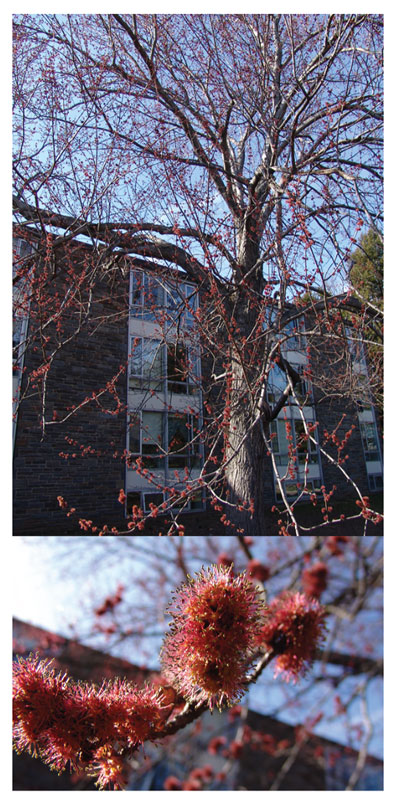
Left: Acer rubrum
Early Flowering Shrubs
There are several native willows including black willow, Salix nigra; pussy willow, Salix discolor; silky willow, Salix sericea; and the prairie willow, Salix humilis. The iconic pussy willow is known for its arching stems that are covered with fuzzy catkins in the spring. At the Philadelphia Flower Show, buying cut branches of pussy willows (non-native species) is a yearly tradition in late winter to early spring.
The catkins, which are the flowers of willows, emerge very early and are a source of nectar for early emerging bees. The leaves are a food source of many caterpillars, including the Viceroy and Mourning Cloak. Many willows also serve an important landscape role in that they can grow on the edge of streams, ponds and lakes, and in poorly drained areas.
The Northern spicebush, Lindera benzoin, serves a multitude of landscape and ecological purposes in the garden. In very early spring before the leaves emerge, the stems are covered in tiny yellow fragrant flowers that are a nectar source for native bees and flies. It’s a larval host plant for the caterpillar of the Spicebush Swallowtail. It’ll thrive in deep shade and in the fall the leaves turn to a golden yellow. It’s also one of the few native shrubs that’s truly deer resistant.
The highbush blueberry, Vaccinium corymbosum, has a wide spreading range from Nova Scotia to Florida and west to East Texas. Like other members of this genus, it prefers an acidic soil and thrives best in full sun. This multi-stemmed shrub reaches 6- to 12-ft. tall with a burgundy fall color. In the spring, it’s covered in pendant, white, urn-shaped flowers and, of course, it produces edible blue fruits. It’s an important food source for bumblebees and many specialist bees, and supports nearly 200 species of caterpillars.
 Early Flowering Native Trees
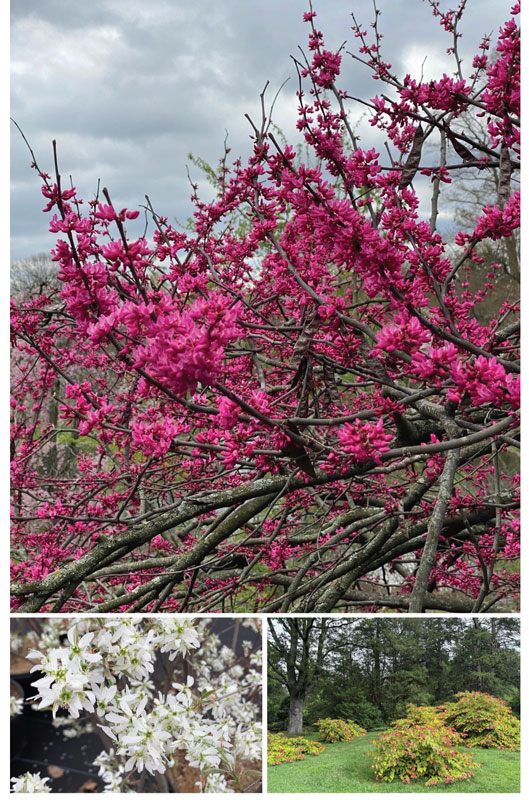
There are about 20 species of serviceberries native to the United States and many of them have exceptional spring flowers and edible fruits in early summer, hence, the common name, Juneberry. This is followed by exceptional fall color, and many of the large shrubs or small flowering trees have smooth gray to silver stems that provide good winter interest. There are several notable species, including Allegheny serviceberry, Amelanchier laevis; Canada serviceberry, Amelanchier canadensis; and a naturally occurring hybrid, Amelanchier x grandiflora, which is a hybrid between Amelanchier arborea and A. laevis. Autumn Brilliance is a popular cultivar. Serviceberries attract early season bees, and then when the fruits are ripe, they’re an excellent food source for songbirds.
Top: Cercis canadensis Appalachian Red; Bottom Left: Amelanchier x grandiflora Autumn Brilliance; Bottom Right: Cercis canadensis Flame Thrower
The red maple, Acer rubrum, is one of the most versatile of all the native trees. In the last several decades, it has become popularized as a durable street tree, especially in urban areas. Many popular selections exist, including Brandywine, Red Sentinel and Redpointe. As the common name would suggest, it’s noted for its typical blazing red fall color. This fast-growing shade tree can grow in a variety of conditions, including poorly drained soils. Before the leaves emerge in the spring, it’s covered in tiny red flowers. The flowers are an important early nectar source for bumblebees and mason bees.
One of the most ornamental of all the early spring flowering trees is the Eastern redbud, Cercis canadensis. In recent years, there’s been considerable hybridization and selections made of many ornamental cultivars, including Appalachian Red and Tennessee Pink, an interesting selection with pink and green emerging leaves. In the spring before the leaves emerge, the stems are completely covered in flowers. Depending on the selection, the flower color can vary from white, pink, cerise and nearly purple. The flowers provide a food source for native bumblebees, solitary bees, carpenter bees and specialized bees like the blueberry bee. Redbud leaves are used by leafcutting bees later in the season. The females cut a circular notch from redbud leaves and then make a cylindrical chamber for egg laying.
 Spring Perennials
Aquilegia canadensis, Eastern red columbine, is a stunning woodland perennial native to many deciduous woodlands in the eastern part of the U. S. Blooming as early as March in some parts of the country, this harbinger of spring has yellow and red pendant flowers with reflexed petals. This can be one of the first nectar sources for the migrating Ruby-throated Hummingbird, which finds its way north from Mexico and Central America in the spring.
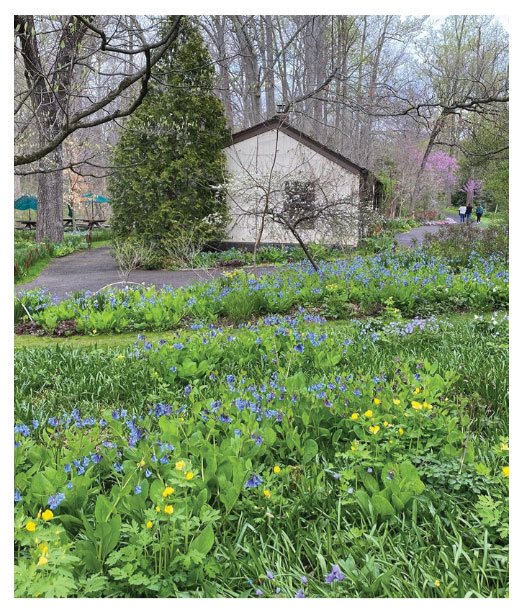
Left: Mertensia virginica
Another early blooming perennial are the Virginia bluebells, Mertensia virginica. Stems grow about a foot tall and are covered in flower buds. The buds of the bluebells are pink and open to an abundance of pendant, sky blue, tubular flowers that are an early food source for long-tongued bees, myriad butterflies, hummingbirds, and native flies and moths.
It’s critical to have native flowering plants early in the season to provide food for early emerging insects and arriving birds like hummingbirds. Having flowering plants throughout the growing season, especially the spring, will provide a rich habitat to support a wide variety of insect and bird life in the garden. Planting a mix of flowering perennials, shrubs and trees will further enhance the ecological impact in the garden. GP
Andrew Bunting is the Vice President of Horticulture for the Pennsylvania Horticultural Society (PHS). Visit PHSonline.org.