9/30/2026
Strengthening Your Brand
Jennifer Polanz
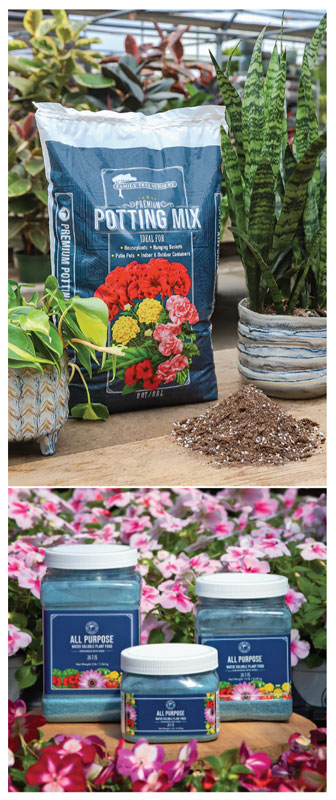
I recently sat down with Jonah Nelson, CEO of Family Tree Nursery in the greater Kansas City area, to ask him about their private labeling experience and what they’ve learned from it that he could share.
They started with a custom potting mix, and since they use Sun Gro Horticulture as their media supplier for the annuals and perennials they grow in-house, it was a no brainer to work with them for the private label mix.
“Customers would come in and they’d say, ‘How does your stuff look so amazing?’” Jonah recalled, adding the secret sauce was their ability to grow, plus the ingredients of the potting mix and the fertilizer.
When they began private labeling the potting mix, they started by offering four sizes, which elicited a lot of discussion about what to offer, Jonah said. The largest bag, a 2.5 cu. ft. mix, is actually a different formulation than the rest with the addition of a controlled-release fertilizer in it, as well as water-retention crystals.
“We only encourage that product specifically for people with outdoor containers,” he said. “That has been a brand differentiator for us, as that bag is very specific for its use and what we recommend it for.”
The other bags are the same mix at 40 qt., 20 qt. and 8 qt., and they can be used for both indoor or outdoor containers. They offer the smaller options to be accessible to anyone who might be intimidated or have trouble handling the 2.5 cu. ft. mix.
They started this endeavor nearly 20 years ago now, around 2008, and today the 2.5 cu. ft. mix is their top SKU for hardgoods, but it wasn’t always this successful. When they first started they were required to print a minimum of 10,000 bags at a time per size and it took them a couple of years to sell out of that first run. Part of the cost included storage of the bags at Sun Gro’s facility, though, so Family Tree could order replenishments as needed until the requirement was met. There were order minimums, too, for shipment, so they would take a semi load at a time of a mix of pallets with the soil assortment.
“But we’ve got three retail locations, and that’s what made it doable for us anyway because we were moving the volume to be able to get those quantities loaded on a truck,” Jonah added.
Once they were confident with how the soil mixes were selling, they began exploring other private label options, which included fertilizer and compost. They worked with a company in Chicago for the fertilizer, which they offer in two formulations each of water-soluble fertilizer and controlled-release fertilizer, all with multiple size options.
From there they’ve been exploring additional options, some of which are hardgoods and some would fall under the merchandise umbrella of branded clothing, mugs, water bottles, pins, 5-gal. buckets (for weeding), kneeler mats and stickers—they sell a ton of stickers! And, of course, they brand their pots and even their carryout boxes and trunk mat liners, pulling the brand through just about every aspect of the store.
Lessons Learned
So what have they learned over the years with private label? One of the keys is working with quality, trustworthy suppliers, whether it’s for soil or shirts. You’re putting your name on it, so whatever you’re selling reflects the quality of your name and brand.
Jonah also said one thing they didn’t anticipate was changes in ingredients once they finished a batch and received a new one. This happened on the fertilizer side, where the product formulation was the same, but the end result looked different than the previous batch. Since it’s in a clear container, they had to reassure customers it hadn’t changed.
“We tested them and looked at them and it was the same product, just completely different color,” he added.
Pricing is also a challenge, as the private label has to stay competitive with the other product lines. They had an instance where a private label company kept inching up pricing on their compost product until it wasn’t feasible anymore.
“We had a great bag designed with them and everything, and we had to end up letting it go because the price outpaced what the customers were willing to pay,” Jonah said, adding it’s taken them about two years to find another company more regional to them as a replacement. “It is challenging because, again, you want to be familiar with the brand and trust in the quality and the consistency of the product, and know that they can keep up with what you’re able to sell.”
There are also legal implications for private label product, and while we did not dive into this aspect deeply, it sounds like it would be a good idea to make sure you work with your supplier partner and perhaps legal counsel to make sure you understand the ins and outs here.
Is It Right For You?
I asked Jonah how they knew private label would be a good fit for them and he said they considered a couple of aspects. One, they had already spent a long time building brand awareness around the Family Tree Nursery name and logo, so that really came first before the products.
“If you haven’t built the brand awareness or recognition of what your logo looks like and what your brand feels like and sounds like, then I don’t know what you’re going to custom label on a bag because nobody’s going to recognize it on a bag,” he added.
Sales volume was also a major factor for them. He did some back-of-the-napkin math and figured that today a garden center with revenue in the $5 to $7 million range would be the sweet spot for considering a private labeling venture. His advice to anyone considering private label is to start smaller and test the waters, then move into bigger product categories and really consider the amount of SKUs you offer. It’s easier to add SKUs versus take away products that some customers might really like, but don’t have the sales volume.
In the end, though, if you’re using a quality product in your own growing operation, it’s worth exploring whether it makes sense to private label it.
“We get a lot of customers that come back saying, ‘I won’t buy my potting mix anywhere else. Your guys’ stuff is the best. It is different,’” Jonah said. “And we didn’t look to find the cheapest product. We tried to find the best product when we did it.” GP