10/30/2026
Plants Can’t Live on Water Alone
Katie Elzer-Peters

“Every plant needs fertilizer,” said Mason Day, VP of Business Development for Jack’s Fertilizer. “Think about it. Plants have been fed from the time they were planted in the greenhouse. Then a customer buys them, takes them home and their supply is cut off.”
So I’m a horticulturist and have been growing plants since I could walk and I’ve never heard such a succinct explanation for why selling fertilizer must be a priority for garden centers.
Fairview Garden Center in Raleigh, North Carolina, displays Recipe for Success cards in different plant categories so customers know what products to ask for.
Forget about add-on sales (we’ll come back to those).
All independent garden centers talk about is wanting their customers to succeed in growing plants. That’s the main message, always, in everything. Usually it’s when to plant, how to dig the hole and where to dig. Sometimes it’s suggestions for what to plant with it, a pot to put it in and how frequently to water.
But as an avid gardener and frequent visitor to garden centers, I can say the amount of plants I’ve been allowed to buy without so much as a passing mention of fertilizer is worth enough money for me to take a really nice European vacation.
Especially when it comes to houseplants. I don’t think I’ve ever been offered houseplant fertilizer. I’m pretty sure the string of a pothos I’ve had since high school has never been fed, much less repotted. (Perhaps I’ll do that now. Maybe that’s why it hasn’t gotten any bigger over the past 31 years.)
If we want our customers to be successful, we can’t let them forget to feed their plants.
You wouldn’t adopt a dog and give him only water, would you?
That’s kind of what’s happening with our customers when they take plants home without the fertilizer.
The Ick Factor
While writing this article, I interviewed five people who sell fertilizer, organic and synthetic, in various capacities:
- Mason Day, VP of Business Development for Jack’s Fertilizer
- Anita Dafonte, Regional Manager for Coast of Maine
- Heather Rollins, Marketing Director of Fairview Garden Center in Raleigh, North Carolina
- Kaitlyn Sterner, Director of Technical Support for Jack’s Fertilizer
- Bonnie Satterthwaite, Territory Sales Manager for Espoma
To a person, they all said the same thing: To get your staff excited about selling fertilizer, you have to reframe “selling” to “helping the customer be successful.” And, no, that isn’t just PR spin. While Mason got the quote at the top of the article, everyone interviewed said something to the same effect: Plants are fed while being grown and then many times are never fed again. They all also said, “Plants can’t live on water alone.”
Instructions on how and with what you actually feed plants depended on who I was talking with. Espoma had a different answer than Jack’s, which had a different answer than Coast of Maine. But we’re not here to decide which type of fertilizer to use or to sell. We’re here to talk about how to sell it so that your customers benefit from success growing their plants.
And plants that are used to being provided with nutrients—in the field, in the greenhouse and at the garden center—need nutrients when they go home with your customers in order to thrive.
If you have 10 seconds, start there. Beyond that? Here’s what you can do.
 Take Advantage of Training Resources
Every fertilizer company has some kind of training program or resource that can be used “off the rack” or made your own. Some companies offer video training. Espoma has their training embedded within the Proven Winners ConnectSpace. Jack’s has videos and webinars posted on their website.
This signage from Jack’s Fertilizer is easy to read and helps customers feel confident in their selection.
Fertilizer companies create those resources for you to use them, so use them!
Here’s how Fairview Garden Center organizes training for their employees. Heather said that Fairview has a training manual they use with new hires that covers the basics. Then training is broken down by department. Each department head trains their team on the fertilizers recommended with the plants in that department.
“We focus on one product per week so that staff can get familiar with it,” she said.
Online, digital and print training resources are great, but what’s even better is a visit from a territory manager or rep. Bonnie (Espoma) and Anita (Coast of Maine) are territory reps and managers who spend lots of time on the road meeting with and training staff directly.
Bonnie said, “You have to commit to the training. Don’t do it during the day—plan for before or after work. Otherwise everyone is too distracted.” She said that time spent on this type of training pays for itself over and over. Whenever possible, ask a rep to visit you.
Everyone mentioned getting products in the hands of staff to feel and to try with their own plants. “You can’t fake genuine enthusiasm from someone who has used and had success with a product,” said Anita. “Customers can hear it in your employee’s voices.”
Make sure your staff can speak from genuine experience and the “ick factor” will disappear.
Merchandise, Merchandise, Merchandise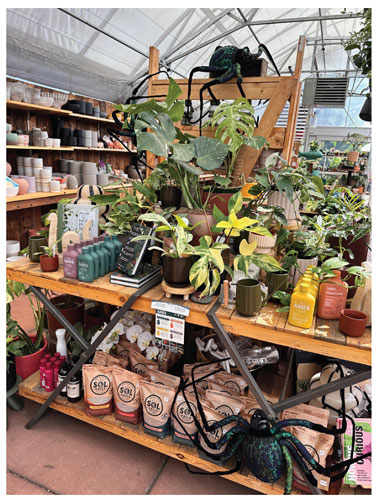
This article is mostly about training staff, but what makes it much easier for staff to sell is creating an ideal environment for selling. The best way to do that is to create a visual and spatial connection between plants and their corresponding fertilizers.
Fairview does this, even outdoors. “In the nursery stock area we have a gazebo with a display of appropriate fertilizer products and soil amendments for trees and shrubs,” said Heather. Fairview also displays “recipe for success” cards to cue customers to ask for fertilizer products at checkout.
Kaitlyn suggested putting water-soluble fertilizer near the watering cans and watering tools to make the visual connection that the two products go together. (Why did that seem like such brand new information to me?! I mean, duh.)
Merchandising fertilizers within their plant categories is still one of the best ways to show customers which product to choose.
Merchandising is an ongoing issue in garden centers because caring for plants and keeping hardgoods (tools, gloves, pots) and bagged goods (fertilizers, potting soil, mulch) are different processes. Sun can fade bags and humidity does a number on everything. But nothing sells fertilizer faster than placing it next to the plant it should accompany home. Who can blame someone for thinking that fertilizer is extra when it’s nowhere to be found unless you wander into a back corner somewhere.
“But the soil isn’t next to the plants,” you might say. Sure. But plant + soil is an equation that customers do themselves. They won’t necessarily, unless they’re avid gardeners, add the mulch and the plant food.
Thanksgiving Farms and Cornell Farms prove that you CAN work fertilizer packaging into attractive displays. Both of the example photos pair houseplants with food and soil amendments.
If you just can’t bring yourself to put the fertilizer next to the plants, add some signage. Jack’s has printable and digital files available, as well as the ability to order printed signs. A bold sign that says “Feed for Blooms” can go a long way when an employee isn’t around.
Lastly, on the merchandising front: stock fertilizers at checkout.
“We have smaller versions of everything at checkout,” said Heather. “And we stock the Espoma Bio-Tone starter there, which we recommend to everyone at the time of planting.”
Heather said that because customers have seen the signage and have likely talked with a staff member in the garden center about fertilizer, it’s an easy upsell at checkout. Customers are primed to want it. They just need to be reminded.
Tie Fertilizer Sales to Guarantees and Warranties
About that Bio-Tone product: Fairview guarantees certain plants that have been properly planted and cared for and in the planting guide and brochure giving planting instructions and information about the guarantee they list the products recommended for use to increase the chances of success and to demonstrate an attempt at proper care by the customer (to keep the warranty at play).
It’s pretty smart to use this type of language. If their customers want the warranty, they’ll do the tasks needed to keep plants healthy, lessening the chance that they’ll need the warranty.
Education for Understanding: Up, Down And All Around
How did we reach the end of an article about fertilizer training without actually telling you what to say to your customers? In short, it’s because your time with customers is short. You may only have 30 seconds with a customer to get them to buy fertilizer. So you start with “You can’t live only on water and neither can your plants,” and move on to exactly which fertilizer they need.
Anita said that using pictures can help customers clue in to the need for fertilizers. “Show them a picture of tomatoes growing with the right fertilizer in the right pH of soil and show them a picture of tomatoes growing without fertilizer in soil out of the right pH range.” She said then you can lead them to buying a pH testing kit and the fertilizer.
Bonnie said that unless someone asks for it, she doesn’t do a lot of NPK training. She does try to get staff to laugh and engage. “I always ask the staff, ‘What is the difference between Tomato-Tone and Garden-Tone?’ I say, ‘Tomato people are freaks!’ and everyone starts laughing, but then I tell them the real difference is that Tomato-Tone has 8% calcium to help prevent blossom end rot.”
Anita uses “Up, Down, All Around” language. She said, “Up is the first number and it is for the greening. When you put the plant in the ground, it is going to take up nitrogen to grow. The second number is down, for root development. Roots are so important to help the plant set fruit and flower. The more root hairs the plant develops, the more nutrients the plant pulls from the soil. The third number is for all-around plant health.”
Mason summed it up like this, “I tell them, ‘If you want leaves, focus on first number, if you want flowers focus on the second, if you want fruit, focus on the third.’”
The TL;DR of it all is: Make it your staff’s mission to tell every customer to “Feed every plant.”
As Kaitlyn said, “Plants can’t scream, but they will show they are hungry.”
A hungry plant doesn’t a successful gardener make. And that’s all we really want: happy, successful gardeners with happy, healthy plants. GP
Katie Elzer-Peters is the owner of The Garden of Words, LLC, a green-industry digital marketing agency. Contact her at Katie@thegardenofwords.com.